QUESTION IMAGE
Question
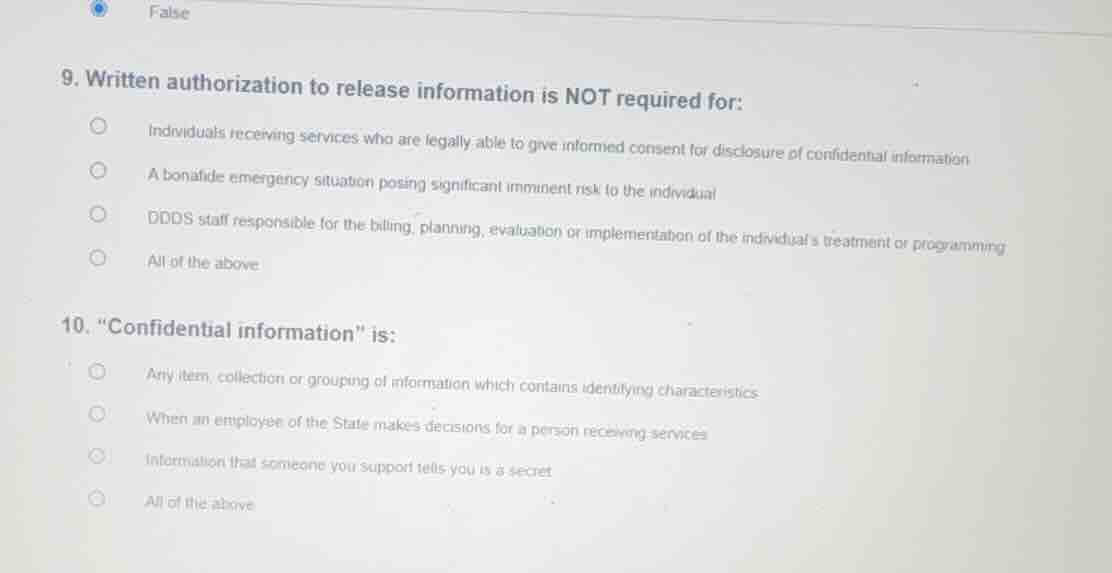
- written authorization to release information is not required for:
- individuals receiving services who are legally able to give informed consent for disclosure of confidential information
- a bonafide emergency situation posing significant imminent risk to the individual
- ddds staff responsible for the billing, planning, evaluation or implementation of the individuals treatment or programming
- all of the above
- \confidential information\ is:
- any item, collection or grouping of information which contains identifying characteristics
- when an employee of the state makes decisions for a person receiving services
- information that someone you support tells you is a secret
- all of the above
Analyze Question 9
This question asks when written authorization to release information is NOT required.
- The first option describes individuals who are legally able to give informed consent. For these individuals, written authorization is required to disclose confidential information.
- The second option describes a bonafide emergency situation posing significant imminent risk. In emergencies involving imminent risk, safety takes priority, and confidential information can be shared without prior written authorization.
- The third option describes DDDS staff responsible for billing, planning, evaluation, or implementation of treatment. Internal staff involved in the direct care, billing, or administration of the individual's program typically have access under routine operations without needing a separate external written release.
- Since both emergency situations and internal staff operations do not require external written authorization, we evaluate if "All of the above" is correct. However, the first option explicitly describes a situation where authorization is required. Therefore, we must look at standard policy exceptions. Typically, emergency situations and internal operations are standard exceptions. In many regulatory frameworks (such as DDDS), emergency situations and internal staff operations are explicit exceptions to the written consent requirement. Let's re-verify: "Individuals receiving services who are legally able to give informed consent..." definitely requires written authorization for disclosure. Thus, "All of the above" cannot be correct. Between the remaining options, emergency situations and internal staff operations are both valid exceptions, but in standard training assessments, emergency disclosures and internal operations are often grouped, or one is the primary intended answer. Let's look closely at standard DDDS (Division of Developmental Disabilities Services) guidelines: written consent is not required for internal staff who need the information to perform their duties (treatment/billing/planning) and in emergency situations. Since the first option definitely requires consent, "All of the above" is incorrect. Let's evaluate the most standard single exception or if there is a specific nuance. Internal staff operations (treatment, billing, planning) are considered routine internal uses rather than "disclosures/releases" to third parties, meaning authorization is not required. Emergency situations are also a classic exception. However, in many policy questions of this type, the exception for internal staff or emergency situations is the key focus. Let's look at the options again. If "All of the above" is not possible, we must choose the most universally applicable exception. Emergency situations and internal staff operations both fit. In standard DDDS training, written authorization is not required for internal staff responsible for treatment/billing/planning, as well as emergency situations. If this is a multiple-choice question where only one can be selected and "All of the above" is disqualified by option 1, let's re-read option 1: "Individuals r…

Snap & solve any problem in the app
Get step-by-step solutions on Sovi AI
Photo-based solutions with guided steps
Explore more problems and detailed explanations
Question 9
- (A) Individuals receiving services who are legally able to give informed consent for disclosure of confidential information
- (B) A bonafide emergency situation posing significant imminent risk to the individual
- (C) DDDS staff responsible for the billing, planning, evaluation or implementation of the individual's treatment or programming (Correct answer)
- (D) All of the above
Question 10
- (A) Any item, collection or grouping of information which contains identifying characteristics (Correct answer)
- (B) When an employee of the State makes decisions for a person receiving services
- (C) Information that someone you support tells you is a secret
- (D) All of the above