QUESTION IMAGE
Question
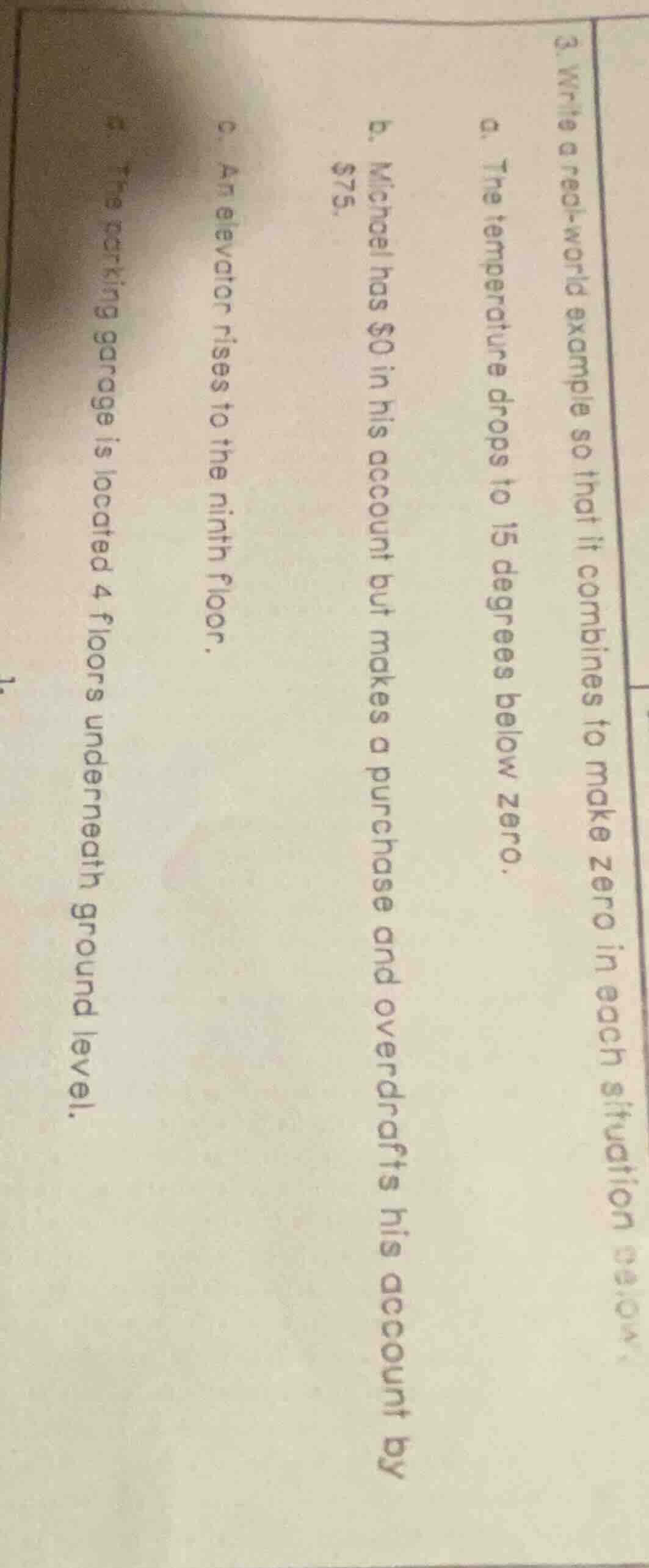
- write a real - world example so that it combines to make zero in each situation below:
a. the temperature drops to 15 degrees below zero.
b. michael has $60 in his account but makes a purchase and overdraws his account by $75.
c. an elevator rises to the ninth floor.
d. the parking garage is located 4 floors underneath ground level.
To solve this, we need to create real - world examples where the sum of two quantities (positive and negative) is zero. Let's take each part one by one:
Part a: Temperature
Step 1: Define the initial and change in temperature
Let's assume the initial temperature is \(15^{\circ}\text{C}\) (above zero). The temperature drops by \(15^{\circ}\text{C}\). Mathematically, if we represent the initial temperature as \(+ 15\) (since it's above zero) and the drop as \(-15\) (a decrease), then \(15+( - 15)=0\).
For example: The temperature in the morning is \(15^{\circ}\text{C}\). In the evening, the temperature drops by \(15^{\circ}\text{C}\). So, \(15+( - 15) = 0\), and the final temperature is \(0^{\circ}\text{C}\).
Part b: Michael's Account
Step 1: Analyze the account balance
Michael has \(\$50\) in his account (we can represent this as \(+50\)). He overdraws (spends more than he has) by \(\$50\) (we represent this as \(- 50\)). Then \(50+( - 50)=0\).
For example: Michael has \(\$50\) in his bank account. He buys a pair of shoes that costs \(\$50\). So, his account balance is \(50 - 50=0\) (or in terms of positive and negative values, \(+50+( - 50) = 0\)).
Part c: Elevator Movement
Step 1: Consider the elevator's position
Let's assume the elevator starts at the ground floor (we can represent the ground floor as \(0\)). It rises to the 9th floor (we can represent this as \(+9\)). Now, if it descends 9 floors (we represent this as \(-9\)), then \(9+( - 9)=0\) (it will be back at the ground floor).
For example: An elevator starts at the ground floor. It goes up to the 9th floor. Then it comes down 9 floors. So, \(9+( - 9)=0\), and it is back at the ground floor.
Part d: Parking Garage
Step 1: Analyze the parking garage's position
The parking garage is 4 floors underneath the ground level (we can represent this as \(-4\)). If we go up 4 floors from the parking garage (we represent this as \(+4\)), then \(-4 + 4=0\) (we reach the ground level).
For example: A parking garage is 4 floors below the ground level. We take an elevator from the parking garage and go up 4 floors. So, \(-4 + 4=0\), and we reach the ground level.

Snap & solve any problem in the app
Get step-by-step solutions on Sovi AI
Photo-based solutions with guided steps
Explore more problems and detailed explanations
s for each part:
a. The temperature in the morning is \(15^{\circ}\text{C}\). In the evening, the temperature drops by \(15^{\circ}\text{C}\). So, \(15+( - 15)=0\), and the final temperature is \(0^{\circ}\text{C}\).
b. Michael has \(\$50\) in his bank account. He buys a pair of shoes that costs \(\$50\). So, his account balance is \(50 - 50 = 0\) (or \(+50+( - 50)=0\)).
c. An elevator starts at the ground floor. It goes up to the 9th floor. Then it comes down 9 floors. So, \(9+( - 9)=0\), and it is back at the ground floor.
d. A parking garage is 4 floors below the ground level. We take an elevator from the parking garage and go up 4 floors. So, \(-4 + 4=0\), and we reach the ground level.