QUESTION IMAGE
Question
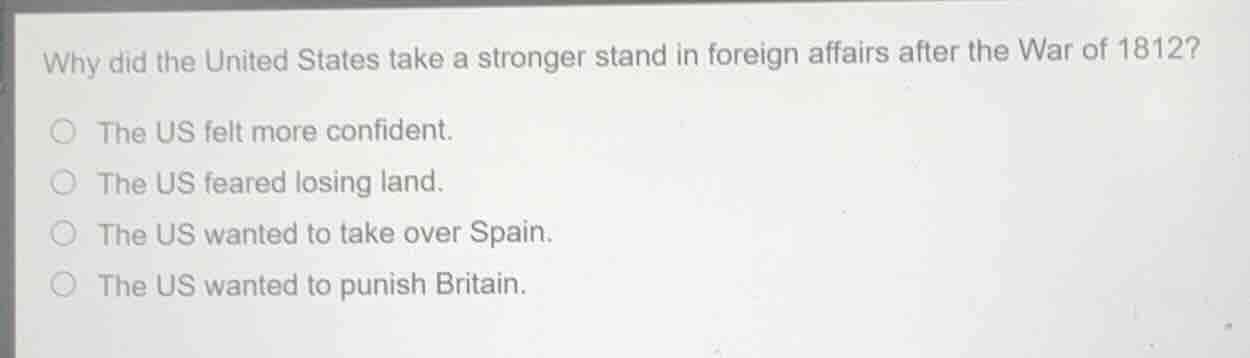
why did the united states take a stronger stand in foreign affairs after the war of 1812?
the us felt more confident.
the us feared losing land.
the us wanted to take over spain.
the us wanted to punish britain.
<pre_analysis>
{
"quality": "clear",
"question_count": 1,
"skills_matched": [
"direct_cot",
"multiple_choice_formatter",
"explain_then_answer",
"tutor",
"mastery_adaptive_brevity"
],
"needs_drawing": false,
"concepts_used": [
"War of 1812",
"Era of Good Feelings",
"Post-War Nationalism"
],
"concept_mastery_cards": {
"war_of_1812": "Mastered",
"era_of_good_feelings": "Mastered",
"post_war_nationalism": "Mastered"
},
"new_concepts": [],
"current_concepts": [
"War of 1812",
"Era of Good Feelings",
"Post-War Nationalism"
]
}
</pre_analysis>
<reasoning>
Analyze the outcome of the War of 1812
Using the War of 1812 and Post-War Nationalism knowledge points
The War of 1812, often called the "Second War for Independence," ended in a draw with the Treaty of Ghent, but successfully defending its sovereignty against Great Britain generated a massive wave of national pride and self-assurance across the United States.
Evaluate the impact on foreign policy
Using the Era of Good Feelings and Post-War Nationalism knowledge points
This newfound national confidence allowed the United States to assert itself more boldly on the global stage, leading directly to proactive foreign policy measures such as the Monroe Doctrine.
</reasoning>
<answer>
<mcq-correct>(A) The US felt more confident.</mcq-correct>
<mcq-option>(B) The US feared losing land.</mcq-option>
<mcq-option>(C) The US wanted to take over Spain.</mcq-option>
<mcq-option>(D) The US wanted to punish Britain.</mcq-option>
</answer>
<post_analysis>
{
"subject": "Social Science",
"question_type": "Multiple Choice",
"knowledge_point": [
"Social Science",
"U.S. History",
"Post-War Nationalism"
]
}
</post_analysis>
Snap & solve any problem in the app
Get step-by-step solutions on Sovi AI
Photo-based solutions with guided steps
Explore more problems and detailed explanations
<pre_analysis>
{
"quality": "clear",
"question_count": 1,
"skills_matched": [
"direct_cot",
"multiple_choice_formatter",
"explain_then_answer",
"tutor",
"mastery_adaptive_brevity"
],
"needs_drawing": false,
"concepts_used": [
"War of 1812",
"Era of Good Feelings",
"Post-War Nationalism"
],
"concept_mastery_cards": {
"war_of_1812": "Mastered",
"era_of_good_feelings": "Mastered",
"post_war_nationalism": "Mastered"
},
"new_concepts": [],
"current_concepts": [
"War of 1812",
"Era of Good Feelings",
"Post-War Nationalism"
]
}
</pre_analysis>
<reasoning>
Analyze the outcome of the War of 1812
Using the War of 1812 and Post-War Nationalism knowledge points
The War of 1812, often called the "Second War for Independence," ended in a draw with the Treaty of Ghent, but successfully defending its sovereignty against Great Britain generated a massive wave of national pride and self-assurance across the United States.
Evaluate the impact on foreign policy
Using the Era of Good Feelings and Post-War Nationalism knowledge points
This newfound national confidence allowed the United States to assert itself more boldly on the global stage, leading directly to proactive foreign policy measures such as the Monroe Doctrine.
</reasoning>
<answer>
<mcq-correct>(A) The US felt more confident.</mcq-correct>
<mcq-option>(B) The US feared losing land.</mcq-option>
<mcq-option>(C) The US wanted to take over Spain.</mcq-option>
<mcq-option>(D) The US wanted to punish Britain.</mcq-option>
</answer>
<post_analysis>
{
"subject": "Social Science",
"question_type": "Multiple Choice",
"knowledge_point": [
"Social Science",
"U.S. History",
"Post-War Nationalism"
]
}
</post_analysis>