Sovi.AI - AI Math Tutor

Scan to solve math questions

QUESTION IMAGE

why is the standing quadriceps stretch a better stretching exercise tha…

Question

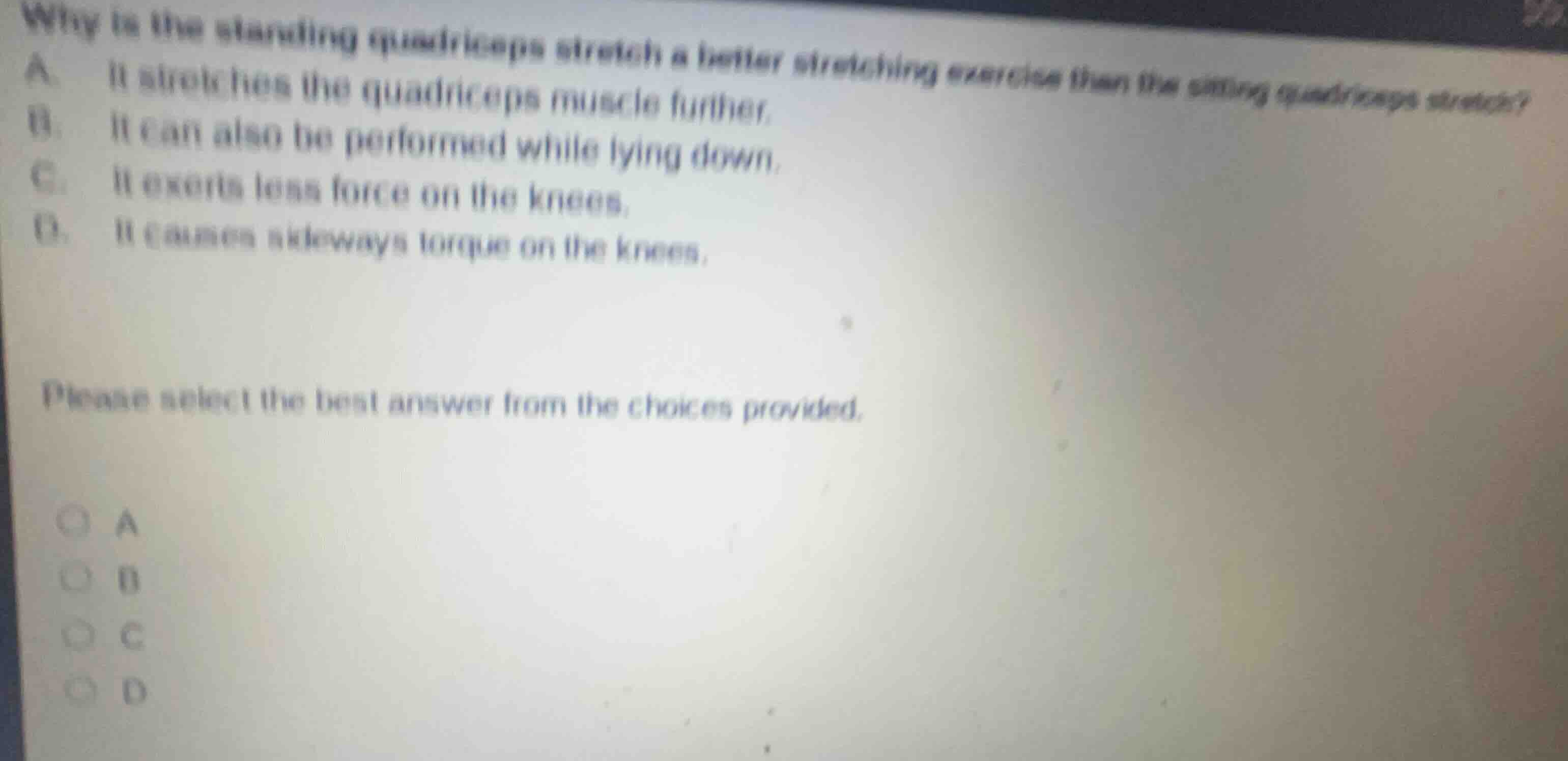
why is the standing quadriceps stretch a better stretching exercise than the sitting quadriceps stretch?
a. it stretches the quadriceps muscle further.
b. it can also be performed while lying down.
c. it exerts less force on the knees.
d. it causes sideways torque on the knees.

please select the best answer from the choices provided.

Explanation:

Response

<pre_analysis>
{
"quality": "clear",
"question_count": 1,
"skills_matched": [
"direct_cot",
"multiple_choice_formatter",
"explain_then_answer",
"quick"
],
"needs_drawing": false,
"concepts_used": [
"Safe Stretching",
"Targeted Stretching"
],
"new_concepts": [
"Quadriceps Stretching Techniques"
],
"current_concepts": [
"Safe Stretching",
"Targeted Stretching",
"Quadriceps Stretching Techniques"
]
}
</pre_analysis>

<reasoning>

Compare biomechanical stress of standing vs. sitting quadriceps stretches

The sitting quadriceps stretch (often performed with one leg bent back behind the body while sitting on the floor) places a high amount of hyperflexion and lateral/sideways torque on the knee joint. In contrast, the standing quadriceps stretch allows the knee to flex in its natural hinge plane with minimal twisting forces.

Evaluate the given options

  • Option A: Both stretches can target the quadriceps muscle effectively; standing does not inherently stretch it further.
  • Option B: A standing stretch cannot be performed while lying down (that would be a prone or side-lying quad stretch).
  • Option C: The standing quadriceps stretch exerts less twisting and hyperflexion force on the knees, making it a safer alternative.
  • Option D: The sitting stretch is the one that causes sideways torque, not the standing stretch.

</reasoning>

<answer>
<mcq-option>A. It stretches the quadriceps muscle further.</mcq-option>
<mcq-option>B. It can also be performed while lying down.</mcq-option>
<mcq-correct>C. It exerts less force on the knees.</mcq-correct>
<mcq-option>D. It causes sideways torque on the knees.</mcq-option>
</answer>

<post_analysis>
{
"subject": "Natural Science",
"question_type": "Multiple Choice",
"knowledge_point": [
"Natural Science",
"Others",
"Physical Education and Health"
]
}
</post_analysis>

Answer:

<pre_analysis>
{
"quality": "clear",
"question_count": 1,
"skills_matched": [
"direct_cot",
"multiple_choice_formatter",
"explain_then_answer",
"quick"
],
"needs_drawing": false,
"concepts_used": [
"Safe Stretching",
"Targeted Stretching"
],
"new_concepts": [
"Quadriceps Stretching Techniques"
],
"current_concepts": [
"Safe Stretching",
"Targeted Stretching",
"Quadriceps Stretching Techniques"
]
}
</pre_analysis>

<reasoning>

Compare biomechanical stress of standing vs. sitting quadriceps stretches

The sitting quadriceps stretch (often performed with one leg bent back behind the body while sitting on the floor) places a high amount of hyperflexion and lateral/sideways torque on the knee joint. In contrast, the standing quadriceps stretch allows the knee to flex in its natural hinge plane with minimal twisting forces.

Evaluate the given options

  • Option A: Both stretches can target the quadriceps muscle effectively; standing does not inherently stretch it further.
  • Option B: A standing stretch cannot be performed while lying down (that would be a prone or side-lying quad stretch).
  • Option C: The standing quadriceps stretch exerts less twisting and hyperflexion force on the knees, making it a safer alternative.
  • Option D: The sitting stretch is the one that causes sideways torque, not the standing stretch.

</reasoning>

<answer>
<mcq-option>A. It stretches the quadriceps muscle further.</mcq-option>
<mcq-option>B. It can also be performed while lying down.</mcq-option>
<mcq-correct>C. It exerts less force on the knees.</mcq-correct>
<mcq-option>D. It causes sideways torque on the knees.</mcq-option>
</answer>

<post_analysis>
{
"subject": "Natural Science",
"question_type": "Multiple Choice",
"knowledge_point": [
"Natural Science",
"Others",
"Physical Education and Health"
]
}
</post_analysis>