QUESTION IMAGE
Question
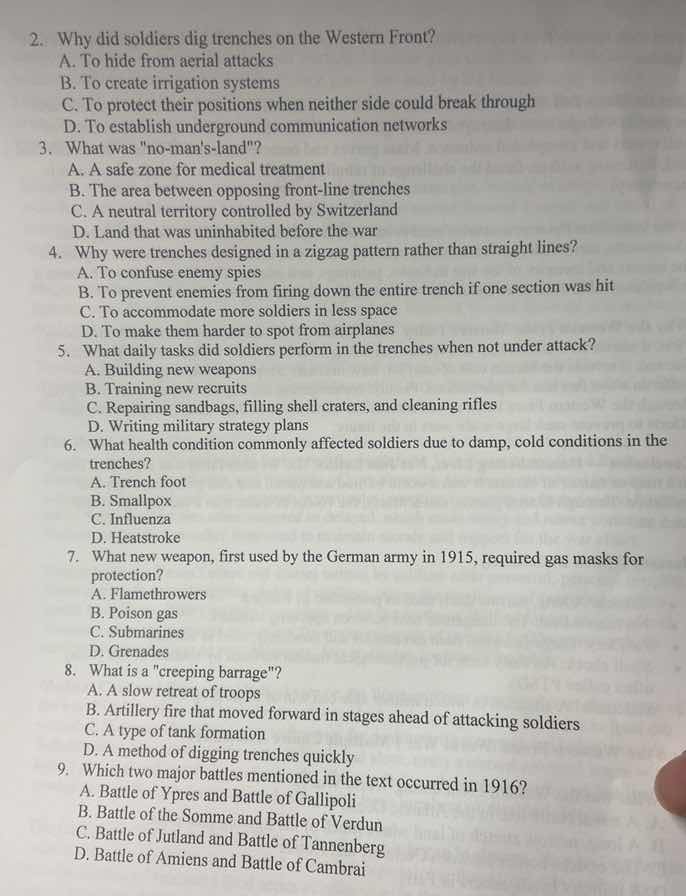
- why did soldiers dig trenches on the western front?
a. to hide from aerial attacks
b. to create irrigation systems
c. to protect their positions when neither side could break through
d. to establish underground communication networks
- what was
o - mans - land\?
a. a safe zone for medical treatment
b. the area between opposing front - line trenches
c. a neutral territory controlled by switzerland
d. land that was uninhabited before the war
- why were trenches designed in a zigzag pattern rather than straight lines?
a. to confuse enemy spies
b. to prevent enemies from firing down the entire trench if one section was hit
c. to accommodate more soldiers in less space
d. to make them harder to spot from airplanes
- what daily tasks did soldiers perform in the trenches when not under attack?
a. building new trenches
b. training new recruits
c. repairing sandbags, filling shell craters, and cleaning rifles
d. writing military strategy plans
- what health condition commonly affected soldiers due to damp, cold conditions in the trenches?
a. trench foot
b. smallpox
c. influenza
d. heatstroke
- what new weapon, first used by the german army in 1915, required gas masks for protection?
a. flamethrowers
b. poison gas
c. submarines
d. grenades
- what is a \creeping barrage\?
a. a slow retreat of troops
b. artillery fire that moved forward in stages ahead of attacking soldiers
c. a type of tank formation
d. a method of digging trenches quickly
- which two major battles mentioned in the text occurred in 1916?
a. battle of ypres and battle of gallipoli
b. battle of the somme and battle of verdun
c. battle of jutland and battle of tannenberg
d. battle of amiens and battle of cambrai
- Trenches on the Western Front were a defensive measure when the war reached a stalemate, with neither side able to advance.
- No-man's-land was the dangerous, unoccupied space between the opposing trenches of the two sides.
- Zigzag trench patterns prevented enemies from firing down the full length of a trench if one section was breached.
- When not under attack, soldiers focused on maintaining their trenches and equipment, including repairing defenses and cleaning weapons.
- Trench foot was a common condition caused by prolonged exposure to cold, damp conditions in the trenches.
- The German army first used poison gas in 1915, which led to the need for gas masks for protection.
- A creeping barrage is a tactic where artillery fire moves forward in stages to cover advancing infantry.
- The Battle of the Somme and Battle of Verdun were both major 1916 battles on the Western Front during WWI.

Snap & solve any problem in the app
Get step-by-step solutions on Sovi AI
Photo-based solutions with guided steps
Explore more problems and detailed explanations
- C. To protect their positions when neither side could break through
- B. The area between opposing front-line trenches
- B. To prevent enemies from firing down the entire trench if one section was hit
- C. Repairing sandbags, filling shell craters, and cleaning rifles
- A. Trench foot
- B. Poison gas
- B. Artillery fire that moved forward in stages ahead of attacking soldiers
- B. Battle of the Somme and Battle of Verdun