QUESTION IMAGE
Question
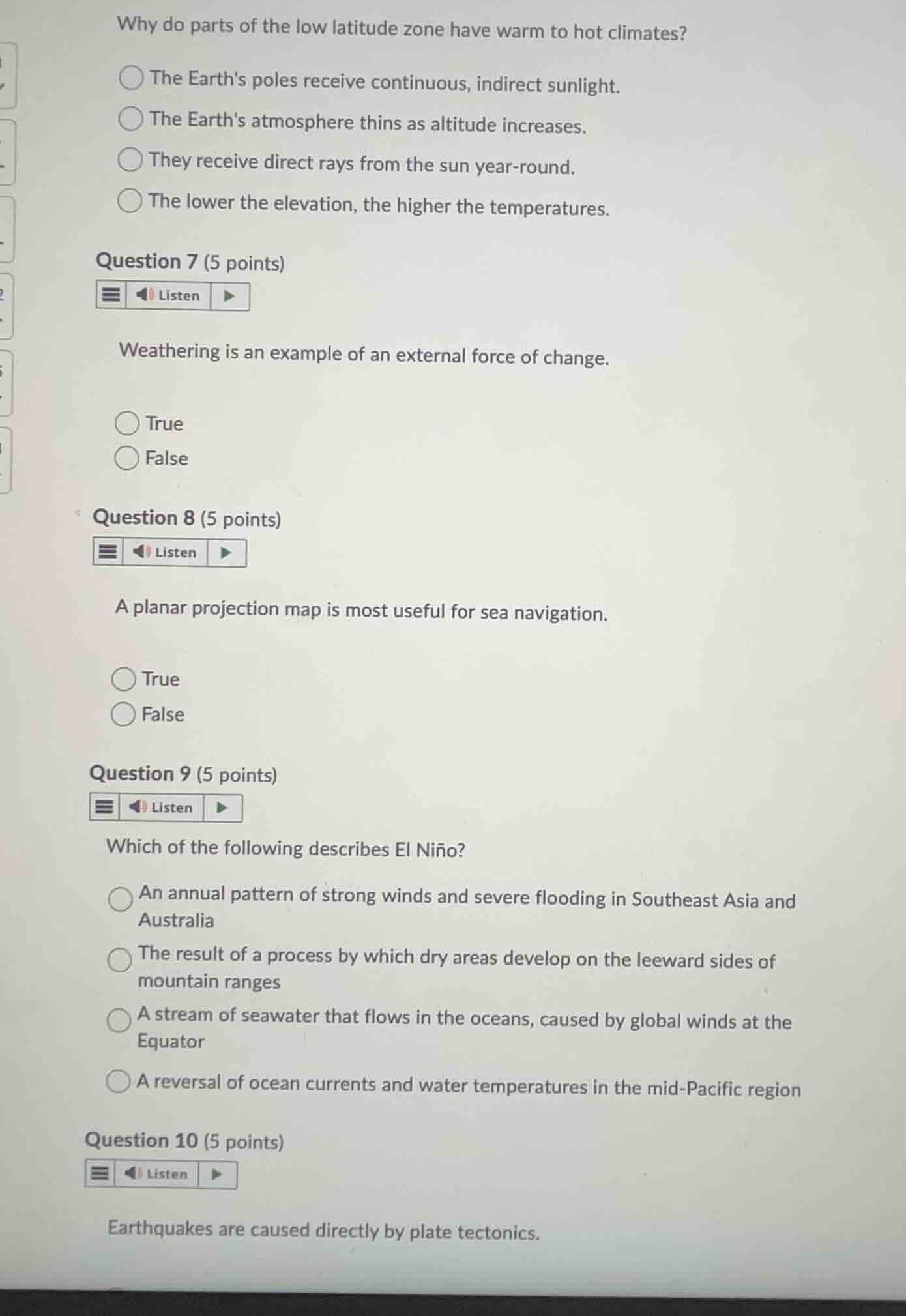
why do parts of the low latitude zone have warm to hot climates?
the earths poles receive continuous, indirect sunlight.
the earths atmosphere thins as altitude increases.
they receive direct rays from the sun year-round.
the lower the elevation, the higher the temperatures.
question 7 (5 points)
weathering is an example of an external force of change.
true
false
question 8 (5 points)
a planar projection map is most useful for sea navigation.
true
false
question 9 (5 points)
which of the following describes el niño?
an annual pattern of strong winds and severe flooding in southeast asia and australia
the result of a process by which dry areas develop on the leeward sides of mountain ranges
a stream of seawater that flows in the oceans, caused by global winds at the equator
a reversal of ocean currents and water temperatures in the mid-pacific region
question 10 (5 points)
earthquakes are caused directly by plate tectonics.
Analyze low latitude zone climates
The low latitude zone (near the Equator) receives direct, concentrated solar radiation year-round because of the Earth's spherical shape and tilt, leading to warm-to-hot climates.
Analyze weathering as an external force
Weathering occurs on the Earth's surface due to atmospheric forces (water, wind, ice, temperature changes), making it a classic external force of change.
Analyze planar projection map utility
Planar (azimuthal) projections are most accurate at their center point and distort heavily toward the edges, making them useful for polar regions but not the primary choice for sea navigation, which historically relies on Mercator (cylindrical) projections.
Analyze El Niño characteristics
El Niño is characterized by a warming of sea surface temperatures and a reversal or weakening of trade winds and ocean currents in the central and eastern equatorial Pacific Ocean.
Analyze the cause of earthquakes
Earthquakes are primarily caused by the sudden release of energy along geological faults, which is a direct result of tectonic plate movements and interactions.

Snap & solve any problem in the app
Get step-by-step solutions on Sovi AI
Photo-based solutions with guided steps
Explore more problems and detailed explanations
Question 6
- The Earth's poles receive continuous, indirect sunlight.
- The Earth's atmosphere thins as altitude increases.
- They receive direct rays from the sun year-round. (Correct answer)
- The lower the elevation, the higher the temperatures.
Question 7
- True (Correct answer)
- False
Question 8
- True
- False (Correct answer)
Question 9
- An annual pattern of strong winds and severe flooding in Southeast Asia and Australia
- The result of a process by which dry areas develop on the leeward sides of mountain ranges
- A stream of seawater that flows in the oceans, caused by global winds at the Equator
- A reversal of ocean currents and water temperatures in the mid-Pacific region (Correct answer)
Question 10
- True (Correct answer)
- False