QUESTION IMAGE
Question
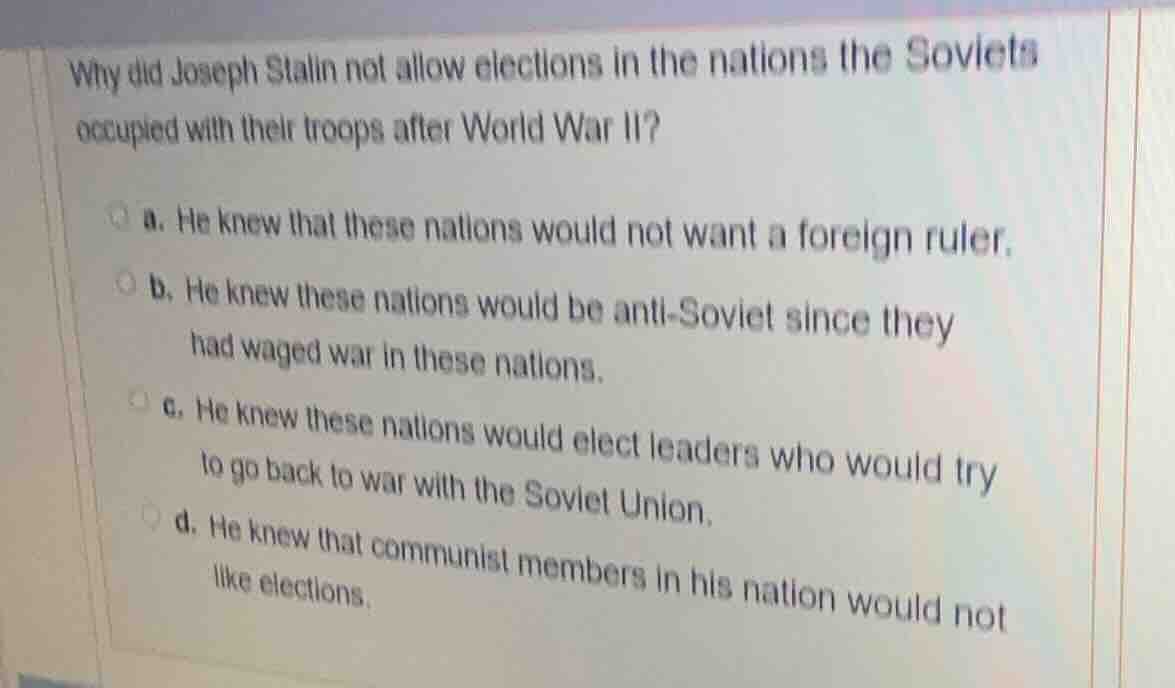
why did joseph stalin not allow elections in the nations the soviets occupied with their troops after world war ii?
a. he knew that these nations would not want a foreign ruler.
b. he knew these nations would be anti-soviet since they had waged war in these nations.
c. he knew these nations would elect leaders who would try to go back to war with the soviet union.
d. he knew that communist members in his nation would not like elections.
🆕 New Concept Discovered: Origins of the Cold War
How post-WWII distrust shaped the global order
Step 1: Analyze Stalin's Post-WWII Goals
Following World War II, the Soviet Union occupied several Eastern European nations that they had liberated from Nazi control. Joseph Stalin's primary objective was to secure the western border of the USSR to prevent any future invasions. To achieve this, he wanted to establish friendly, communist "satellite states" in Eastern Europe.
Step 2: Evaluate the Impact of Free Elections
Stalin was fully aware that the populations of these occupied Eastern European nations harbored strong anti-Soviet sentiments. The Red Army had caused significant destruction during the war, and Soviet occupation was seen as a new form of foreign domination.
If free and democratic elections were allowed, these nations would almost certainly vote for non-communist, anti-Soviet leaders. This would ruin Stalin's plan of creating a secure buffer zone of loyal ally states.
Step 3: Match with the Given Options
- a. He knew that these nations would not want a foreign ruler. This is incorrect because elections would allow them to choose their own domestic leaders, not a foreign ruler.
- b. He knew these nations would be anti-Soviet since they had waged war in these nations. This is correct. Because of the destructive warfare and occupation by Soviet forces, the local populations held deep anti-Soviet feelings and would not vote for pro-Soviet communist governments.
- c. He knew these nations would elect leaders who would try to go back to war with the Soviet Union. This is incorrect; these war-torn nations wanted peace and recovery, not to initiate a new war against a superpower.
- d. He knew that communist members in his nation would not like elections. This is incorrect; the decision was driven by geopolitical security and control over Eastern Europe, not the internal preferences of domestic party members regarding foreign elections.

Snap & solve any problem in the app
Get step-by-step solutions on Sovi AI
Photo-based solutions with guided steps
Explore more problems and detailed explanations
b. He knew these nations would be anti-Soviet since they had waged war in these nations.