QUESTION IMAGE
Question
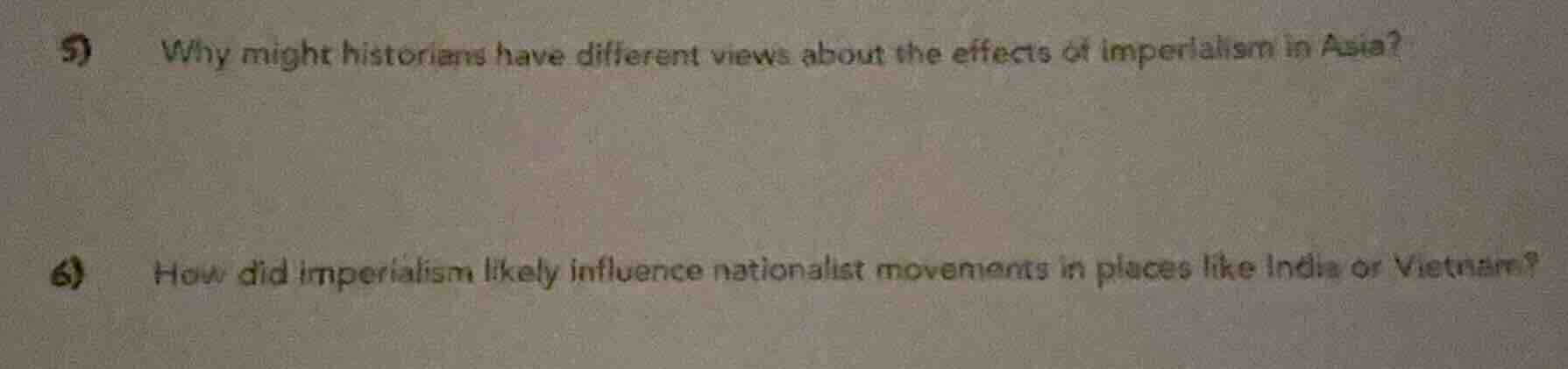
- why might historians have different views about the effects of imperialism in asia?
- how did imperialism likely influence nationalist movements in places like india or vietnam?
Brief Explanations
For question 5:
- Source Bias: Historians rely on different primary sources (government records, local accounts, missionary reports) that reflect the perspectives of imperial powers, colonized peoples, or neutral observers, leading to conflicting interpretations.
- Focus of Analysis: Some historians emphasize economic harm (resource extraction, destroyed local industries), while others highlight long-term modernization (infrastructure, education systems, administrative structures).
- Ideological Frameworks: Scholars may use competing theoretical lenses (Marxist, post-colonial, liberal) that shape how they evaluate imperialism's costs and benefits.
- Geographic/Temporal Scope: Historians studying different Asian regions (e.g., India vs. Southeast Asia) or specific time periods within imperialism will draw different conclusions based on localized experiences.
For question 6:
- Unification Against a Common Enemy: Imperial rule created a shared external oppressor, uniting diverse local groups (linguistic, religious, regional) that previously had little collective identity, fostering pan-national solidarity.
- Exposure to Western Ideologies: Colonized elites and activists were exposed to European ideas of self-determination, democracy, and nationalism, which they adapted to frame demands for independence.
- Economic and Grievance Mobilization: Imperial exploitation (land seizures, unfair taxation, restricted economic opportunities) created widespread economic hardship, providing a rallying point for nationalist movements to organize mass support.
- Emergence of Leadership Figures: Colonial systems trained a small class of local administrators and professionals who gained organizational skills and used their status to lead nationalist campaigns (e.g., Gandhi in India, Ho Chi Minh in Vietnam).
- Repression as a Catalyst: Violent suppression of local protests by imperial powers (e.g., the Amritsar Massacre in India) galvanized public anger and pushed moderate activists toward more radical, mass-based independence movements.

Snap & solve any problem in the app
Get step-by-step solutions on Sovi AI
Photo-based solutions with guided steps
Explore more problems and detailed explanations
- Historians have differing views on imperialism in Asia due to reliance on biased primary sources, varied analytical focuses (harm vs. modernization), competing ideological frameworks, and differences in the geographic or temporal scope of their research.
- Imperialism influenced nationalist movements in India and Vietnam by:
- Uniting diverse local groups against a shared colonial oppressor
- Introducing Western ideas of self-determination and nationalism that activists adapted for their own independence campaigns
- Creating widespread economic grievances that mobilized mass support for nationalist causes
- Training a class of local leaders with the skills to organize and lead independence movements
- Using violent repression that galvanized public anger and radicalized moderate pro-independence efforts