QUESTION IMAGE
Question
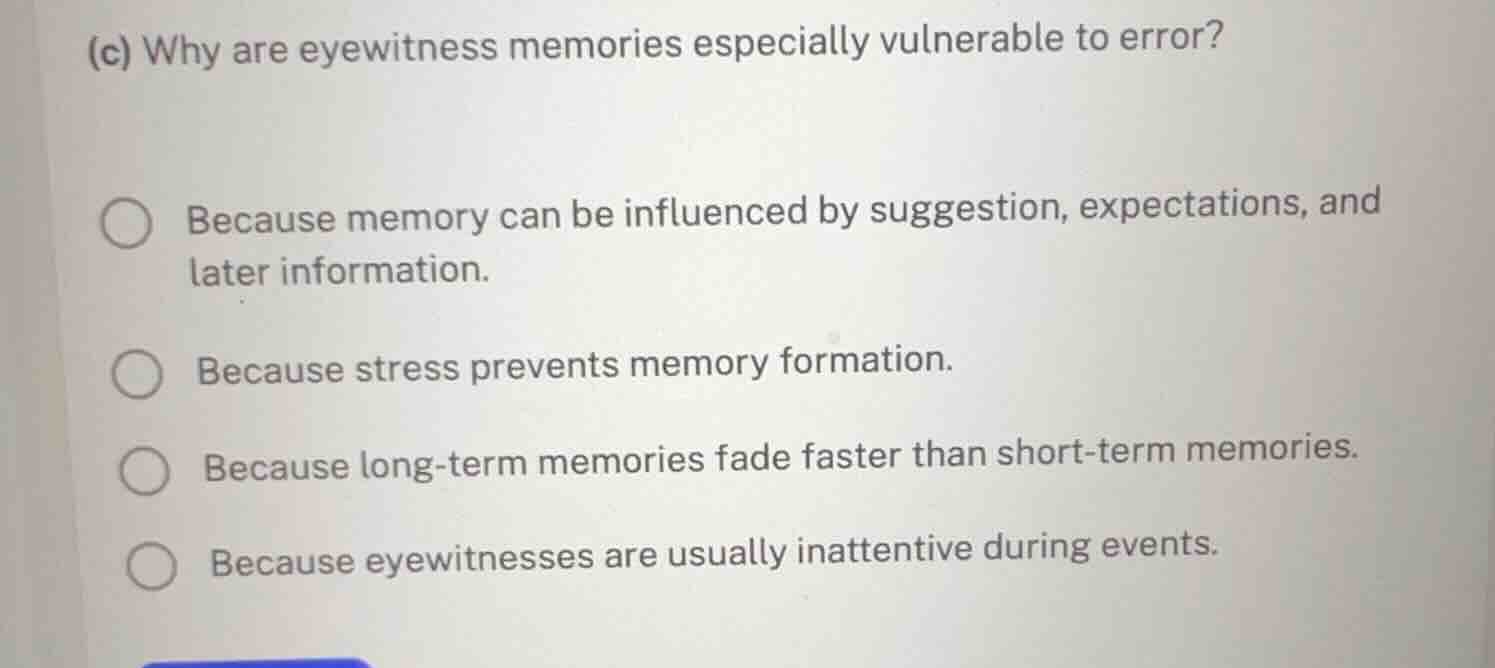
(c) why are eyewitness memories especially vulnerable to error?
because memory can be influenced by suggestion, expectations, and later information.
because stress prevents memory formation.
because long-term memories fade faster than short-term memories.
because eyewitnesses are usually inattentive during events.
Analyze memory reconstructive nature
Human memory does not record events like a video camera. Instead, it is a reconstructive process. When we retrieve a memory, we piece together fragments of the original event along with post-event information, schemas, and expectations. This makes memories highly malleable and susceptible to distortion over time.
Evaluate the first option
The first option states that eyewitness memories are vulnerable because they can be influenced by suggestion, expectations, and later information. This aligns directly with cognitive psychology research (such as Elizabeth Loftus's work on the misinformation effect), which demonstrates that leading questions, societal expectations, and post-event discussions can alter what an eyewitness remembers.
Evaluate the remaining options
- Option 2: Stress does not entirely prevent memory formation; high stress can focus attention on central details (like a weapon) while reducing memory for peripheral details.
- Option 3: Long-term memories do not fade faster than short-term memories; short-term memory has a very limited duration (seconds) compared to long-term memory.
- Option 4: Eyewitnesses are not necessarily inattentive; they may pay close attention, but their cognitive processing and subsequent recall are still subject to reconstructive errors.

Snap & solve any problem in the app
Get step-by-step solutions on Sovi AI
Photo-based solutions with guided steps
Explore more problems and detailed explanations
- (A) Because memory can be influenced by suggestion, expectations, and later information. (Correct answer)
- (B) Because stress prevents memory formation.
- (C) Because long-term memories fade faster than short-term memories.
- (D) Because eyewitnesses are usually inattentive during events.