QUESTION IMAGE
Question
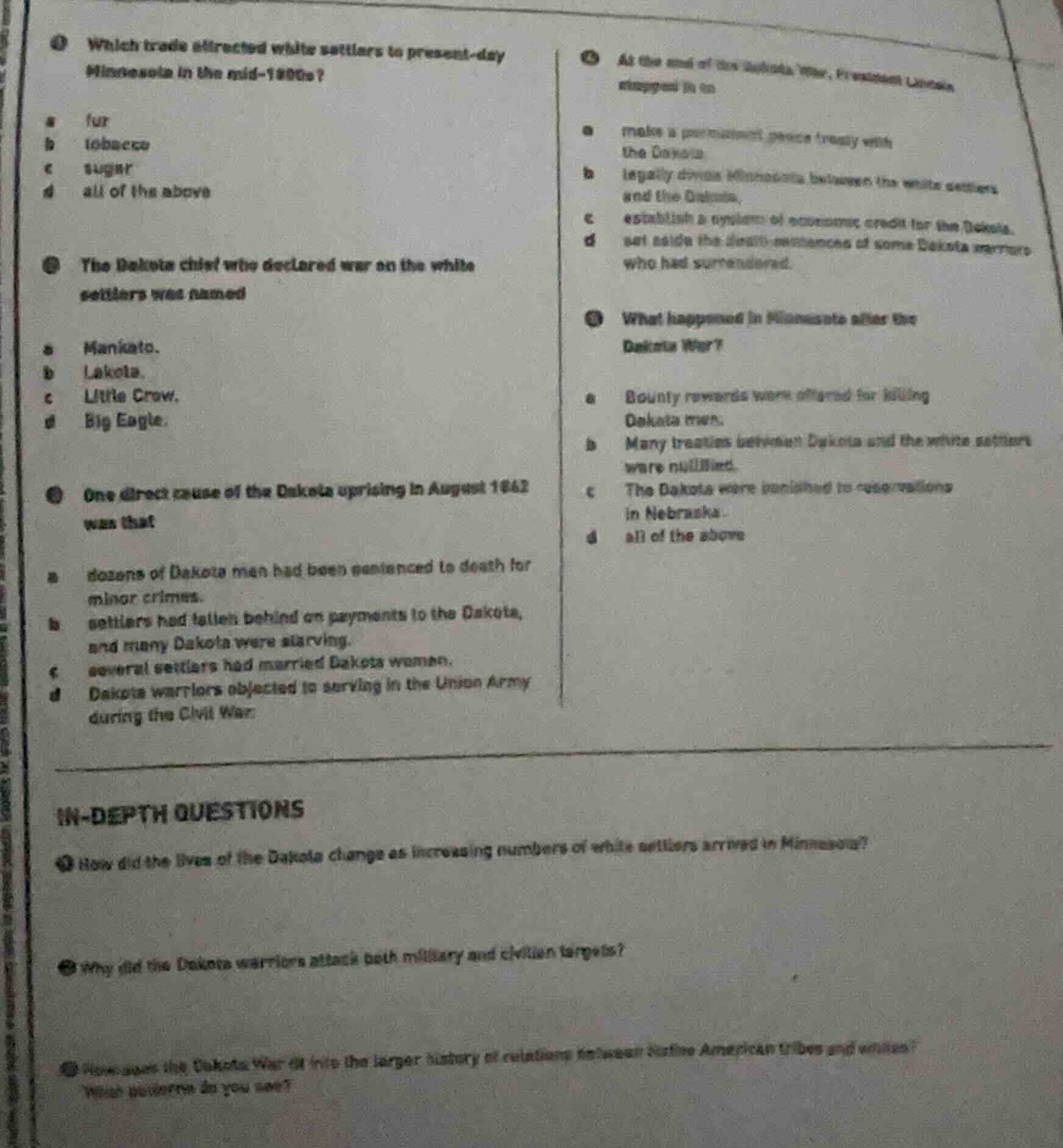
1 which trade attracted white settlers to present - day minnesota in the mid - 1800s?
a fur
b tobacco
c sugar
d all of the above
2 the dakota chief who declared war on the white settlers was named
a mankato.
b lakota.
c little crow.
d big eagle.
3 one direct cause of the dakota uprising in august 1862 was that?
a dozens of dakota men had been sentenced to death for minor crimes.
b settlers had fallen behind on payments to the dakota, and many dakota were starving.
c several settlers had married dakota women.
d dakota warriors objected to serving in the union army during the civil war.
4 at the end of the dakota war, president lincoln stepped in
a make a permanent peace treaty with the dakota.
b legally divide minnesota between the white settlers and the dakota.
c establish a system of economic credit for the dakota.
d set aside the death sentences of some dakota warriors who had surrendered.
5 what happened in minnesota after the dakota war?
a bounty rewards were offered for killing dakota men.
b many treaties between dakota and the white settlers were nullified.
c the dakota were banished to reservations in nebraska.
d all of the above
in - depth questions
1 how did the lives of the dakota change as increasing numbers of white settlers arrived in minnesota?
2 why did the dakota warriors attack both military and civilian targets?
3 how does the dakota war fit into the larger history of relations between native american tribes and whites? which patterns do you see?
Multiple Choice Questions
- The fur trade was the primary economic draw for white settlers to mid-1800s Minnesota.
- Little Crow (Taoyateduta) was the Dakota chief who led the war against white settlers in 1862.
- The Dakota uprising was triggered by unfulfilled treaty payments, leading to widespread starvation among the Dakota.
- President Lincoln commuted the death sentences of most Dakota warriors who surrendered, reducing the number from 303 to 39.
- After the Dakota War, bounties were offered for Dakota men, existing treaties were nullified, and the Dakota were exiled to Nebraska reservations.
In-Depth Questions
- As white settlers arrived, the Dakota lost most of their traditional land via treaties, were confined to smaller reservations, lost access to hunting grounds, and faced cultural erosion and economic dependency on the U.S. government.
- Dakota warriors attacked both targets: military sites to counter armed government forces, and civilian sites to disrupt settler expansion and retaliate for unfulfilled promises and starvation.
- The Dakota War fits the pattern of U.S.-Indigenous relations: broken treaties, dispossession of land, violent conflict over resources, and forced removal of Indigenous groups, reflecting a broader history of colonial expansion and Indigenous resistance.

Snap & solve any problem in the app
Get step-by-step solutions on Sovi AI
Photo-based solutions with guided steps
Explore more problems and detailed explanations
Multiple Choice Questions
- a. fur
- c. Little Crow.
- b. settlers had fallen behind on payments to the Dakota, and many Dakota were starving.
- d. set aside the death sentences of some Dakota warriors who had surrendered.
- d. all of the above
In-Depth Questions
- The Dakota lost most traditional land via treaties, were restricted to small reservations, lost hunting access, faced cultural erosion, and became economically dependent on the U.S. government.
- They attacked military targets to counter armed government forces, and civilian targets to disrupt settler expansion and retaliate for unfulfilled promises and starvation.
- It follows the pattern of broken treaties, land dispossession, violent resource conflict, and forced Indigenous removal, reflecting colonial expansion and Indigenous resistance in U.S.-Indigenous relations.