QUESTION IMAGE
Question
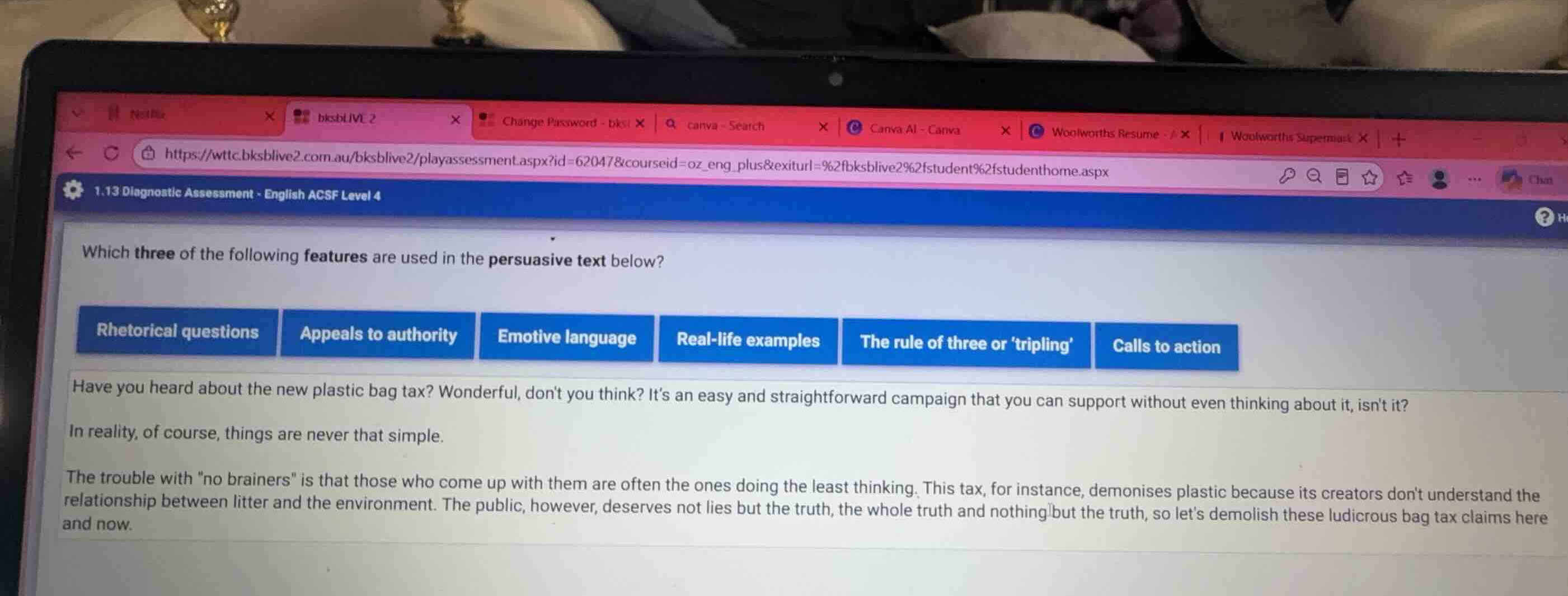
which three of the following features are used in the persuasive text below?
rhetorical questions
appeals to authority
emotive language
real-life examples
the rule of three or tripling
calls to action
have you heard about the new plastic bag tax? wonderful, dont you think? its an easy and straightforward campaign that you can support without even thinking about it, isnt it?
in reality, of course, things are never that simple.
the trouble with
o brainers\ is that those who come up with them are often the ones doing the least thinking. this tax, for instance, demonises plastic because its creators dont understand the relationship between litter and the environment. the public, however, deserves not lies but the truth, the whole truth and nothing but the truth, so lets demolish these ludicrous bag tax claims here and now.
Analyze the question and text
The question asks to identify three persuasive features used in the provided text. Let's read the text carefully to find evidence of the listed features: "Rhetorical questions", "Appeals to authority", "Emotive language", "Real-life examples", "The rule of three or 'tripling'", and "Calls to action".
Identify rhetorical questions
The text begins with: "Have you heard about the new plastic bag tax? Wonderful, don't you think?" and ends the first paragraph with "...isn't it?". These are questions asked to make a point rather than to elicit an answer. Thus, Rhetorical questions are present.
Identify the rule of three
In the second paragraph, the text states: "...the public, however, deserves not lies but the truth, the whole truth and nothing but the truth...". This repetition of three parallel elements ("the truth, the whole truth and nothing but the truth") is a classic example of The rule of three or 'tripling' used for emphasis.
Identify emotive language
The text uses highly charged, emotional words to influence the reader's feelings. Examples include: "demonises plastic", "deserves not lies", "demolish these ludicrous bag tax claims". Words like "demonises", "lies", "demolish", and "ludicrous" are strong, subjective, and designed to provoke an emotional reaction. Thus, Emotive language is present.
Verify remaining options
- Appeals to authority: There are no references to experts, statistics, or authoritative figures.
- Real-life examples: No specific real-world case studies or concrete examples are detailed.
- Calls to action: While the text suggests a stance ("let's demolish these ludicrous bag tax claims"), it functions more as a statement of intent/opinion rather than a direct, actionable instruction to the reader to do something specific (like "sign this petition" or "vote no"). The three most prominent and structurally distinct features are the rhetorical questions, the tripling phrase, and the highly emotive vocabulary.

Snap & solve any problem in the app
Get step-by-step solutions on Sovi AI
Photo-based solutions with guided steps
Explore more problems and detailed explanations
The three features used in the persuasive text are:
- Rhetorical questions
- Emotive language
- The rule of three or 'tripling'