QUESTION IMAGE
Question
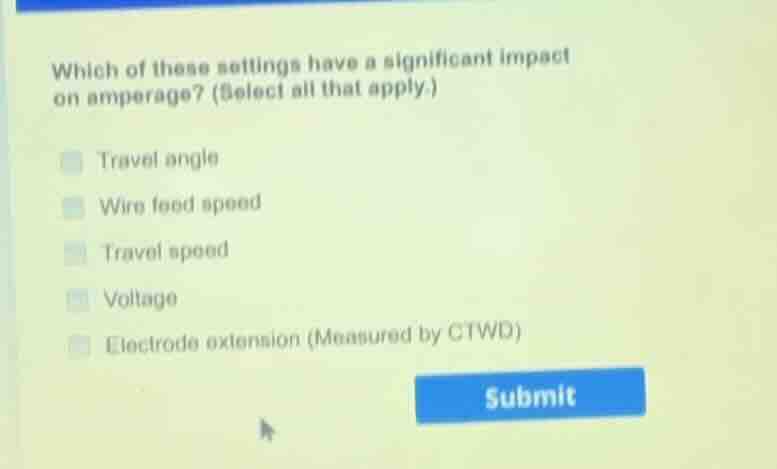
which of these settings have a significant impact on amperage? (select all that apply.)
travel angle
wire feed speed
travel speed
voltage
electrode extension (measured by ctwd)
Identify the welding process context
Using the GMAW Amperage Variables knowledge point
The question asks which settings significantly impact amperage. In semi-automatic wire welding processes like GMAW (MIG) and FCAW, a constant voltage (CV) power source is used. Under CV, the welder sets the voltage and wire feed speed, while the amperage is determined dynamically by the system.
Analyze wire feed speed
Using the GMAW Amperage Variables knowledge point
In CV welding, wire feed speed (WFS) is the primary control for amperage. Increasing WFS forces more electrode wire into the arc, requiring more current (amperage) to melt it at a rate that maintains a stable arc length.
Analyze electrode extension
Using the Electrode Extension knowledge point
Electrode extension (or stickout, measured by CTWD) introduces electrical resistance. A longer extension increases resistance, causing more preheating (Joule heating) of the wire. This reduces the amount of current (amperage) needed from the power source to melt the wire. Conversely, a shorter extension decreases resistance and increases amperage.
Evaluate other options
Using the GMAW Amperage Variables knowledge point
- Travel angle and Travel speed affect weld bead shape, penetration, and heat input per unit length, but they do not directly control or significantly impact the machine's operating amperage.
- Voltage is set independently on a CV power source and primarily controls arc length and bead width, not the current (amperage) level.

Snap & solve any problem in the app
Get step-by-step solutions on Sovi AI
Photo-based solutions with guided steps
Explore more problems and detailed explanations
- Travel angle
- Wire feed speed (Correct answer)
- Travel speed
- Voltage
- Electrode extension (Measured by CTWD) (Correct answer)