QUESTION IMAGE
Question
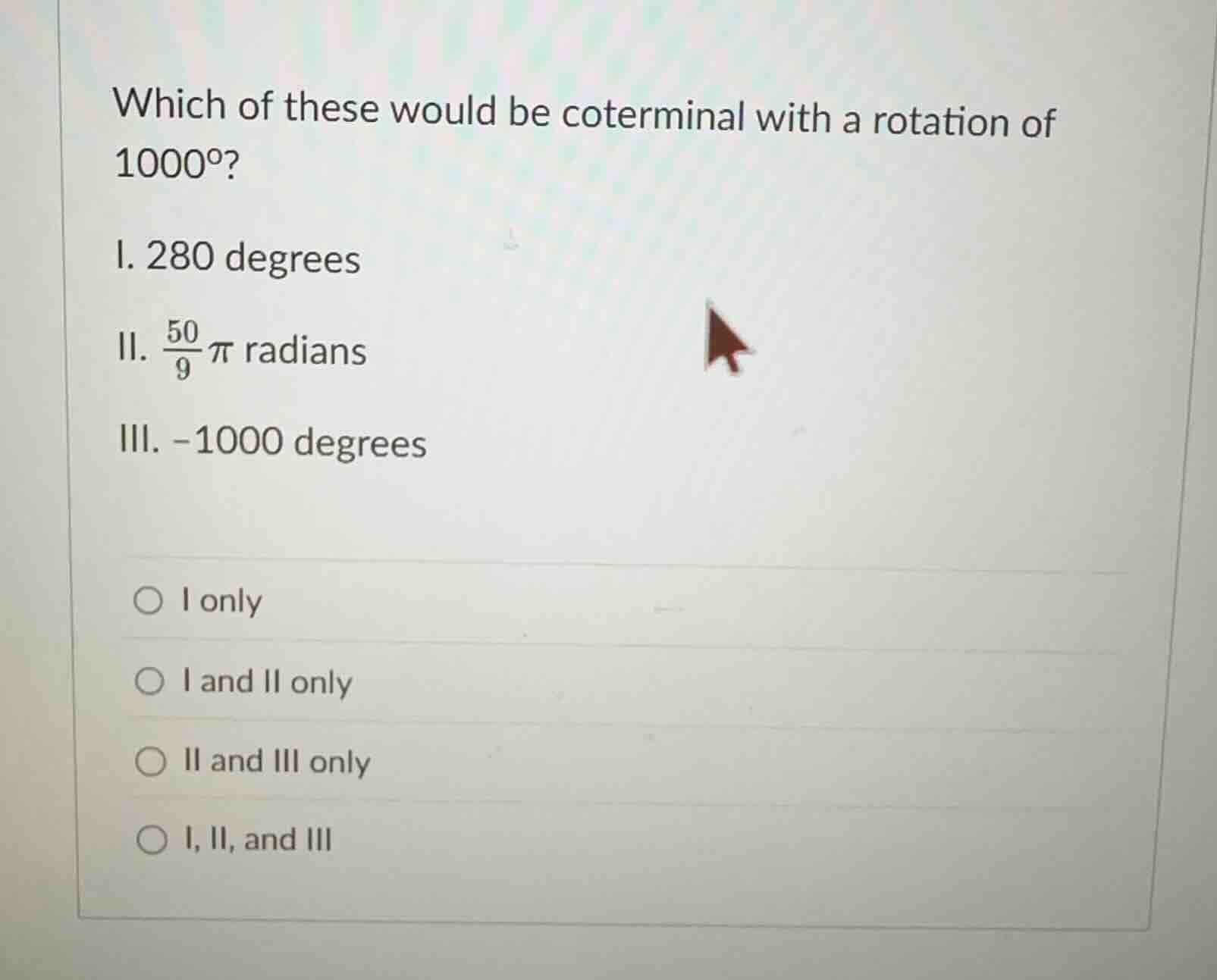
which of these would be coterminal with a rotation of \\(1000^\circ\\)?
i. 280 degrees
ii. \\(\frac{50}{9}\pi\\) radians
iii. \\(-1000\\) degrees
- i only
- i and ii only
- ii and iii only
- i, ii, and iii
Define coterminal angles
Coterminal angles share the same terminal side.
They differ by integer multiples of \(360^\circ\) or \(2\pi\) radians.
We express this as \(\theta_1 - \theta_2 = 360^\circ \cdot k\) for some integer \(k\).
Analyze Statement I
We check if \(280^\circ\) is coterminal with \(1000^\circ\).
Subtract the two angles:
Since \(720^\circ = 2 \cdot 360^\circ\), they differ by an integer multiple of \(360^\circ\).
Thus, Statement I is coterminal.
Analyze Statement II
Convert \(\frac{50}{9}\pi\) radians to degrees to compare.
Multiply by the conversion factor \(\frac{180^\circ}{\pi}\):
Since \(\frac{50}{9}\pi\) radians is exactly equal to \(1000^\circ\), they share the same terminal side.
Thus, Statement II is coterminal.
Analyze Statement III
We check if \(-1000^\circ\) is coterminal with \(1000^\circ\).
Subtract the two angles:
Divide by \(360^\circ\) to check for an integer multiple:
Since this is not an integer, Statement III is not coterminal.
Determine the correct option
Only Statements I and II are coterminal with \(1000^\circ\).
This matches the option "I and II only".

Snap & solve any problem in the app
Get step-by-step solutions on Sovi AI
Photo-based solutions with guided steps
Explore more problems and detailed explanations
- I only
- I and II only (Correct answer)
- II and III only
- I, II, and III