QUESTION IMAGE
Question
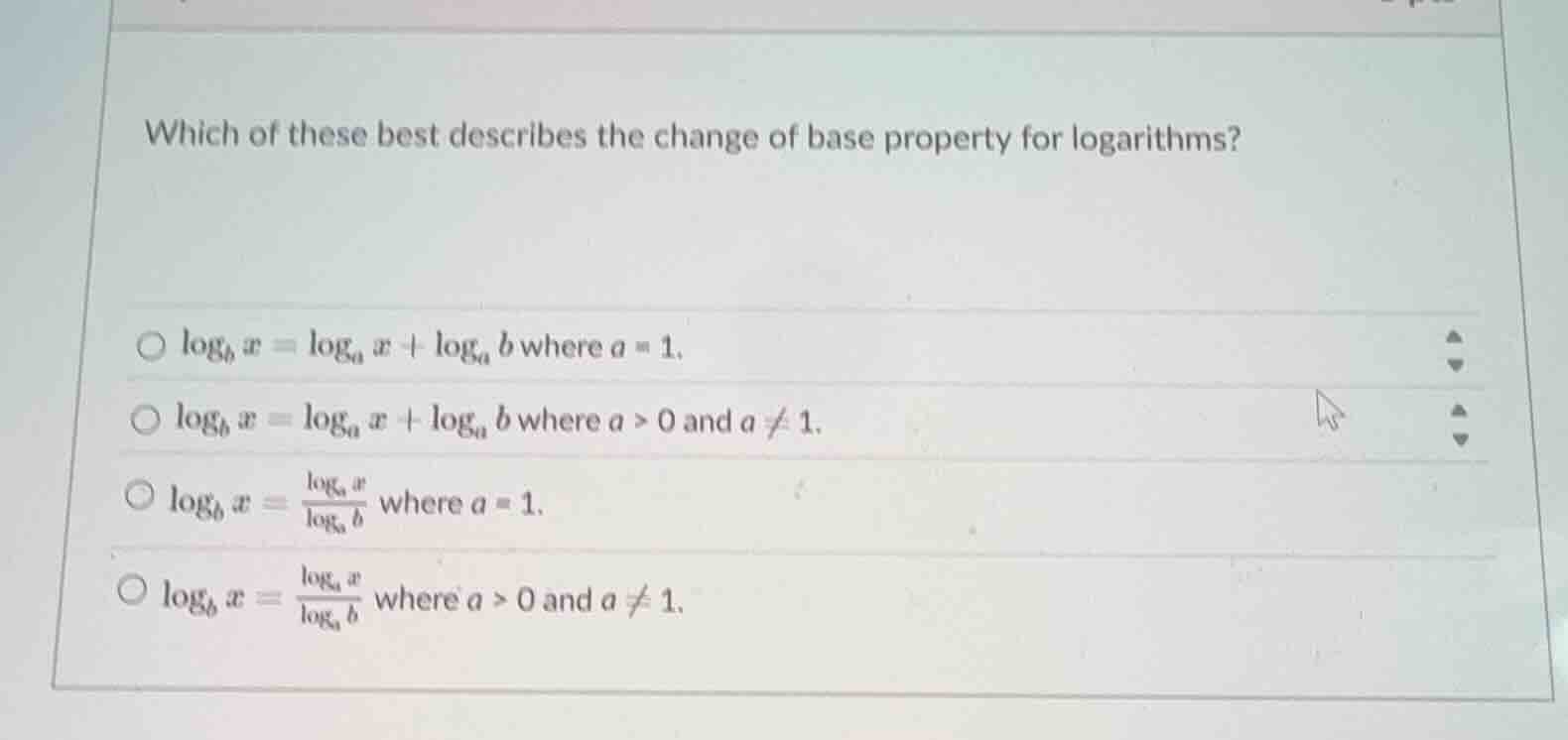
which of these best describes the change of base property for logarithms?\\(\circ\\ \log_b x = \log_a x + \log_a b\\) where \\(a = 1\\).\\(\circ\\ \log_b x = \log_a x + \log_a b\\) where \\(a > 0\\) and \\(a \
eq 1\\).\\(\circ\\ \log_b x = \frac{\log_a x}{\log_a b}\\) where \\(a = 1\\).\\(\circ\\ \log_b x = \frac{\log_a x}{\log_a b}\\) where \\(a > 0\\) and \\(a \
eq 1\\).
Step1: Recall change of base rule
The change of base property for logarithms states that for any positive real numbers $x$, $b$, $a$ (where $a
eq 1$, $b
eq 1$), $\log_b x = \frac{\log_a x}{\log_a b}$.
Step2: Validate domain of $a$
Logarithm bases must be positive and not equal to 1, so $a > 0$ and $a
eq 1$. Eliminate options with incorrect formulas or invalid $a$ values.

Snap & solve any problem in the app
Get step-by-step solutions on Sovi AI
Photo-based solutions with guided steps
Explore more problems and detailed explanations
$\boldsymbol{\log_b x = \frac{\log_a x}{\log_a b} \text{ where } a > 0 \text{ and } a
eq 1.}$