QUESTION IMAGE
Question
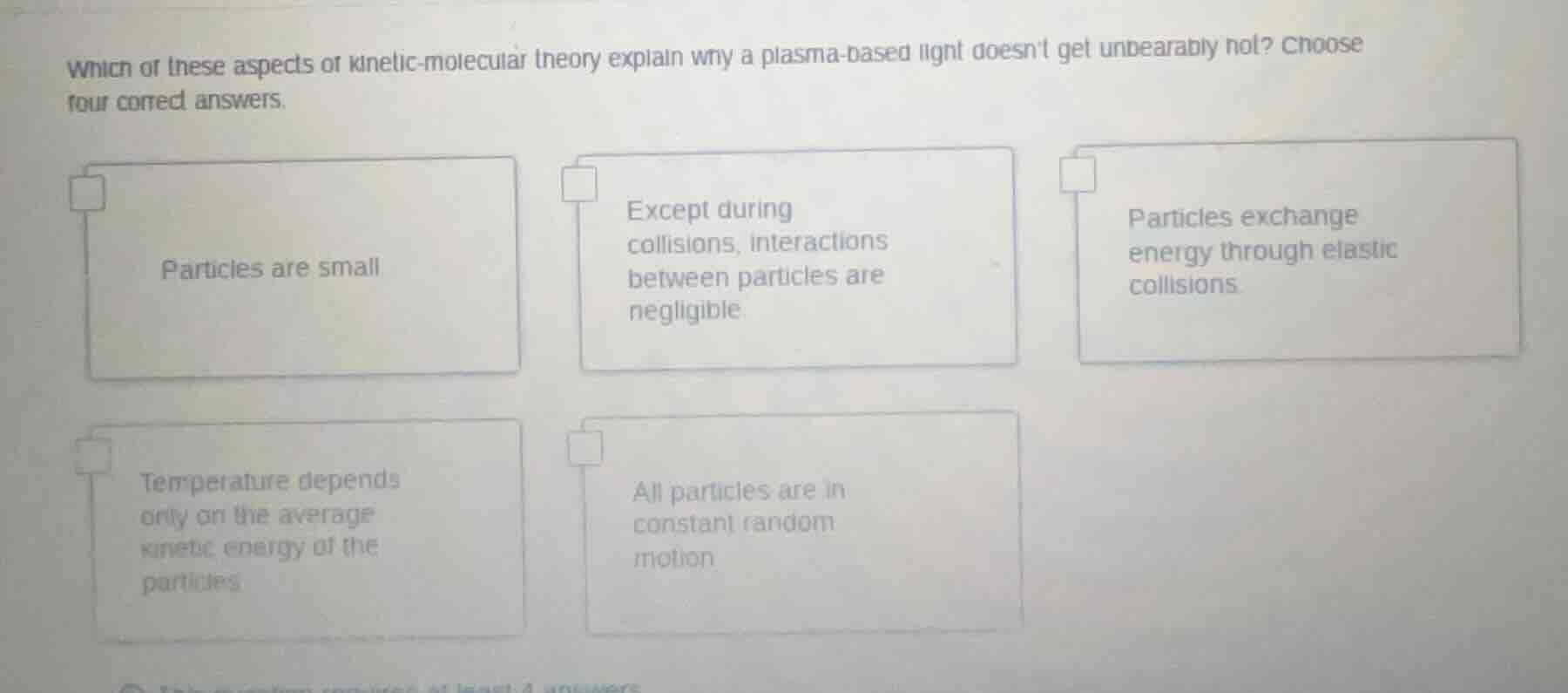
which of these aspects of kinetic-molecular theory explain why a plasma-based light doesnt get unbearably hot? choose four correct answers.
- particles are small
- except during collisions, interactions between particles are negligible
- particles exchange energy through elastic collisions
- temperature depends only on the average kinetic energy of the particles
- all particles are in constant random motion
Analyze the physical system
The question asks which aspects of Kinetic Molecular Theory explain why a plasma-based light (such as a fluorescent bulb or neon sign) does not get unbearably hot. A plasma-based light contains high-energy electrons and ions (plasma) at very low density.
Connect temperature to kinetic energy
Using the Kinetic Molecular Theory concept, temperature is a measure of the average kinetic energy of the particles:
In a low-pressure plasma light, the light-emitting electrons have extremely high kinetic energy (high "electron temperature"), but because their mass is tiny and the overall density of heavy gas particles (atoms/ions) is extremely low, the total thermal energy transferred to the glass is very small. Thus, the macroscopic temperature of the bulb remains low.
Evaluate the given options
Let's evaluate each of the five visible options in the context of Kinetic Molecular Theory and how they relate to the behavior of particles in a low-density gas/plasma:
- Particles are small: This is a core postulate of Kinetic Molecular Theory (particles have negligible volume compared to the container). In a plasma light, the extremely small size and low density mean very few collisions transfer energy to the walls, keeping it cool.
- Except during collisions, interactions between particles are negligible: This postulate explains why particles move independently and do not clump together, allowing high-energy electrons to travel freely and excite gas atoms without constantly transferring heat through intermolecular attractions.
- Particles exchange energy through elastic collisions: Elastic collisions mean total kinetic energy is conserved during collisions. Energy is redistributed among particles rather than being lost as heat to the surroundings in an uncontrolled manner.
- Temperature depends only on the average kinetic energy of the particles: This is the direct definition of temperature in Kinetic Molecular Theory. It explains why we can have high-energy electrons (high electron temperature) without the macroscopic bulb feeling hot, because the heavy particles have much lower average kinetic energy.
- All particles are in constant random motion: While true for Kinetic Molecular Theory, this general postulate describes gas behavior but does not specifically explain the lack of heat transfer or the temperature distribution in the same direct way as the other four postulates regarding particle interactions, size, elastic collisions, and the definition of temperature.
Selecting the four most direct postulates of Kinetic Molecular Theory that define the thermal and interactive behavior of these particles:
- "Particles are small"
- "Except during collisions, interactions between particles are negligible"
- "Particles exchange energy through elastic collisions"
- "Temperature depends only on the average kinetic energy of the particles"

Snap & solve any problem in the app
Get step-by-step solutions on Sovi AI
Photo-based solutions with guided steps
Explore more problems and detailed explanations
- Particles are small (Correct answer)
- Except during collisions, interactions between particles are negligible (Correct answer)
- Particles exchange energy through elastic collisions (Correct answer)
- Temperature depends only on the average kinetic energy of the particles (Correct answer)
- All particles are in constant random motion