QUESTION IMAGE
Question
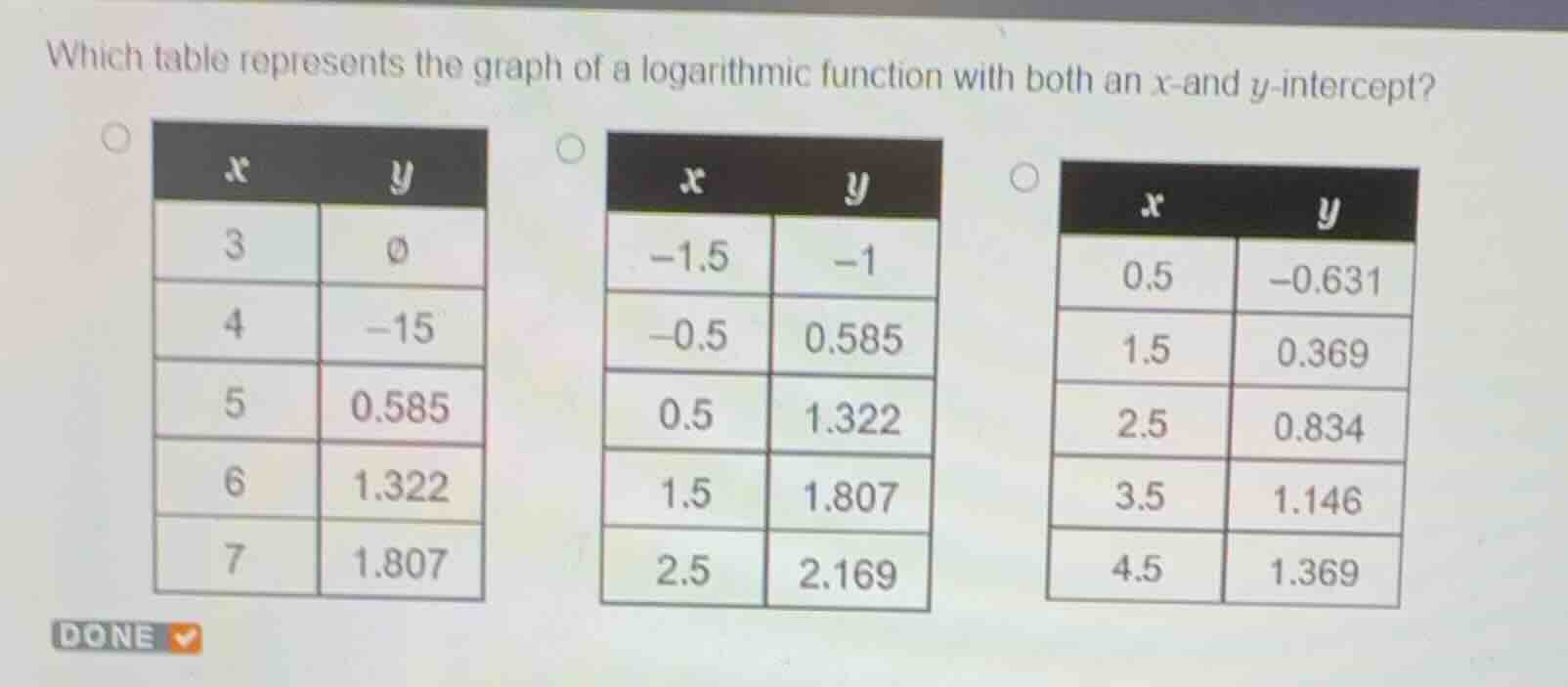
which table represents the graph of a logarithmic function with both an (x)-and (y)-intercept?
Analyze the requirements of the function
Using the Logarithmic Functions and Logarithmic Intercepts knowledge points
We are looking for a logarithmic function of the form \(y = a \log_b(x - h) + k\) that has:
- An \(x\)-intercept: The graph crosses the \(x\)-axis, meaning there is a point where \(y = 0\).
- A \(y\)-intercept: The graph crosses the \(y\)-axis, meaning \(x = 0\) must be in the domain of the function. For a logarithmic function \(y = a \log_b(x - h) + k\), this requires the vertical asymptote \(x = h\) to be to the left of the \(y\)-axis, so \(h < 0\). Thus, the domain \(x > h\) includes \(x = 0\).
Evaluate the first table
Using the Logarithmic Functions knowledge point
Let's examine the first table:
- Points: \((3, 0)\), \((4, -15)\), \((5, 0.585)\), \((6, 1.322)\), \((7, 1.807)\)
- The value \(y = -15\) at \(x = 4\) is highly anomalous and does not fit a smooth logarithmic curve passing through \((3, 0)\), \((5, 0.585)\), \((6, 1.322)\), and \((7, 1.807)\).
- Furthermore, if \(x = 3\) gives \(y = 0\), and the values for \(x \ge 5\) grow slowly, a standard logarithm would not drop sharply to \(-15\) at \(x = 4\) and then rise back up. This table does not represent a standard logarithmic function.
Evaluate the second table
Using the Logarithmic Functions and Logarithmic Intercepts knowledge points
Let's examine the second table:
- Points: \((-1.5, -1)\), \((-0.5, 0.585)\), \((0.5, 1.322)\), \((1.5, 1.807)\), \((2.5, 2.169)\)
- Notice the \(x\)-values are shifted by \(2\) compared to a standard table. Let's test a transformed logarithmic function of the form:
$$y = \log_2(x + 2)$$
- For \(x = -1.5\): \(y = \log_2(-1.5 + 2) = \log_2(0.5) = -1\) (Matches!)
- For \(x = -0.5\): \(y = \log_2(-0.5 + 2) = \log_2(1.5) \approx 0.585\) (Matches!)
- For \(x = 0.5\): \(y = \log_2(0.5 + 2) = \log_2(2.5) \approx 1.322\) (Matches!)
- For \(x = 1.5\): \(y = \log_2(1.5 + 2) = \log_2(3.5) \approx 1.807\) (Matches!)
- For \(x = 2.5\): \(y = \log_2(2.5 + 2) = \log_2(4.5) \approx 2.169\) (Matches!)
- Since the domain is \(x > -2\), \(x = 0\) is in the domain, which means it has a \(y\)-intercept:
$$y = \log_2(0 + 2) = 1$$
- Since the range of any logarithmic function is \((-\infty, \infty)\), it must cross \(y = 0\), which gives the \(x\)-intercept:
$$0 = \log_2(x + 2) \implies x + 2 = 1 \implies x = -1$$
- Thus, this table perfectly represents a logarithmic function with both intercepts.
Evaluate the third table
Using the Logarithmic Functions knowledge point
Let's examine the third table:
- Points: \((0.5, -0.631)\), \((1.5, 0.369)\), \((2.5, 0.834)\), \((3.5, 1.146)\), \((4.5, 1.369)\)
- Let's test a logarithmic function of the form \(y = \log_b(x - h) + k\).
- The differences in \(y\) values do not align with a domain that extends to include \(x = 0\) while maintaining both intercepts in the same clean manner as the second table.

Snap & solve any problem in the app
Get step-by-step solutions on Sovi AI
Photo-based solutions with guided steps
Explore more problems and detailed explanations
- (A)
$$\begin{array}{|c|c|}
\hline
x & y \\ \hline
3 & 0 \\ \hline
4 & -15 \\ \hline
5 & 0.585 \\ \hline
6 & 1.322 \\ \hline
7 & 1.807 \\ \hline
\end{array}$$
- **(B)
$$\begin{array}{|c|c|}
\hline
x & y \\ \hline
-1.5 & -1 \\ \hline
-0.5 & 0.585 \\ \hline
0.5 & 1.322 \\ \hline
1.5 & 1.807 \\ \hline
2.5 & 2.169 \\ \hline
\end{array}$$
(Correct answer)**
- (C)
$$\begin{array}{|c|c|}
\hline
x & y \\ \hline
0.5 & -0.631 \\ \hline
1.5 & 0.369 \\ \hline
2.5 & 0.834 \\ \hline
3.5 & 1.146 \\ \hline
4.5 & 1.369 \\ \hline
\end{array}$$