QUESTION IMAGE
Question
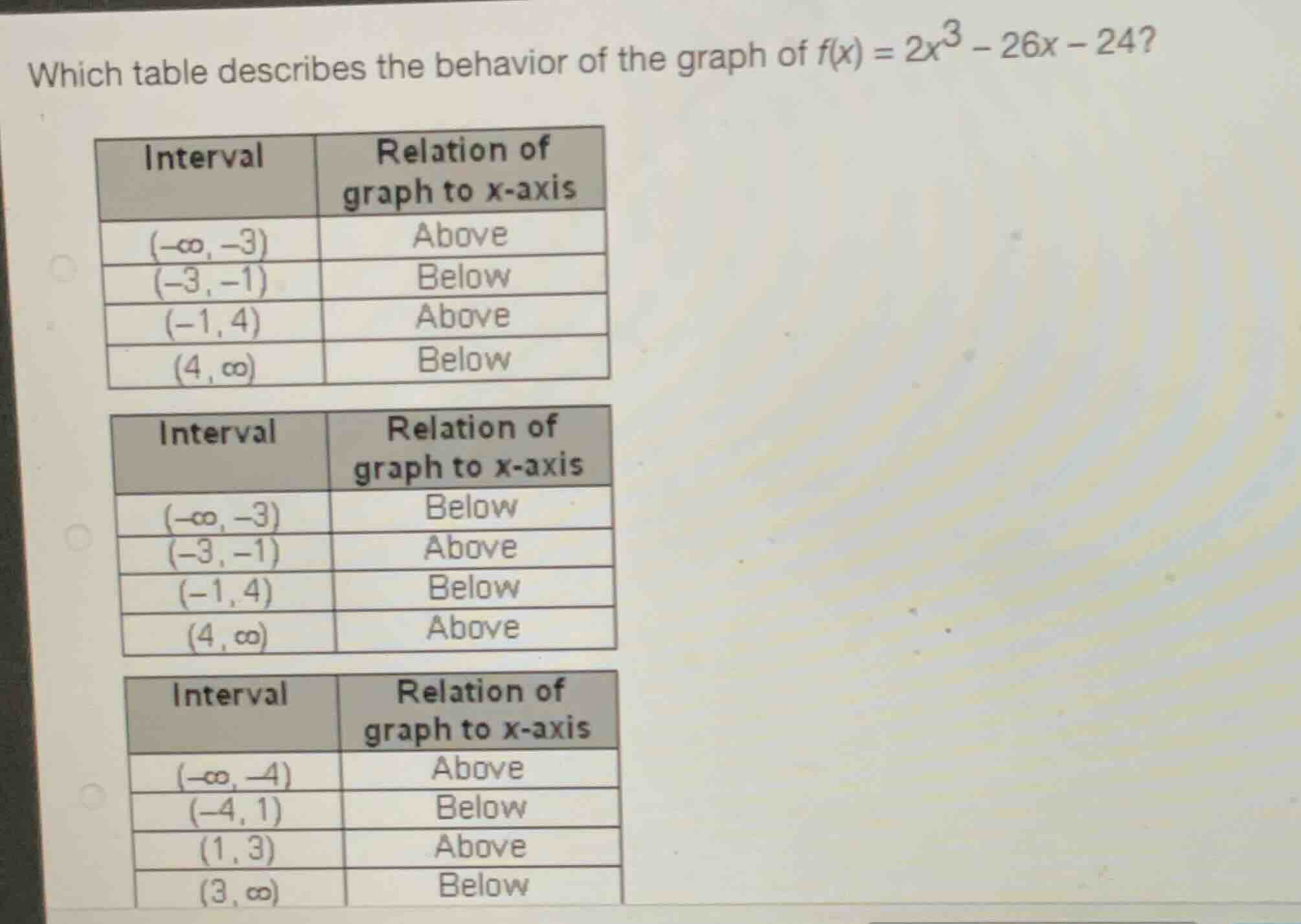
which table describes the behavior of the graph of \\(f(x) = 2x^3 - 26x - 24\\)?
\
$$\begin{tabular}{|c|c|}
\\hline
\\textbf{interval} & \\textbf{relation of graph to x-axis} \\\\
\\hline
\\((-\\infty, -3)\\) & above \\\\
\\hline
\\((-3, -1)\\) & below \\\\
\\hline
\\((-1, 4)\\) & above \\\\
\\hline
\\((4, \\infty)\\) & below \\\\
\\hline
\\end{tabular}$$
\
$$\begin{tabular}{|c|c|}
\\hline
\\textbf{interval} & \\textbf{relation of graph to x-axis} \\\\
\\hline
\\((-\\infty, -3)\\) & below \\\\
\\hline
\\((-3, -1)\\) & above \\\\
\\hline
\\((-1, 4)\\) & below \\\\
\\hline
\\((4, \\infty)\\) & above \\\\
\\hline
\\end{tabular}$$
\
$$\begin{tabular}{|c|c|}
\\hline
\\textbf{interval} & \\textbf{relation of graph to x-axis} \\\\
\\hline
\\((-\\infty, -4)\\) & above \\\\
\\hline
\\((-4, 1)\\) & below \\\\
\\hline
\\((1, 3)\\) & above \\\\
\\hline
\\((3, \\infty)\\) & below \\\\
\\hline
\\end{tabular}$$
Find the roots of the polynomial
Using the Rational Root Theorem and Polynomial Factoring knowledge points
$$
LATEXBLOCK0
$$
The roots are \(x = -3\), \(x = -1\), and \(x = 4\).
Determine the sign in each interval
We analyze the sign of \(f(x)\) on the intervals defined by the roots:
- For \((-\infty, -3)\): Choose \(x = -4\).
$$f(-4) = 2(-1)(-3)(-8) < 0 \quad \text{(Below)}$$
- For \((-3, -1)\): Choose \(x = -2\).
$$f(-2) = 2(1)(-1)(-6) > 0 \quad \text{(Above)}$$
- For \((-1, 4)\): Choose \(x = 0\).
$$f(0) = -24 < 0 \quad \text{(Below)}$$
- For \((4, \infty)\): Choose \(x = 5\).
$$f(5) = 2(8)(6)(1) > 0 \quad \text{(Above)}$$
Match with the correct table option
Comparing our sign analysis to the given choices:
- \((-\infty, -3)\): Below
- \((-3, -1)\): Above
- \((-1, 4)\): Below
- \((4, \infty)\): Above
This matches the second table option.

Snap & solve any problem in the app
Get step-by-step solutions on Sovi AI
Photo-based solutions with guided steps
Explore more problems and detailed explanations
- (A) First table: Above, Below, Above, Below for intervals \((-\infty, -3)\), \((-3, -1)\), \((-1, 4)\), \((4, \infty)\)
- (B) Second table: Below, Above, Below, Above for intervals \((-\infty, -3)\), \((-3, -1)\), \((-1, 4)\), \((4, \infty)\) (Correct answer)
- (C) Third table: Above, Below, Above, Below for intervals \((-\infty, -4)\), \((-4, 1)\), \((1, 3)\), \((3, \infty)\)