QUESTION IMAGE
Question
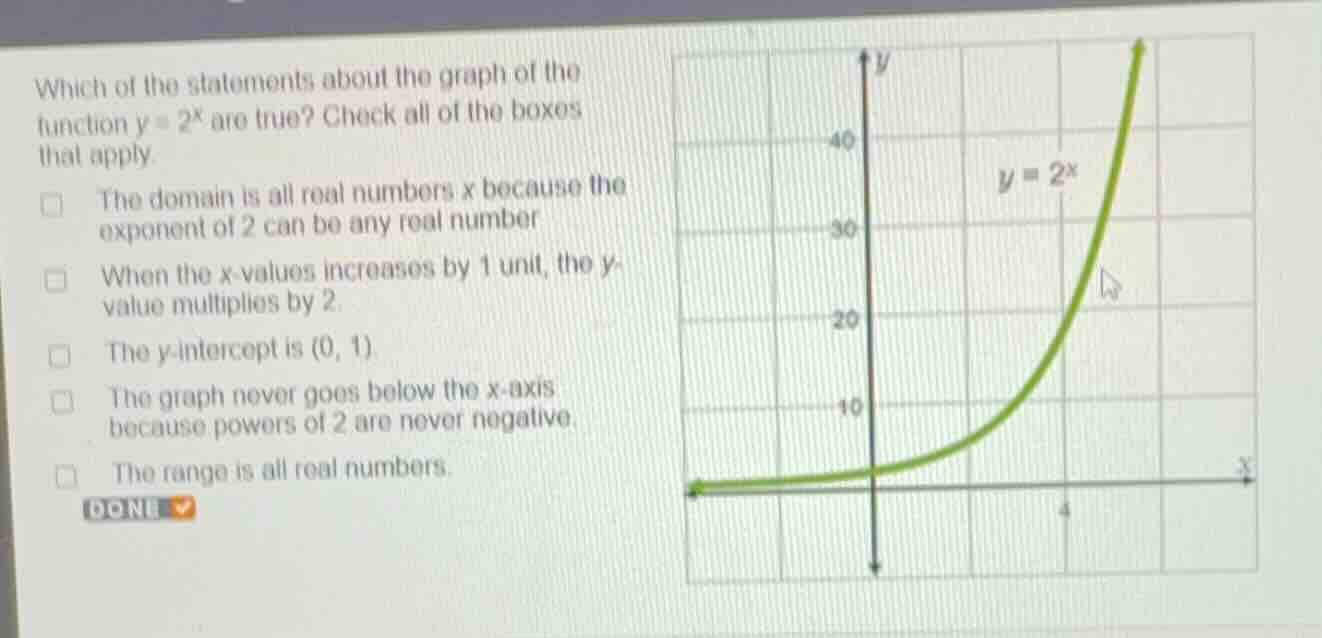
which of the statements about the graph of the function \\(y = 2^x\\) are true? check all of the boxes that apply.
the domain is all real numbers \\(x\\) because the exponent of 2 can be any real number.
when the \\(x\\)-values increases by 1 unit, the \\(y\\)-value multiplies by 2.
the \\(y\\)-intercept is \\((0, 1)\\).
the graph never goes below the \\(x\\)-axis because powers of 2 are never negative.
the range is all real numbers.
<pre_analysis>
{
"quality": "clear",
"question_count": 1,
"skills_matched": [
"direct_cot",
"multiple_choice_formatter",
"explain_then_answer",
"tutor",
"mastery_adaptive_brevity"
],
"needs_drawing": false,
"concepts_used": [
"Exponential Function Graphs"
],
"new_concepts": [
"Exponential Function Properties"
],
"current_concepts": [
"Exponential Function Graphs",
"Exponential Function Properties"
]
}
</pre_analysis>
<reasoning>
Analyze the domain of the function
Using the Exponential Function Graphs knowledge point
The function is \(y = 2^x\). Since the exponent \(x\) can be any real number, the domain is all real numbers. Thus, the first statement is true.
Analyze the rate of change
Using the Exponential Function Graphs knowledge point
For any \(x\), if we increase \(x\) by 1, the new value is \(y(x+1) = 2^{x+1} = 2 \cdot 2^x = 2y(x)\). The \(y\)-value multiplies by 2. Thus, the second statement is true.
Analyze the y-intercept
Using the Exponential Function Graphs knowledge point
To find the \(y\)-intercept, we set \(x = 0\):
\[
y = 2^0 = 1
\]
The \(y\)-intercept is \((0, 1)\). Thus, the third statement is true.
Analyze the lower bound of the graph
Using the Exponential Function Graphs knowledge point
Since \(2^x > 0\) for all real numbers \(x\), the graph never goes below the \(x\)-axis. Thus, the fourth statement is true.
Analyze the range of the function
Using the Exponential Function Graphs knowledge point
The range of \(y = 2^x\) is \((0, \infty)\), which means \(y\) must be strictly positive. It is not all real numbers. Thus, the fifth statement is false.
</reasoning>
<answer>
<mcq-correct>The domain is all real numbers x because the exponent of 2 can be any real number</mcq-correct>
<mcq-correct>When the x-values increases by 1 unit, the y-value multiplies by 2.</mcq-correct>
<mcq-correct>The y-intercept is (0, 1).</mcq-correct>
<mcq-correct>The graph never goes below the x-axis because powers of 2 are never negative.</mcq-correct>
<mcq-option>The range is all real numbers.</mcq-option>
</answer>
<post_analysis>
{
"subject": "Mathematics",
"question_type": "Multiple Choice",
"knowledge_point": [
"Mathematics",
"Algebra",
"Exponential Function Graphs"
]
}
</post_analysis>
Snap & solve any problem in the app
Get step-by-step solutions on Sovi AI
Photo-based solutions with guided steps
Explore more problems and detailed explanations
<pre_analysis>
{
"quality": "clear",
"question_count": 1,
"skills_matched": [
"direct_cot",
"multiple_choice_formatter",
"explain_then_answer",
"tutor",
"mastery_adaptive_brevity"
],
"needs_drawing": false,
"concepts_used": [
"Exponential Function Graphs"
],
"new_concepts": [
"Exponential Function Properties"
],
"current_concepts": [
"Exponential Function Graphs",
"Exponential Function Properties"
]
}
</pre_analysis>
<reasoning>
Analyze the domain of the function
Using the Exponential Function Graphs knowledge point
The function is \(y = 2^x\). Since the exponent \(x\) can be any real number, the domain is all real numbers. Thus, the first statement is true.
Analyze the rate of change
Using the Exponential Function Graphs knowledge point
For any \(x\), if we increase \(x\) by 1, the new value is \(y(x+1) = 2^{x+1} = 2 \cdot 2^x = 2y(x)\). The \(y\)-value multiplies by 2. Thus, the second statement is true.
Analyze the y-intercept
Using the Exponential Function Graphs knowledge point
To find the \(y\)-intercept, we set \(x = 0\):
\[
y = 2^0 = 1
\]
The \(y\)-intercept is \((0, 1)\). Thus, the third statement is true.
Analyze the lower bound of the graph
Using the Exponential Function Graphs knowledge point
Since \(2^x > 0\) for all real numbers \(x\), the graph never goes below the \(x\)-axis. Thus, the fourth statement is true.
Analyze the range of the function
Using the Exponential Function Graphs knowledge point
The range of \(y = 2^x\) is \((0, \infty)\), which means \(y\) must be strictly positive. It is not all real numbers. Thus, the fifth statement is false.
</reasoning>
<answer>
<mcq-correct>The domain is all real numbers x because the exponent of 2 can be any real number</mcq-correct>
<mcq-correct>When the x-values increases by 1 unit, the y-value multiplies by 2.</mcq-correct>
<mcq-correct>The y-intercept is (0, 1).</mcq-correct>
<mcq-correct>The graph never goes below the x-axis because powers of 2 are never negative.</mcq-correct>
<mcq-option>The range is all real numbers.</mcq-option>
</answer>
<post_analysis>
{
"subject": "Mathematics",
"question_type": "Multiple Choice",
"knowledge_point": [
"Mathematics",
"Algebra",
"Exponential Function Graphs"
]
}
</post_analysis>