QUESTION IMAGE
Question
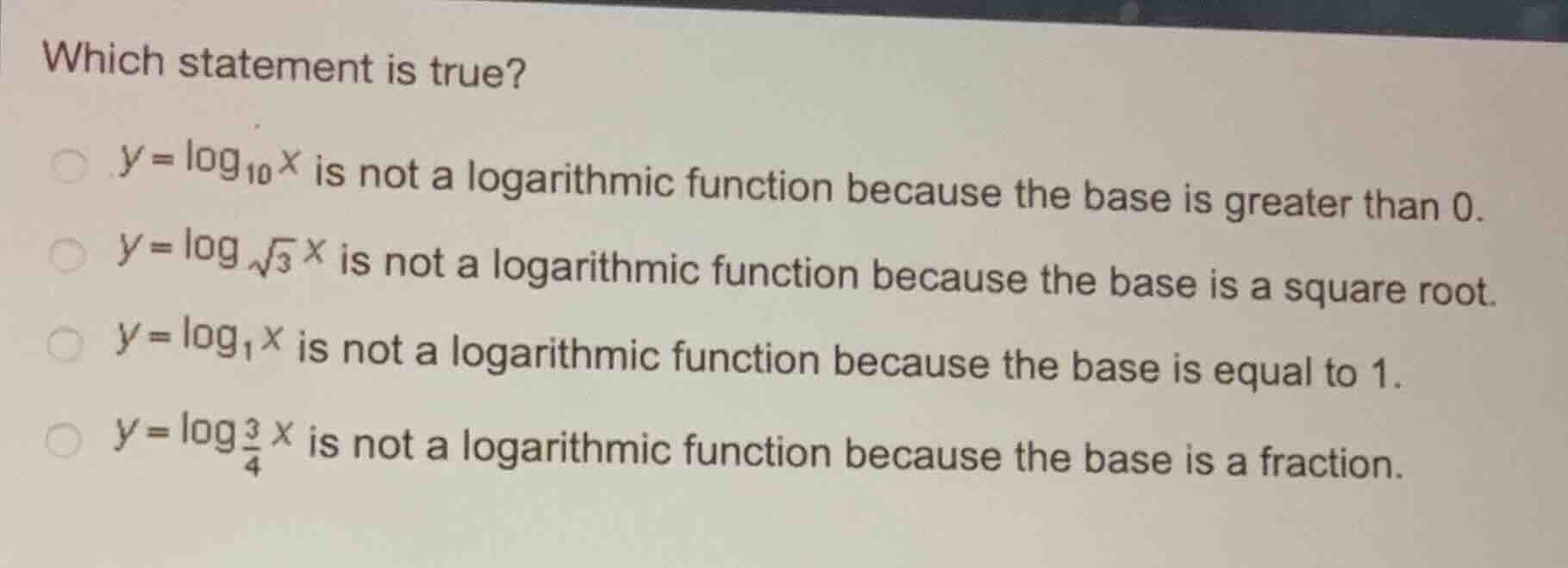
which statement is true?
\\(y = \log_{10} x\\) is not a logarithmic function because the base is greater than 0.
\\(y = \log_{\sqrt{3}} x\\) is not a logarithmic function because the base is a square root.
\\(y = \log_{1} x\\) is not a logarithmic function because the base is equal to 1.
\\(y = \log_{\frac{3}{4}} x\\) is not a logarithmic function because the base is a fraction.
Define logarithmic function base restrictions
$$
y = \log_{b} x \implies b > 0 \text{ and } b
eq 1
$$
Evaluate each statement against base restrictions
$$
LATEXBLOCK0
$$
Identify the correct statement
$$
y = \log_{1} x \text{ is not a logarithmic function because the base is equal to 1.}
$$

Snap & solve any problem in the app
Get step-by-step solutions on Sovi AI
Photo-based solutions with guided steps
Explore more problems and detailed explanations
- (A) \(y = \log_{10} x\) is not a logarithmic function because the base is greater than 0.
- (B) \(y = \log_{\sqrt{3}} x\) is not a logarithmic function because the base is a square root.
- (C) \(y = \log_{1} x\) is not a logarithmic function because the base is equal to 1. (Correct answer)
- (D) \(y = \log_{\frac{3}{4}} x\) is not a logarithmic function because the base is a fraction.