QUESTION IMAGE
Question
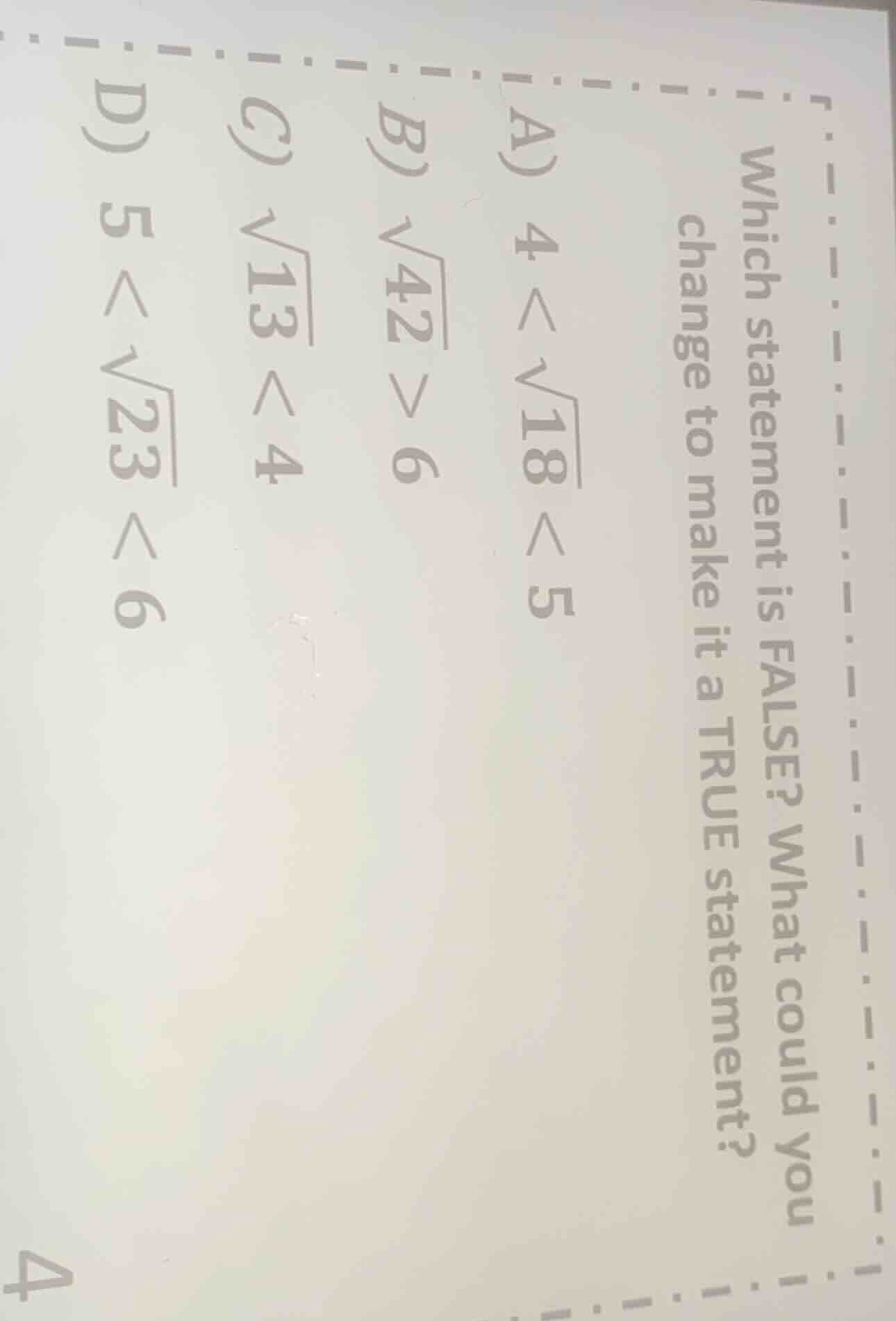
which statement is false? what could you change to make it a true statement?
a) $4 < \sqrt{18} < 5$
b) $\sqrt{42} > 6$
c) $\sqrt{13} < 4$
d) $5 < \sqrt{23} < 6$
Step1: Analyze Option A
We know that \(4 = \sqrt{16}\) and \(5=\sqrt{25}\). Since \(16 < 18 < 25\), then \(\sqrt{16}<\sqrt{18}<\sqrt{25}\), which means \(4 < \sqrt{18}< 5\). So Option A is True.
Step2: Analyze Option B
We know that \(6=\sqrt{36}\). Since \(42>36\), then \(\sqrt{42}>\sqrt{36}\), so \(\sqrt{42} > 6\). Option B is True.
Step3: Analyze Option C
We know that \(4 = \sqrt{16}\). Since \(13 < 16\), then \(\sqrt{13}<\sqrt{16}\), so \(\sqrt{13}< 4\). Option C is True? Wait, no, wait: Wait, \(4=\sqrt{16}\), and \(13 < 16\), so \(\sqrt{13}<\sqrt{16} = 4\), so \(\sqrt{13}<4\) is True? Wait, no, the option is \(\sqrt{13}<4\), which is true. Wait, maybe I made a mistake. Wait, let's check Option D.
Step4: Analyze Option D
We know that \(5=\sqrt{25}\) and \(6=\sqrt{36}\). Since \(23 < 25\), then \(\sqrt{23}<\sqrt{25}=5\). So the statement \(5 < \sqrt{23}< 6\) is False because \(\sqrt{23}<5\), not \(5 < \sqrt{23}\).
Wait, let's re - check Option C: \(4=\sqrt{16}\), \(13 < 16\), so \(\sqrt{13}<\sqrt{16}=4\), so \(\sqrt{13}<4\) is True. Option D: \(5 = \sqrt{25}\), \(23<25\), so \(\sqrt{23}<\sqrt{25}=5\), so \(5 < \sqrt{23}\) is false, so the statement \(5 < \sqrt{23}< 6\) is false.
To make Option D a true statement, we can change it to \(4<\sqrt{23}<5\) (since \(\sqrt{16} = 4\), \(\sqrt{25}=5\), and \(16 < 23<25\), so \(4<\sqrt{23}<5\)) or \(5>\sqrt{23}>4\) or other similar changes. But the false statement is Option D.
Wait, maybe I messed up Option C. Let's re - calculate \(\sqrt{13}\approx3.605\), which is less than 4, so \(\sqrt{13}<4\) is true. Option D: \(\sqrt{23}\approx4.796\), so \(5<\sqrt{23}\) is false, because \(4.796 < 5\). So the false statement is Option D.
To make it true, we can change the first inequality sign. For example, change \(5 < \sqrt{23}< 6\) to \(4 < \sqrt{23}< 5\) (since \(\sqrt{16}=4\), \(\sqrt{25}=5\), and \(16 < 23<25\), so \(4<\sqrt{23}<5\)) or change \(5\) to \(4\), so \(4 < \sqrt{23}< 6\) (since \(4=\sqrt{16}\), \(6=\sqrt{36}\), and \(16 < 23<36\), so \(4<\sqrt{23}<6\) is true).

Snap & solve any problem in the app
Get step-by-step solutions on Sovi AI
Photo-based solutions with guided steps
Explore more problems and detailed explanations
The false statement is D) \(5 < \sqrt{23}< 6\). To make it a true statement, we can change it to \(4 < \sqrt{23}< 5\) (or other valid changes like \(5>\sqrt{23}>4\) or \(4 < \sqrt{23}< 6\) etc.).