QUESTION IMAGE
Question
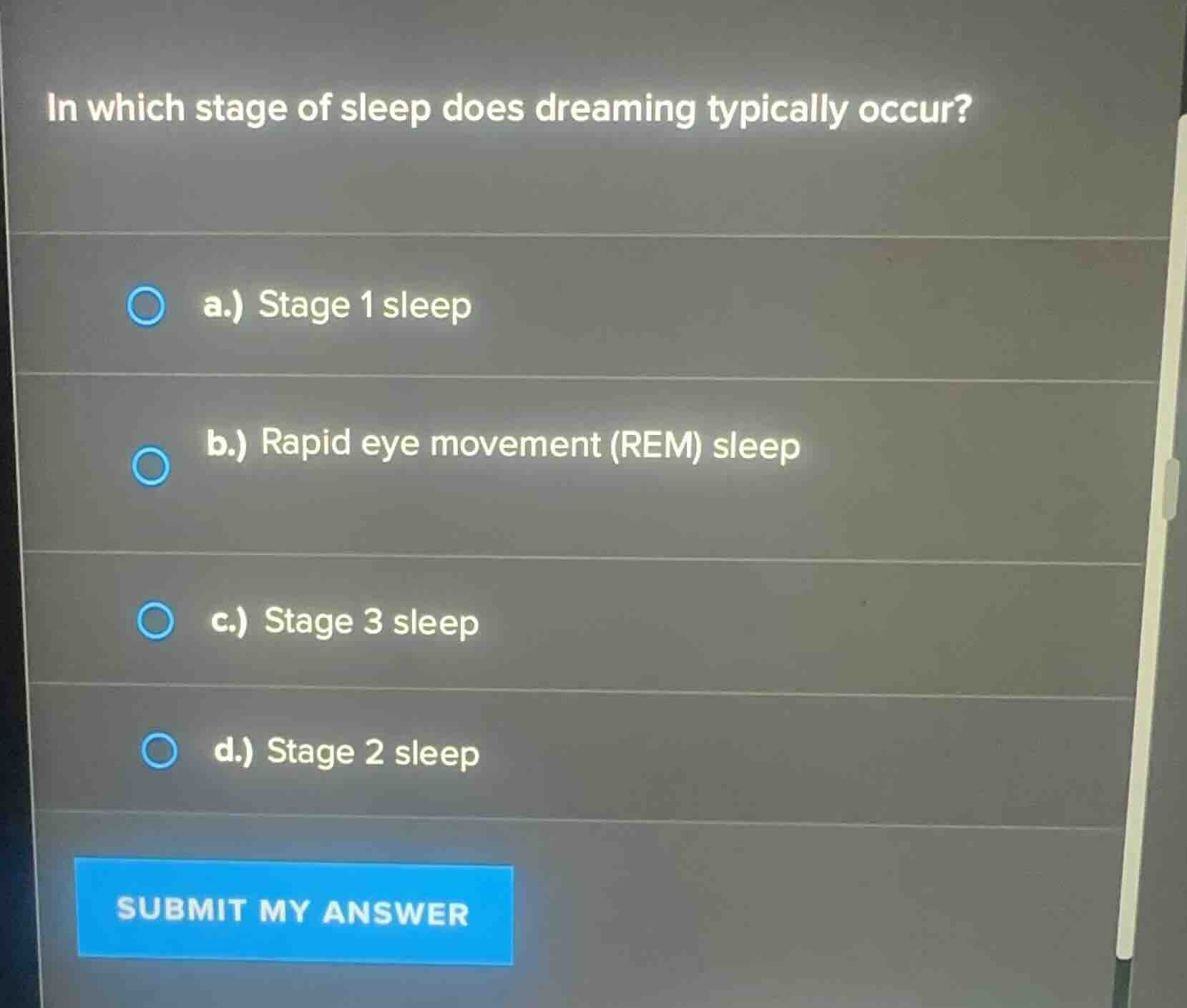
in which stage of sleep does dreaming typically occur?
a.) stage 1 sleep
b.) rapid eye movement (rem) sleep
c.) stage 3 sleep
d.) stage 2 sleep
submit my answer
Identify the physiological characteristics of sleep stages
Sleep is divided into non-rapid eye movement (NREM) sleep (Stages 1, 2, and 3) and rapid eye movement (REM) sleep. Each stage has distinct brainwave patterns and physiological characteristics.
Associate dreaming with the correct sleep stage
While minor, less vivid thought-like mentation can occur during NREM stages, vivid, narrative-driven, and highly memorable dreaming typically occurs during rapid eye movement (REM) sleep. During this stage, brain activity closely resembles waking levels, and muscle atonia (temporary paralysis) occurs to prevent acting out dreams.
Evaluate the given multiple-choice options
- Stage 1 sleep: A light transitional stage of NREM sleep; not the primary stage for typical dreaming.
- Rapid eye movement (REM) sleep: The stage characterized by high brain activity, rapid eye movements, and the vast majority of vivid dreaming.
- Stage 3 sleep: Deep NREM sleep (slow-wave sleep) associated with physical recovery rather than active dreaming.
- Stage 2 sleep: A deeper stage of NREM sleep characterized by sleep spindles and K-complexes; not the primary stage for dreaming.
Therefore, option (b) is the correct choice.

Snap & solve any problem in the app
Get step-by-step solutions on Sovi AI
Photo-based solutions with guided steps
Explore more problems and detailed explanations
- a.) Stage 1 sleep
- b.) Rapid eye movement (REM) sleep (Correct answer)
- c.) Stage 3 sleep
- d.) Stage 2 sleep