QUESTION IMAGE
Question
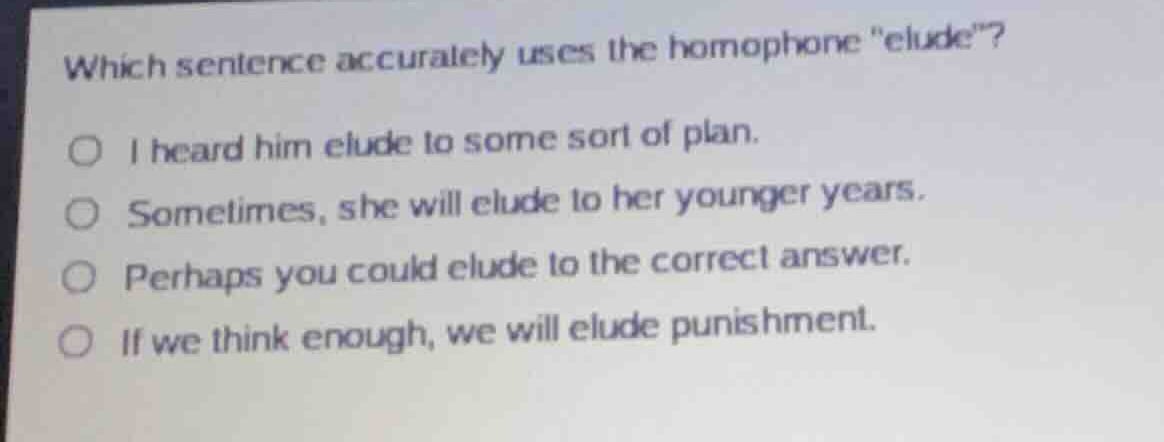
which sentence accurately uses the homophone \elude\?
i heard him elude to some sort of plan.
sometimes, she will elude to her younger years.
perhaps you could elude to the correct answer.
if we think enough, we will elude punishment.
Define the homophones "elude" and "allude"
The word "elude" means to evade, escape, or avoid (typically danger, an enemy, or a pursuer). Its homophone "allude" means to suggest or call attention to indirectly (usually followed by the preposition "to").
Analyze the context of each sentence option
- "I heard him elude to some sort of plan." -> Incorrect. The context requires "allude" (to make an indirect reference).
- "Sometimes, she will elude to her younger years." -> Incorrect. The context requires "allude" (to refer indirectly).
- "Perhaps you could elude to the correct answer." -> Incorrect. The context requires "allude" (to hint at).
- "If we think enough, we will elude punishment." -> Correct. "Elude" is used properly here to mean escape or avoid punishment.

Snap & solve any problem in the app
Get step-by-step solutions on Sovi AI
Photo-based solutions with guided steps
Explore more problems and detailed explanations
- (A) I heard him elude to some sort of plan.
- (B) Sometimes, she will elude to her younger years.
- (C) Perhaps you could elude to the correct answer.
- (D) If we think enough, we will elude punishment. (Correct answer)