QUESTION IMAGE
Question
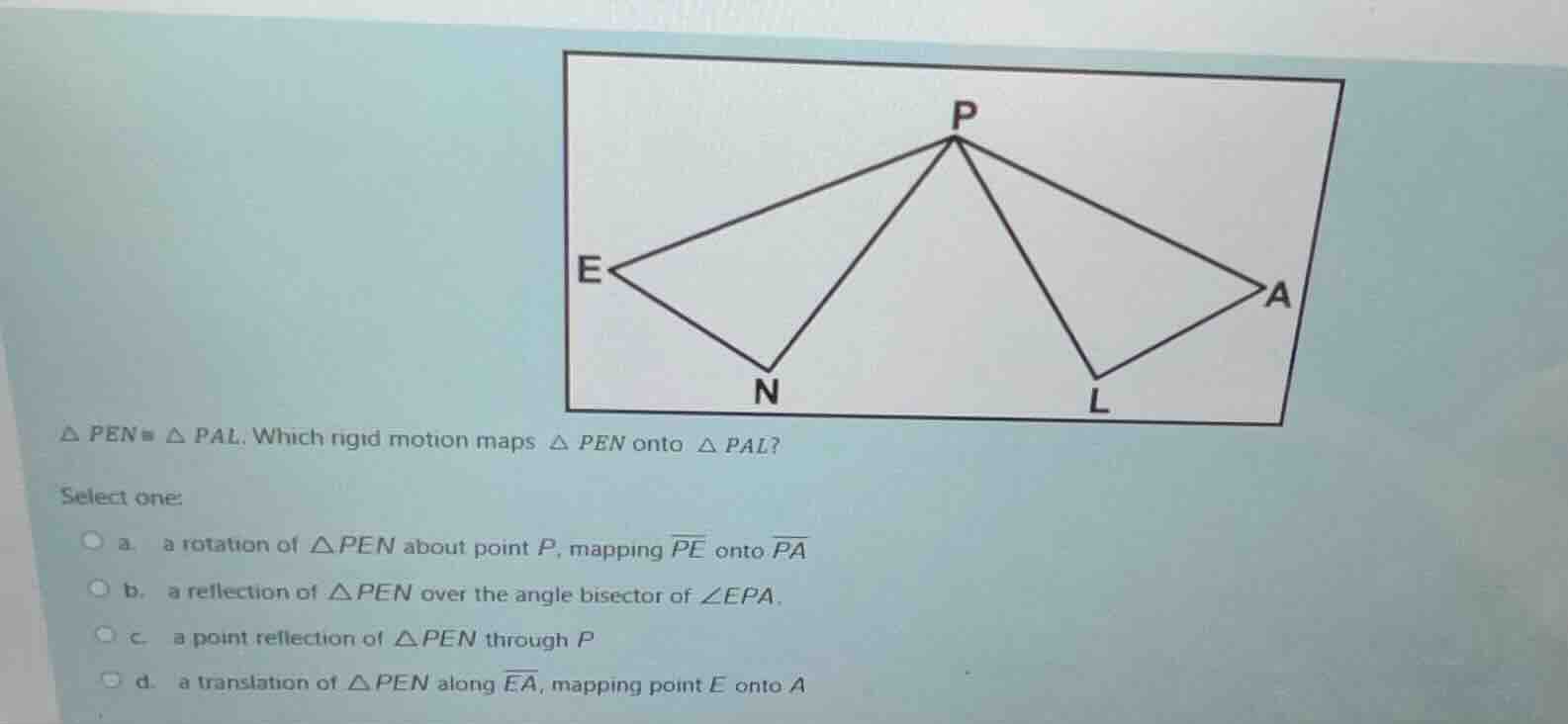
\\(\delta pen \cong \delta pal\\). which rigid motion maps \\(\delta pen\\) onto \\(\delta pal\\)?
select one:
a. a rotation of \\(\delta pen\\) about point \\(p\\), mapping \\(\overline{pe}\\) onto \\(\overline{pa}\\)
b. a reflection of \\(\delta pen\\) over the angle bisector of \\(\angle epa\\)
c. a point reflection of \\(\delta pen\\) through \\(p\\)
d. a translation of \\(\delta pen\\) along \\(\overline{ea}\\), mapping point \\(e\\) onto \\(a\\)
⚡ Using what you learned: Rigid Transformations (Translation, Rotation, Reflection)
Step 1: Analyze the given congruence statement
The problem states that:
This correspondence tells us how the vertices map to each other under the rigid motion:
- Vertex \( P \) maps to vertex \( P \) (it is a fixed point).
- Vertex \( E \) maps to vertex \( A \).
- Vertex \( N \) maps to vertex \( L \).
Consequently, the line segment \( \overline{PE} \) must map onto the line segment \( \overline{PA} \).
Step 2: Evaluate the options
- Option a: "a rotation of \( \Delta PEN \) about point \( P \), mapping \( \overline{PE} \) onto \( \overline{PA} \)"
- Since \( P \) is a fixed point shared by both triangles, rotating \( \Delta PEN \) around \( P \) until the side \( \overline{PE} \) aligns with \( \overline{PA} \) will also rotate the rest of the triangle, mapping \( N \) to \( L \). This correctly maps \( \Delta PEN \) onto \( \Delta PAL \).
- Option b: "a reflection of \( \Delta PEN \) over the angle bisector of \( \angle EPA \)"
- Reflecting over the angle bisector of \( \angle EPA \) would swap the positions of \( E \) and \( A \), but it would reverse the orientation (handedness) of the triangle. A reflection would map the counterclockwise-oriented \( \Delta PEN \) to a clockwise-oriented triangle, which does not match the orientation of \( \Delta PAL \).
- Option c: "a point reflection of \( \Delta PEN \) through \( P \)"
- A point reflection through \( P \) is equivalent to a \( 180^\circ \) rotation, which would map \( E \) to a point collinear with \( P \) and \( E \) on the opposite side of \( P \). This does not align with \( A \).
- Option d: "a translation of \( \Delta PEN \) along \( \overline{EA} \), mapping point \( E \) onto \( A \)"
- A translation would shift the entire triangle, meaning the image of \( P \) would move to a new position, rather than staying fixed at \( P \).

Snap & solve any problem in the app
Get step-by-step solutions on Sovi AI
Photo-based solutions with guided steps
Explore more problems and detailed explanations
a. a rotation of \( \Delta PEN \) about point \( P \), mapping \( \overline{PE} \) onto \( \overline{PA} \)