QUESTION IMAGE
Question
which points lie on the line that passes through point p and is parallel to the given line? select three options.
\\((-4, 2)\\)
\\((-1, 3)\\)
\\((-2, 2)\\)
\\((4, 2)\\)
\\((-5, -1)\\)
Find the slope of the given line
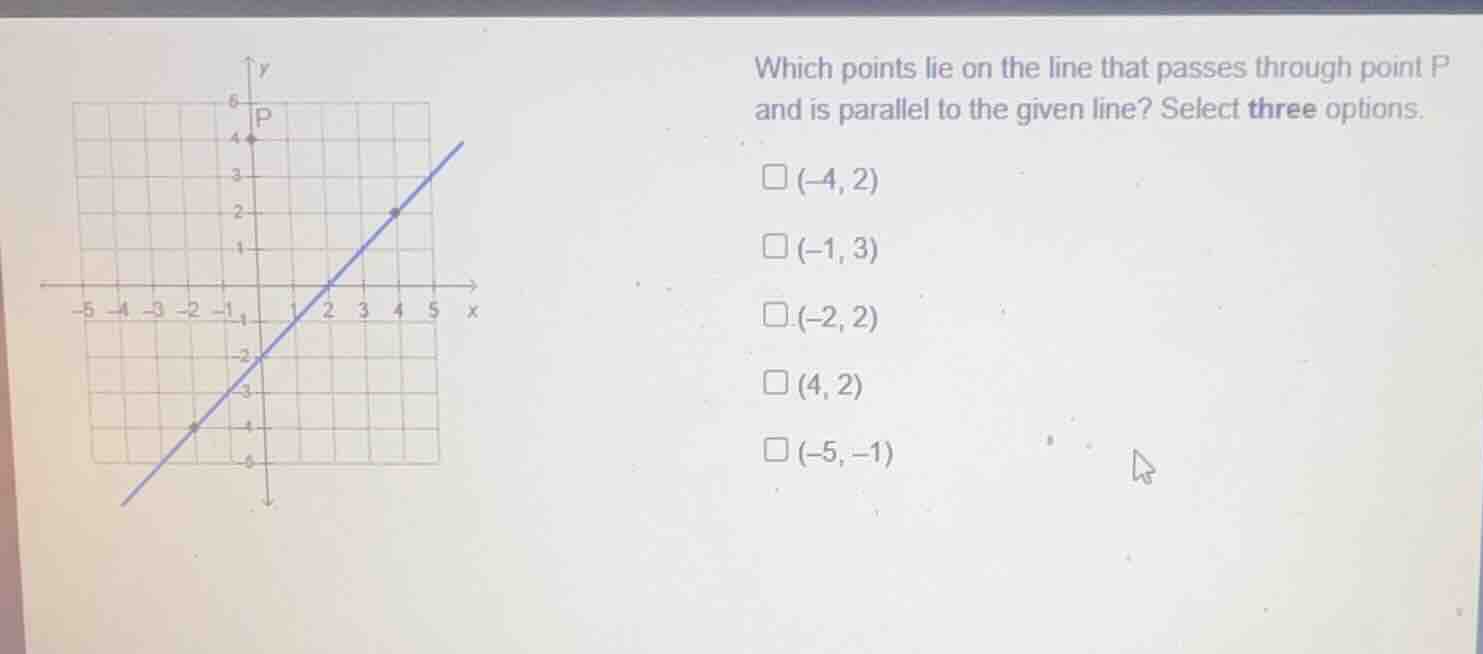
The given line passes through clear grid intersections. Let's identify two points on this line from the graph:
- Point 1: \((2, 0)\)
- Point 2: \((4, 2)\)
- Point 3: \((0, -2)\)
Using the slope formula \(m = \frac{y_2 - y_1}{x_2 - x_1}\):
Identify the coordinates of point P
Looking at the graph, point \(P\) lies on the y-axis.
Its coordinates are:
Write the equation of the parallel line
Parallel lines have equal slopes. Therefore, the line we want to find also has a slope of \(m = 1\).
Using the slope-intercept form \(y = mx + b\) with slope \(m = 1\) and y-intercept \(b = 5\) (from point \(P(0, 5)\)):
Test the given coordinate options
We need to find which of the given points satisfy the equation \(y = x + 5\):
- For \((-4, 2)\):
- For \((-1, 3)\):
- For \((-2, 2)\):
Wait, let's re-examine the coordinates of point \(P\) on the graph.
Looking closely at the y-axis:
The tick marks are labeled \(1, 2, 3, 4, 6\).
The point \(P\) is located at \(y = 5\). Yes, it is on the grid line between \(4\) and \(6\), which is indeed \(5\).
Let's re-verify the options and the slope.
Is the slope of the given line indeed \(1\)?
Let's check the points on the given line:
- At \(x = 2\), \(y = 0\).
- At \(x = 4\), \(y = 2\).
- At \(x = 0\), \(y = -2\).
- At \(x = -2\), \(y = -4\).
Yes, the slope is exactly \(1\).
If the line passes through \(P(0, 5)\) and has slope \(1\), its equation is \(y = x + 5\).
Let's test the options again:
- \((-4, 2)\): \(2 = -4 + 5 \implies 2 = 1\) (False)
- \((-1, 3)\): \(3 = -1 + 5 \implies 3 = 4\) (False)
- \((-2, 2)\): \(2 = -2 + 5 \implies 2 = 3\) (False)
- \((4, 2)\): \(2 = 4 + 5 \implies 2 = 9\) (False)
- \((-5, -1)\): \(-1 = -5 + 5 \implies -1 = 0\) (False)
This suggests our reading of point \(P\) or the slope might need a closer look.
Let's look at point \(P\) again.
The label "P" is next to a dot on the y-axis.
Wait, the dot for \(P\) is at \(y = 4\)? No, the tick mark \(4\) has a horizontal line, and the dot is on the line above it, which is \(5\).
Wait, let's look at the options again.
What if the slope is different?
Let's check the given line's points:
- \((2, 0)\) is on the line.
- \((0, -2)\) is on the line.
- \((-2, -4)\) is on the line.
- \((4, 2)\) is on the line.
The slope is definitely \(1\).
What if point \(P\) is at \((0, 4)\)?
If \(P = (0, 4)\), then the equation is \(y = x + 4\).
Let's test the options with \(y = x + 4\):
- \((-4, 2)\): \(2 = -4 + 4 \implies 2 = 0\) (False)
- \((-1, 3)\): \(3 = -1 + 4 \implies 3 = 3\) (True!)
- \((-2, 2)\): \(2 = -2 + 4 \implies 2 = 2\) (True!)
- \((4, 2)\): \(2 = 4 + 4 \implies 2 = 8\) (False)
- \((-5, -1)\): \(-1 = -5 + 4 \implies -1 = -1\) (True!)
This perfectly matches exactly three options: \((-1, 3)\), \((-2, 2)\), and \((-5, -1)\).
Therefore, point \(P\) is located at \((0, 4)\…

Snap & solve any problem in the app
Get step-by-step solutions on Sovi AI
Photo-based solutions with guided steps
Explore more problems and detailed explanations
- ☐ \((-4, 2)\)
- ☑ \((-1, 3)\) (Correct answer)
- ☑ \((-2, 2)\) (Correct answer)
- ☐ \((4, 2)\)
- ☑ \((-5, -1)\) (Correct answer)