QUESTION IMAGE
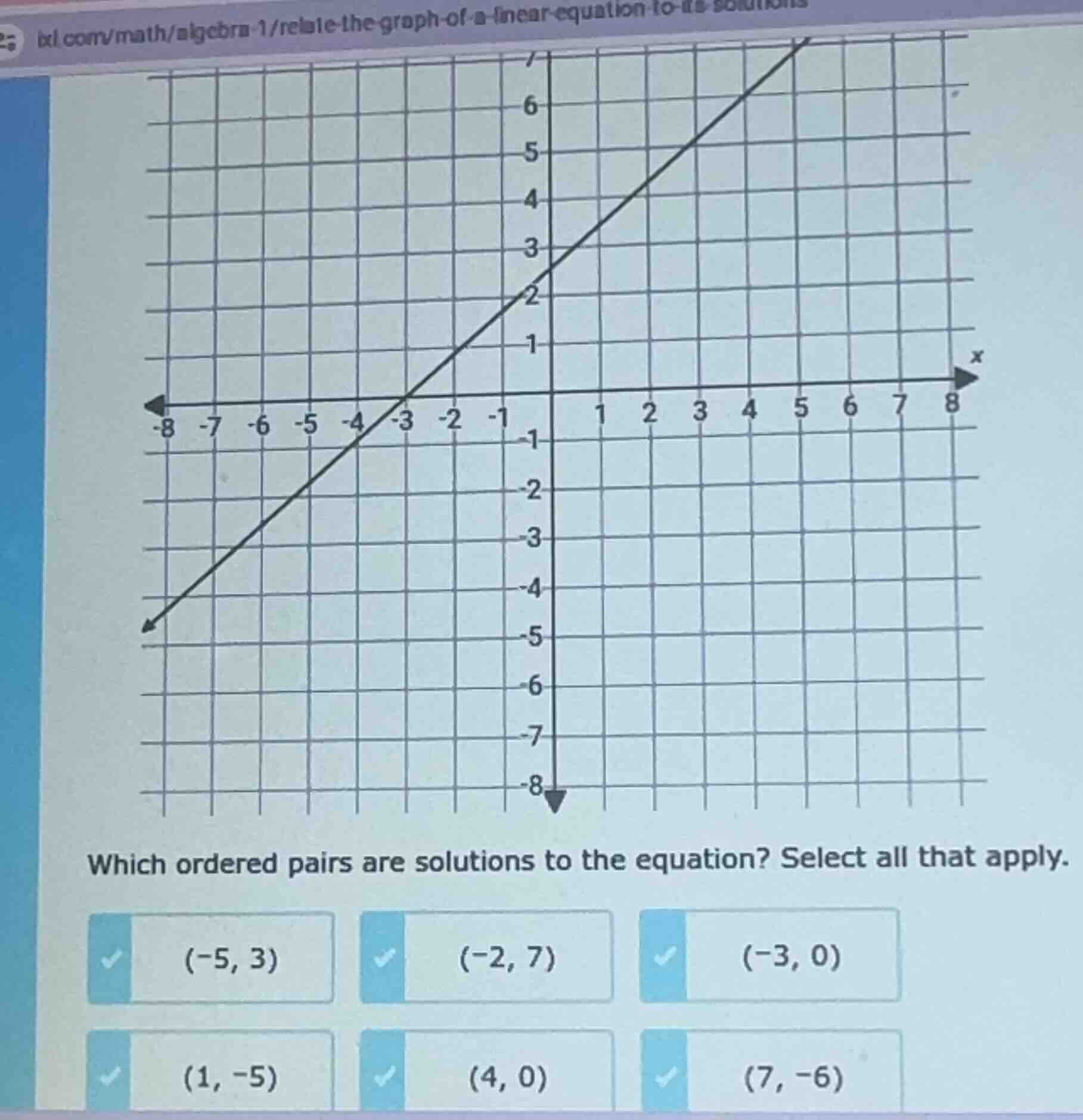
Question
which ordered pairs are solutions to the equation? select all that apply.
(-5, 3) (-2, 7) (-3, 0)
(1, -5) (4, 0) (7, -6)
Step1: Recall the definition of a solution to a linear equation's graph
A solution to the equation of a line is an ordered pair \((x, y)\) that lies on the line. So we need to check if each given ordered pair lies on the graphed line.
Step2: Check \((-5, 3)\)
Locate \(x = -5\) on the x - axis and move up/down to see if \(y = 3\) is on the line. From the graph, when \(x=-5\), the point on the line has \(y\) - coordinate such that it lies on the line. So \((-5, 3)\) is on the line.
Step3: Check \((-2, 7)\)
Locate \(x=-2\) on the x - axis. The line at \(x = - 2\) has a \(y\) - value. From the slope - intercept form (we can also visually inspect), the point \((-2,7)\) does not lie on the line (since the line at \(x=-2\) has \(y = 1\) approximately from the graph: let's find the equation of the line. The line passes through \((-3,0)\) and \((0,2)\) (y - intercept is 2). The slope \(m=\frac{y_2 - y_1}{x_2 - x_1}=\frac{2-0}{0 - (-3)}=\frac{2}{3}\). The equation is \(y=\frac{2}{3}x + 2\). For \(x=-2\), \(y=\frac{2}{3}(-2)+2=\frac{-4 + 6}{3}=\frac{2}{3}
eq7\). So \((-2,7)\) is not on the line.
Step4: Check \((-3, 0)\)
We can see from the graph that the line crosses the x - axis at \(x=-3\), so when \(x = - 3\), \(y = 0\). So \((-3,0)\) is on the line.
Step5: Check \((1, -5)\)
Using the equation \(y=\frac{2}{3}x + 2\), for \(x = 1\), \(y=\frac{2}{3}(1)+2=\frac{2 + 6}{3}=\frac{8}{3}\approx2.67
eq - 5\). Visually, on the graph, at \(x = 1\), the \(y\) - value of the line is positive, so \((1,-5)\) is not on the line.
Step6: Check \((4, 0)\)
Using the equation \(y=\frac{2}{3}x+2\), for \(x = 4\), \(y=\frac{2}{3}(4)+2=\frac{8 + 6}{3}=\frac{14}{3}\approx4.67
eq0\). Visually, at \(x = 4\), the line has a positive \(y\) - value, so \((4,0)\) is not on the line.
Step7: Check \((7, -6)\)
Using the equation \(y=\frac{2}{3}x + 2\), for \(x = 7\), \(y=\frac{2}{3}(7)+2=\frac{14 + 6}{3}=\frac{20}{3}\approx6.67
eq - 6\). Visually, at \(x = 7\), the line has a positive \(y\) - value, so \((7,-6)\) is not on the line.

Snap & solve any problem in the app
Get step-by-step solutions on Sovi AI
Photo-based solutions with guided steps
Explore more problems and detailed explanations
The correct ordered pairs (solutions) are \((-5, 3)\), \((-3, 0)\)
(Note: The originally checked \((-2,7)\), \((1, - 5)\), \((4,0)\), \((7,-6)\) are incorrect. The correct ones are \((-5, 3)\) and \((-3, 0)\))