QUESTION IMAGE
Question
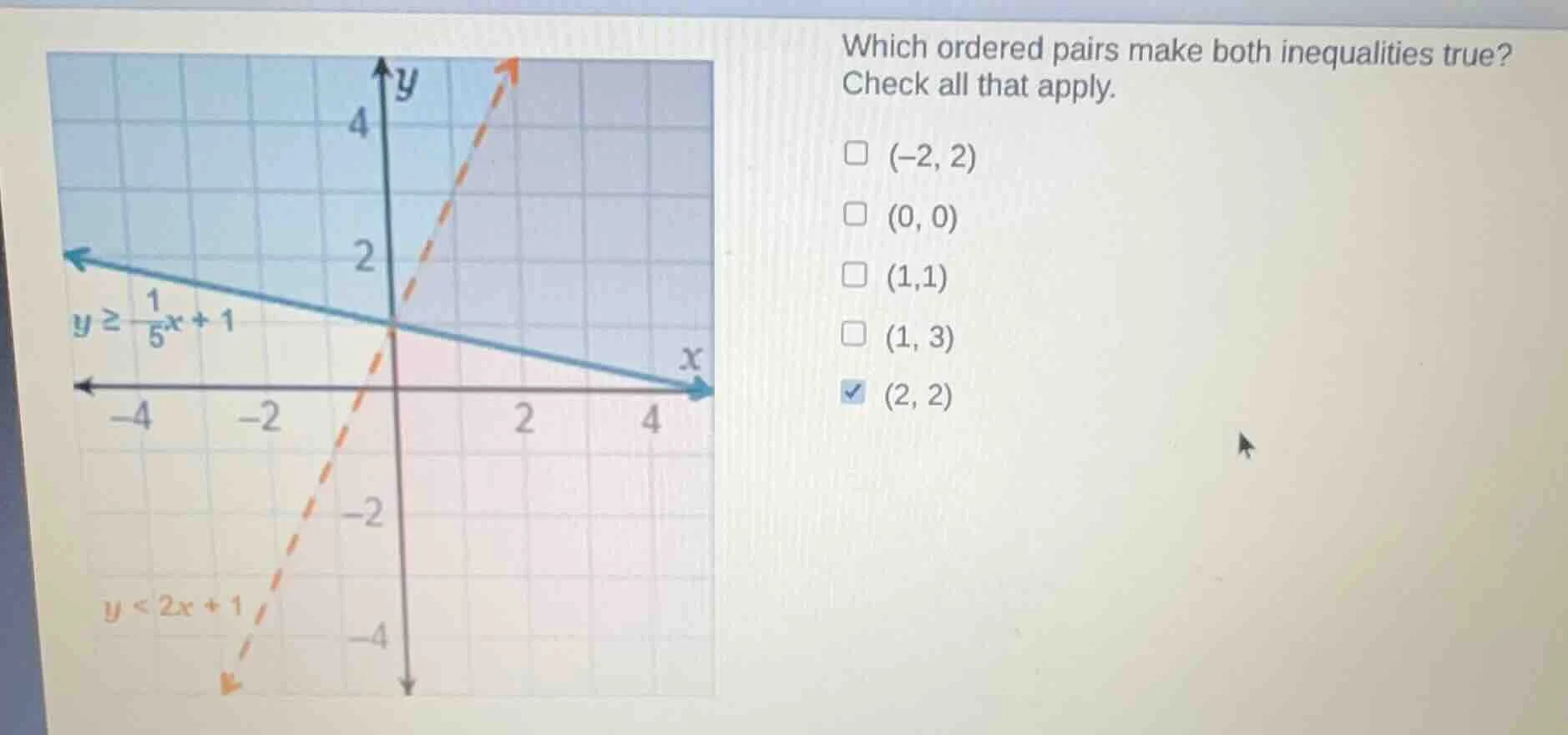
which ordered pairs make both inequalities true? check all that apply. (-2, 2) (0, 0) (1,1) (1, 3) (2, 2) the graph has two inequalities: y ≥ (1/5)x + 1 (blue line) and y < 2x + 1 (dashed orange line).
Step1: Analyze \((-2, 2)\)
Substitute \(x = -2\), \(y = 2\) into \(y\geq\frac{1}{5}x + 1\): \(\frac{1}{5}\times(-2)+1=\frac{-2 + 5}{5}=\frac{3}{5}\), \(2\geq\frac{3}{5}\) (true). Substitute into \(y<2x + 1\): \(2\times(-2)+1=-3\), \(2<-3\) (false). So \((-2,2)\) is out.
Step2: Analyze \((0, 0)\)
Substitute \(x = 0\), \(y = 0\) into \(y\geq\frac{1}{5}x + 1\): \(0\geq1\) (false). So \((0,0)\) is out.
Step3: Analyze \((1, 1)\)
Substitute \(x = 1\), \(y = 1\) into \(y\geq\frac{1}{5}x + 1\): \(\frac{1}{5}\times1+1=\frac{6}{5}=1.2\), \(1\geq1.2\) (false). So \((1,1)\) is out.
Step4: Analyze \((1, 3)\)
Substitute \(x = 1\), \(y = 3\) into \(y<2x + 1\): \(2\times1+1 = 3\), \(3<3\) (false). So \((1,3)\) is out.
Step5: Analyze \((2, 2)\)
Substitute \(x = 2\), \(y = 2\) into \(y\geq\frac{1}{5}x + 1\): \(\frac{1}{5}\times2+1=\frac{2 + 5}{5}=\frac{7}{5}=1.4\), \(2\geq1.4\) (true). Substitute into \(y<2x + 1\): \(2\times2+1 = 5\), \(2<5\) (true). So \((2,2)\) works. Also, let's re - check \((1,3)\) for \(y\geq\frac{1}{5}x + 1\): \(\frac{1}{5}\times1+1 = 1.2\), \(3\geq1.2\) (true), but for \(y<2x + 1\): \(2\times1+1 = 3\), \(3<3\) is false. For \((-2,2)\): \(y\geq\frac{1}{5}x + 1\): \(\frac{1}{5}\times(-2)+1 = 0.6\), \(2\geq0.6\) (true); \(y<2x + 1\): \(2\times(-2)+1=-3\), \(2<-3\) (false). For \((0,0)\): \(y\geq\frac{1}{5}x + 1\): \(0\geq1\) (false). For \((1,1)\): \(y\geq\frac{1}{5}x + 1\): \(1\geq1.2\) (false). Wait, also check \((1,3)\) again? No, but also, is there another? Wait, maybe I missed \((1,3)\) earlier? No, \(y = 3\) and \(2x+1=3\), so \(y<2x + 1\) is \(3<3\) which is false. Wait, but let's check \((2,2)\) again, which we did. Also, let's check \((1,3)\) for \(y\geq\frac{1}{5}x + 1\): \(1/5*1 + 1=6/5 = 1.2\), \(3\geq1.2\) (true). For \(y<2x + 1\): \(2*1+1 = 3\), \(3<3\) is false. Now, let's check \((2,2)\): \(y\geq\frac{1}{5}x + 1\): \(1/5*2+1=7/5 = 1.4\), \(2\geq1.4\) (true); \(y<2x + 1\): \(2*2+1 = 5\), \(2<5\) (true). Also, is there another? Wait, maybe \((1,3)\) was miscalculated? No. Wait, maybe the dashed line for \(y < 2x+1\) means the points on the line are not included. Now, let's check \((2,2)\) is correct. Also, let's check \((1,3)\) again: \(y = 3\), \(2x + 1=3\), so \(y<2x + 1\) is false. Now, what about \((-2,2)\): \(y<2x + 1\) gives \(2<-3\) which is false. \((0,0)\): \(y\geq\frac{1}{5}x + 1\) gives \(0\geq1\) false. \((1,1)\): \(y\geq\frac{1}{5}x + 1\) gives \(1\geq1.2\) false. So only \((2,2)\) and wait, maybe I made a mistake with \((1,3)\)? No, the inequality is \(y < 2x + 1\), so the point \((1,3)\) is on the line \(y = 2x+1\) (since \(x = 1\), \(y=3\) and \(2x + 1=3\)), so it's not included. Now, let's check \((2,2)\) again, which is correct. Also, let's check \((1,3)\) for \(y\geq\frac{1}{5}x + 1\): it's true, but for \(y < 2x+1\) it's false. So the correct ordered pairs are \((2,2)\) and wait, maybe \((1,3)\) is wrong, but let's re - examine the graph. The blue line is \(y\geq\frac{1}{5}x + 1\) (solid line, so points on it are included), the orange line is \(y < 2x+1\) (dashed line, points on it are not included). So for a point to be in the solution set, it must be in the region above the blue line and below the orange line. Let's take \((2,2)\): above blue line (\(y = 2\), blue line at \(x = 2\) is \(y=\frac{1}{5}*2 + 1=1.4\), \(2\geq1.4\)) and below orange line (\(y = 2\), orange line at \(x = 2\) is \(y=2*2 + 1=5\), \(2<5\)). For \((1,3)\): on the orange line, so not included. For \((-2,2)\): above blue line (\(y = 2\), blue line at \(x=-2\) is \(y=\frac{1}{5}*(-2)+1 = 0.6\), \(2\geq0.6\)) bu…

Snap & solve any problem in the app
Get step-by-step solutions on Sovi AI
Photo-based solutions with guided steps
Explore more problems and detailed explanations
(2, 2) (and we can confirm that among the given options, only (2, 2) satisfies both \(y\geq\frac{1}{5}x + 1\) and \(y<2x + 1\))