QUESTION IMAGE
Question
which ordered pair needs to be removed in order for the mapping to represent a function?
\\((-3, -4)\\)
\\((-2, -1)\\)
\\((1, -3)\\)
\\((3, 7)\\)
Identify the input-output relations
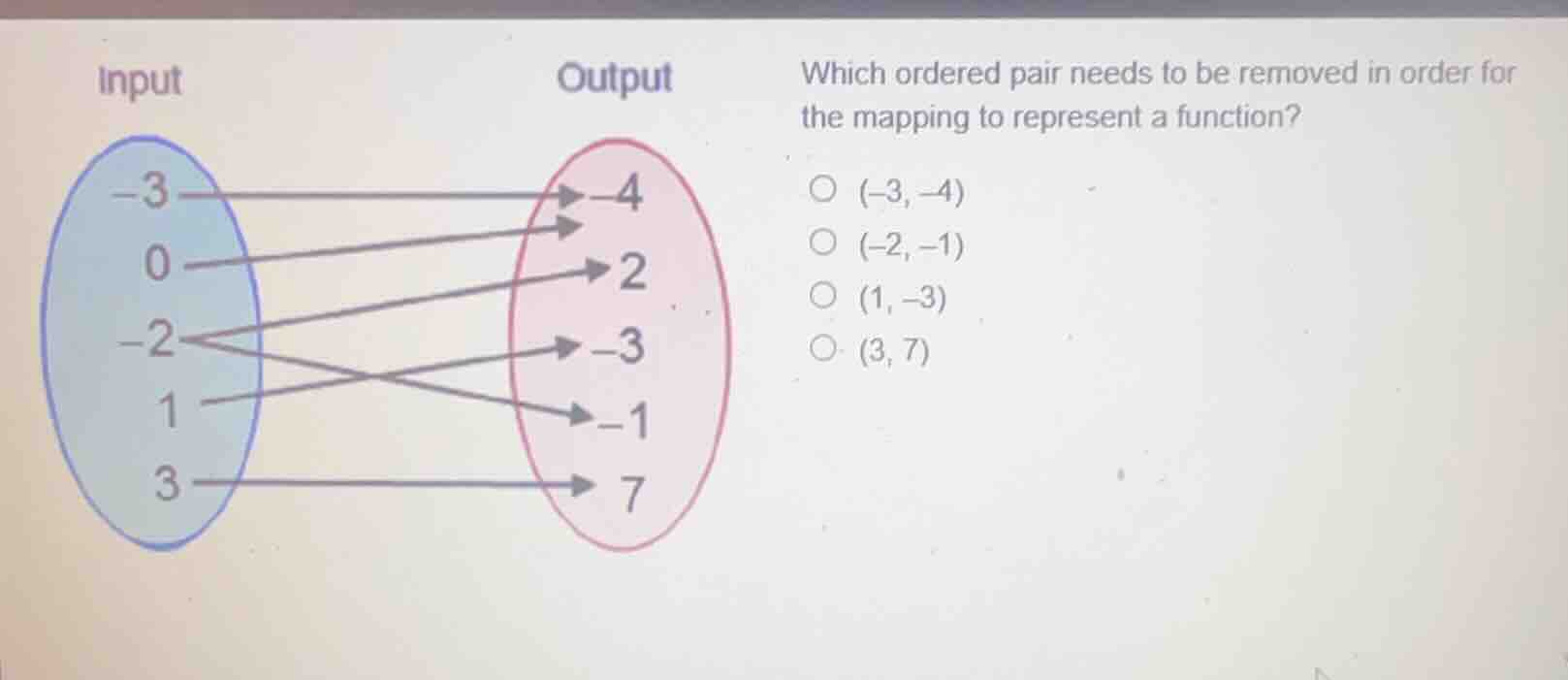
To analyze the mapping diagram, we first list all the ordered pairs \((x, y)\) represented by the arrows pointing from the "Input" set (domain) to the "Output" set (codomain):
- The input \(-3\) maps to \(-4\), giving the ordered pair \((-3, -4)\).
- The input \(0\) maps to \(-4\), giving the ordered pair \((0, -4)\).
- The input \(-2\) maps to \(2\) and \(-1\), giving the ordered pairs \((-2, 2)\) and \((-2, -1)\).
- The input \(1\) maps to \(-3\), giving the ordered pair \((1, -3)\).
- The input \(3\) maps to \(7\), giving the ordered pair \((3, 7)\).
Apply the definition of a function
For a relation to represent a function, each input value in the domain must map to exactly one output value in the range. If a single input maps to multiple different outputs, the relation is not a function.
Locate the violating input
Looking at our list of ordered pairs, we see that the input \(-2\) maps to two different outputs:
- \(-2
ightarrow 2\)
- \(-2
ightarrow -1\)
This violates the definition of a function because the input \(-2\) does not have a unique output.
Determine which pair to remove
To make the mapping a function, we must eliminate the duplicate mapping for the input \(-2\). This means we need to remove either \((-2, 2)\) or \((-2, -1)\).
Looking at the given multiple-choice options:
- \((-3, -4)\)
- \((-2, -1)\)
- \((1, -3)\)
- \((3, 7)\)
The only option that resolves the violation is \((-2, -1)\). Removing this ordered pair leaves \(-2\) mapping only to \(2\), which makes the relation a valid function.

Snap & solve any problem in the app
Get step-by-step solutions on Sovi AI
Photo-based solutions with guided steps
Explore more problems and detailed explanations
- (A) \((-3, -4)\)
- (B) \((-2, -1)\) (Correct answer)
- (C) \((1, -3)\)
- (D) \((3, 7)\)