QUESTION IMAGE
Question
which image is a reflection of the black polygon in quadrant i?
the black polygon in quadrant i
the red polygon in quadrant ii
the blue polygon in quadrant iii
Identify the original figure and its vertices
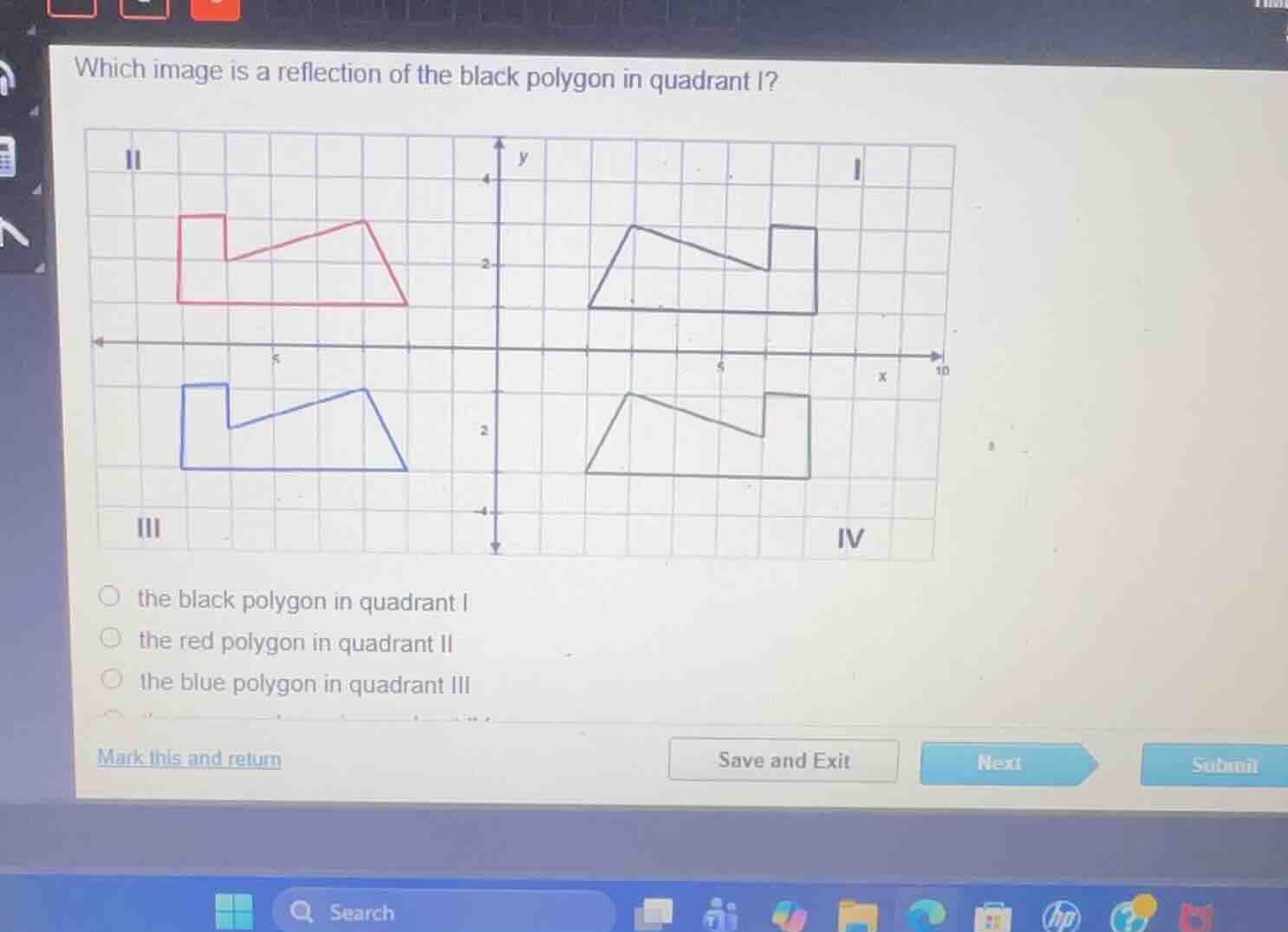
The original figure is the black polygon located in Quadrant I. Let's identify the coordinates of its key vertices from the grid:
- Bottom-left vertex: \((2, 1)\)
- Bottom-right vertex: \((8, 1)\)
- Top-right outer corner: \((8, 3)\)
- Top-right inner corner: \((7, 3)\)
- Top-right inner dip: \((7, 2)\)
- Top-left peak: \((3, 3)\)
Analyze the transformation of the red polygon in Quadrant II
Using the Coordinate Transformations knowledge point, we check the coordinates of the red polygon in Quadrant II:
- Bottom-right vertex: \((-2, 1)\)
- Bottom-left vertex: \((-8, 1)\)
- Top-left outer corner: \((-8, 3)\)
- Top-left inner corner: \((-7, 3)\)
- Top-left inner dip: \((-7, 2)\)
- Top-right peak: \((-3, 3)\)
Comparing these to the original black polygon vertices \((x, y)\), each corresponding vertex is at \((-x, y)\). This represents a reflection across the y-axis.
Analyze the transformation of the blue polygon in Quadrant III
We check the coordinates of the blue polygon in Quadrant III:
- Top-right vertex: \((-2, -1)\)
- Top-left vertex: \((-8, -1)\)
- Bottom-left outer corner: \((-8, -3)\)
- Bottom-left inner corner: \((-7, -3)\)
- Bottom-left inner dip: \((-7, -2)\)
- Bottom-right peak: \((-3, -3)\)
Comparing these to the original black polygon vertices \((x, y)\), each corresponding vertex is at \((-x, -y)\). This represents a rotation of \(180^\circ\) about the origin (or a double reflection across both axes).
Analyze the transformation of the green polygon in Quadrant IV
We check the coordinates of the green polygon in Quadrant IV:
- Top-left vertex: \((2, -1)\)
- Top-right vertex: \((8, -1)\)
- Bottom-right outer corner: \((8, -3)\)
- Bottom-right inner corner: \((7, -3)\)
- Bottom-right inner dip: \((7, -2)\)
- Bottom-left peak: \((3, -3)\)
Comparing these to the original black polygon vertices \((x, y)\), each corresponding vertex is at \((x, -y)\). This represents a reflection across the x-axis.
Determine the correct option
The question asks "Which image is a reflection of the black polygon in quadrant I?".
- The red polygon in quadrant II is a reflection across the y-axis.
- The green polygon in quadrant IV is a reflection across the x-axis.
Looking at the visible multiple-choice options:
- "the black polygon in quadrant I" (Original image)
- "the red polygon in quadrant II" (Valid reflection across the y-axis)
- "the blue polygon in quadrant III" (Rotation, not a single reflection)
The fourth option (partially cut off but representing the green polygon in quadrant IV) is not fully visible, but "the red polygon in quadrant II" is a clearly listed, correct option representing a reflection.

Snap & solve any problem in the app
Get step-by-step solutions on Sovi AI
Photo-based solutions with guided steps
Explore more problems and detailed explanations
- the black polygon in quadrant I
- the red polygon in quadrant II (Correct answer)
- the blue polygon in quadrant III