QUESTION IMAGE
Question
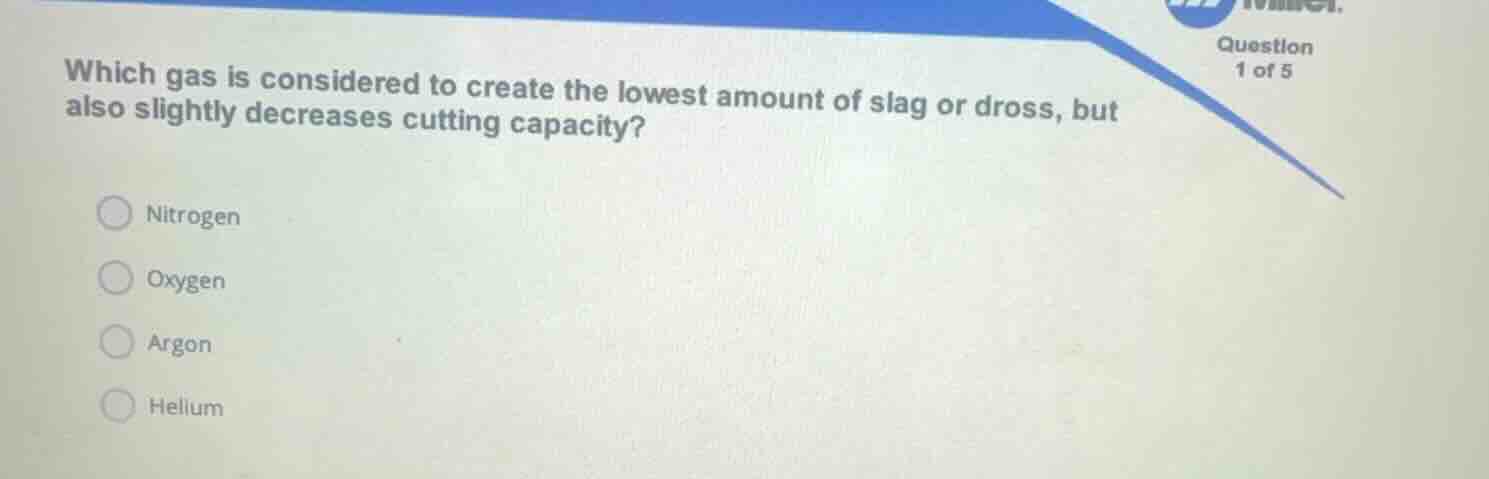
which gas is considered to create the lowest amount of slag or dross, but also slightly decreases cutting capacity?
nitrogen
oxygen
argon
helium
Analyze plasma cutting gas characteristics
In plasma arc cutting, different gases affect the cut quality, dross (slag) formation, and cutting speed/capacity. Nitrogen, oxygen, argon, and helium are common choices, each with distinct thermal and chemical properties.
Evaluate nitrogen gas
Nitrogen provides excellent cut quality and is highly effective for cutting stainless steel and aluminum. It produces very low amounts of dross or slag on these materials, resulting in clean edges, though it can slightly decrease the maximum cutting capacity compared to highly reactive gases like oxygen on carbon steel.
Evaluate oxygen gas
Oxygen is primarily used for cutting carbon steel because it reacts exothermically with the iron, which actually increases cutting speed and capacity. However, it is not associated with decreasing cutting capacity.
Evaluate argon and helium
Argon is very heavy and inert, usually mixed with other gases rather than used alone for primary cutting because of its low energy density. Helium has high thermal conductivity but is expensive and typically used in mixtures to increase speed on thick non-ferrous materials, rather than being characterized by a slight decrease in capacity with minimal dross.
Select the correct option
Nitrogen is the standard gas recognized for producing the cleanest, lowest-dross cuts on non-ferrous metals while offering a slightly lower cutting capacity compared to oxygen-assisted cutting.

Snap & solve any problem in the app
Get step-by-step solutions on Sovi AI
Photo-based solutions with guided steps
Explore more problems and detailed explanations
- Nitrogen (Correct answer)
- Oxygen
- Argon
- Helium