QUESTION IMAGE
Question
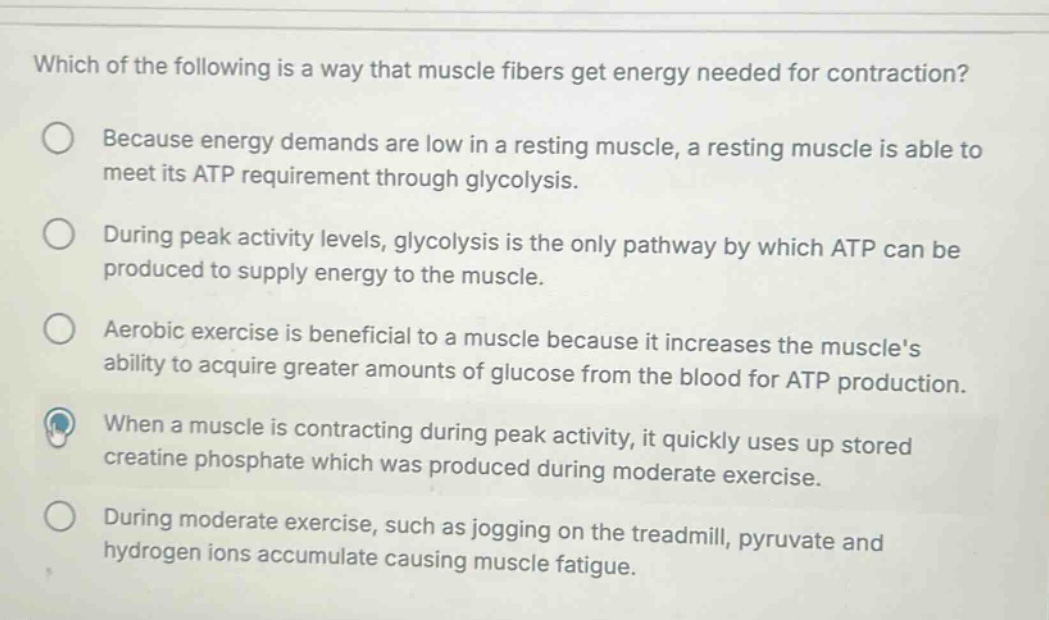
which of the following is a way that muscle fibers get energy needed for contraction?
because energy demands are low in a resting muscle, a resting muscle is able to meet its atp requirement through glycolysis.
during peak activity levels, glycolysis is the only pathway by which atp can be produced to supply energy to the muscle.
aerobic exercise is beneficial to a muscle because it increases the muscles ability to acquire greater amounts of glucose from the blood for atp production.
when a muscle is contracting during peak activity, it quickly uses up stored creatine phosphate which was produced during moderate exercise.
during moderate exercise, such as jogging on the treadmill, pyruvate and hydrogen ions accumulate causing muscle fatigue.
🆕 New Concept Discovered: Muscle Metabolism
How muscles generate ATP during different activity levels.
Step 1: Analyze the energy demands of resting muscle
At rest, muscle fibers have low energy demands and plenty of oxygen available. Instead of relying on glycolysis (which is anaerobic and less efficient), resting muscle fibers produce ATP primarily through aerobic metabolism of fatty acids. Therefore, the first statement is incorrect.
Step 2: Analyze energy production during peak activity
During peak activity, the demand for ATP is extremely high. While glycolysis is a major contributor because it produces ATP rapidly without oxygen, it is not the only pathway. The muscle also utilizes its immediate, short-term reserves of ATP and creatine phosphate (CP). Therefore, the second statement is incorrect.
Step 3: Analyze the effect of aerobic exercise
Aerobic exercise improves muscle performance by increasing cardiovascular efficiency, capillary density, and the number of mitochondria within muscle fibers (enhancing their ability to produce ATP aerobically). It does not primarily function by simply increasing the muscle's ability to "acquire greater amounts of glucose from the blood." Therefore, the third statement is incorrect.
Step 4: Analyze the role of creatine phosphate (CP)
Creatine phosphate is a high-energy molecule stored in muscle fibers. During periods of rest or moderate activity, muscles produce more ATP than they need, and the excess energy is transferred to creatine to build up a reserve of creatine phosphate. When the muscle transitions to peak activity, this stored creatine phosphate is rapidly broken down to quickly regenerate ATP for contraction. This matches the fourth statement.
Step 5: Analyze moderate exercise and fatigue
During moderate exercise, muscles rely on aerobic metabolism. Pyruvate is efficiently broken down in the mitochondria, and hydrogen ions do not accumulate significantly to cause rapid fatigue. Significant accumulation of lactic acid (from pyruvate conversion under anaerobic conditions) and hydrogen ions occurs during intense, anaerobic peak activity, not moderate exercise. Therefore, the fifth statement is incorrect.

Snap & solve any problem in the app
Get step-by-step solutions on Sovi AI
Photo-based solutions with guided steps
Explore more problems and detailed explanations
When a muscle is contracting during peak activity, it quickly uses up stored creatine phosphate which was produced during moderate exercise.