QUESTION IMAGE
Question
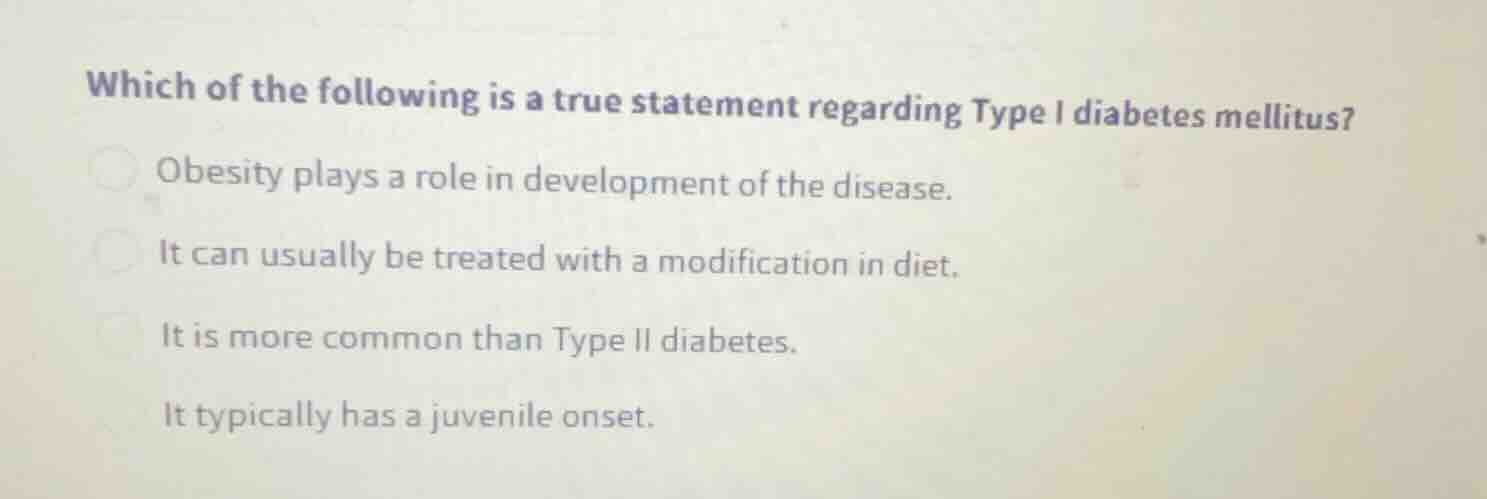
which of the following is a true statement regarding type i diabetes mellitus?
obesity plays a role in development of the disease.
it can usually be treated with a modification in diet.
it is more common than type ii diabetes.
it typically has a juvenile onset.
<pre_analysis>
{
"quality": "clear",
"question_count": 1,
"skills_matched": [
"direct_cot",
"multiple_choice_formatter",
"explain_then_answer",
"tutor",
"mastery_adaptive_brevity"
],
"needs_drawing": false,
"concepts_used": [
"Diabetes Mellitus Epidemiology"
],
"new_concepts": [
"Type I Diabetes Pathophysiology"
],
"current_concepts": [
"Diabetes Mellitus Epidemiology",
"Type I Diabetes Pathophysiology"
]
}
</pre_analysis>
<reasoning>
Analyze Type I diabetes characteristics
Using the Diabetes Mellitus Epidemiology knowledge point
- Type I diabetes mellitus is an autoimmune condition characterized by the destruction of pancreatic beta cells, leading to absolute insulin deficiency.
- It typically presents in children, adolescents, or young adults, which is historically referred to as having a "juvenile onset."
Evaluate the given options
- Obesity plays a role in development of the disease: Incorrect. Obesity is a major risk factor for Type II diabetes, not Type I.
- It can usually be treated with a modification in diet: Incorrect. Because there is an absolute lack of insulin production, patients with Type I diabetes require lifelong exogenous insulin therapy; diet modification alone is insufficient.
- It is more common than Type II diabetes: Incorrect. Type II diabetes accounts for approximately 90-95% of all diabetes cases, making Type I much less common.
- It typically has a juvenile onset: Correct. Type I diabetes most commonly develops and is diagnosed during childhood or adolescence.
</reasoning>
<answer>
<mcq-option>Obesity plays a role in development of the disease.</mcq-option>
<mcq-option>It can usually be treated with a modification in diet.</mcq-option>
<mcq-option>It is more common than Type II diabetes.</mcq-option>
<mcq-correct>It typically has a juvenile onset.</mcq-correct>
</answer>
<post_analysis>
{
"subject": "Natural Science",
"question_type": "Multiple Choice",
"knowledge_point": [
"Natural Science",
"Medicine",
"Type I Diabetes Pathophysiology"
]
}
</post_analysis>
Snap & solve any problem in the app
Get step-by-step solutions on Sovi AI
Photo-based solutions with guided steps
Explore more problems and detailed explanations
<pre_analysis>
{
"quality": "clear",
"question_count": 1,
"skills_matched": [
"direct_cot",
"multiple_choice_formatter",
"explain_then_answer",
"tutor",
"mastery_adaptive_brevity"
],
"needs_drawing": false,
"concepts_used": [
"Diabetes Mellitus Epidemiology"
],
"new_concepts": [
"Type I Diabetes Pathophysiology"
],
"current_concepts": [
"Diabetes Mellitus Epidemiology",
"Type I Diabetes Pathophysiology"
]
}
</pre_analysis>
<reasoning>
Analyze Type I diabetes characteristics
Using the Diabetes Mellitus Epidemiology knowledge point
- Type I diabetes mellitus is an autoimmune condition characterized by the destruction of pancreatic beta cells, leading to absolute insulin deficiency.
- It typically presents in children, adolescents, or young adults, which is historically referred to as having a "juvenile onset."
Evaluate the given options
- Obesity plays a role in development of the disease: Incorrect. Obesity is a major risk factor for Type II diabetes, not Type I.
- It can usually be treated with a modification in diet: Incorrect. Because there is an absolute lack of insulin production, patients with Type I diabetes require lifelong exogenous insulin therapy; diet modification alone is insufficient.
- It is more common than Type II diabetes: Incorrect. Type II diabetes accounts for approximately 90-95% of all diabetes cases, making Type I much less common.
- It typically has a juvenile onset: Correct. Type I diabetes most commonly develops and is diagnosed during childhood or adolescence.
</reasoning>
<answer>
<mcq-option>Obesity plays a role in development of the disease.</mcq-option>
<mcq-option>It can usually be treated with a modification in diet.</mcq-option>
<mcq-option>It is more common than Type II diabetes.</mcq-option>
<mcq-correct>It typically has a juvenile onset.</mcq-correct>
</answer>
<post_analysis>
{
"subject": "Natural Science",
"question_type": "Multiple Choice",
"knowledge_point": [
"Natural Science",
"Medicine",
"Type I Diabetes Pathophysiology"
]
}
</post_analysis>