QUESTION IMAGE
Question
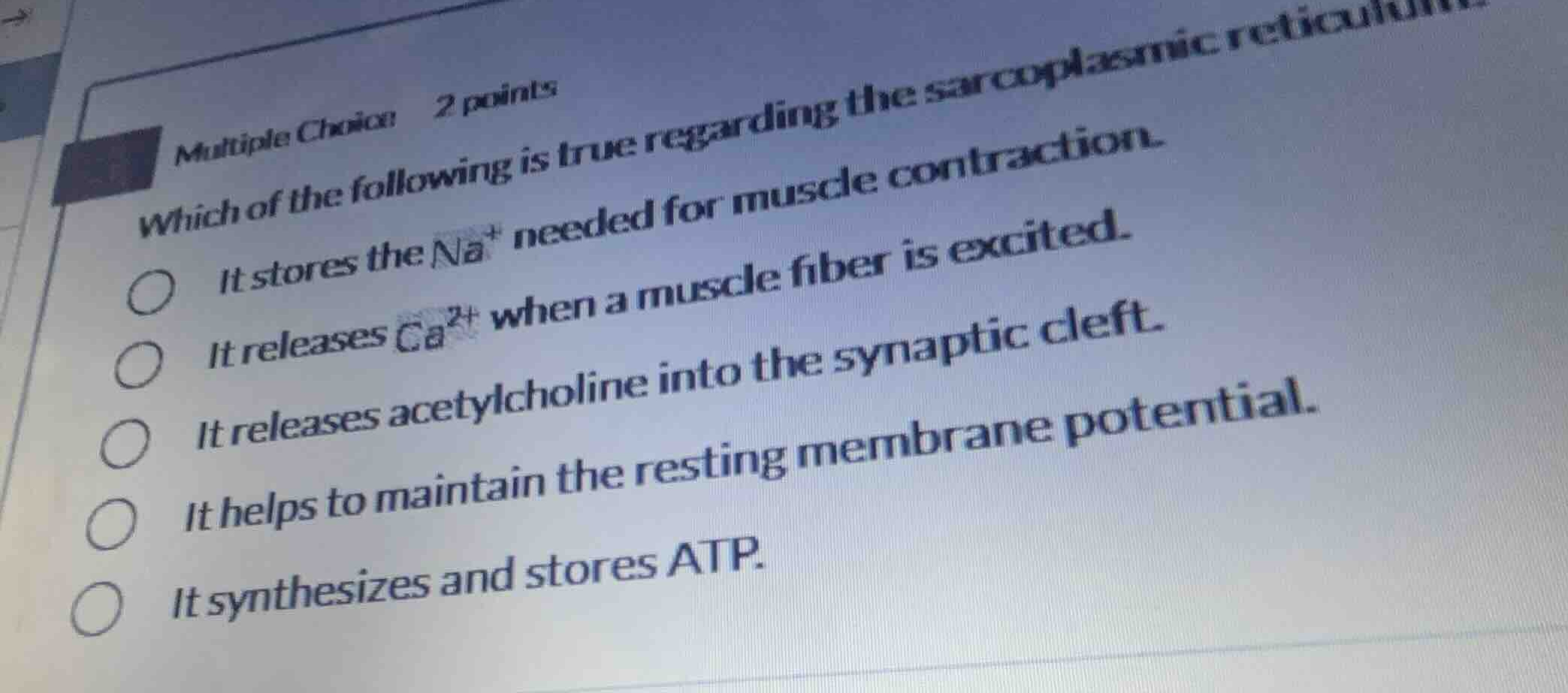
which of the following is true regarding the sarcoplasmic reticulum?
- it stores the \\(\text{na}^+\\) needed for muscle contraction.
- it releases \\(\text{ca}^{2+}\\) when a muscle fiber is excited.
- it releases acetylcholine into the synaptic cleft.
- it helps to maintain the resting membrane potential.
- it synthesizes and stores atp.
Analyze the role of the sarcoplasmic reticulum
The sarcoplasmic reticulum (SR) is a specialized smooth endoplasmic reticulum found in muscle cells. Its primary physiological role is to regulate intracellular calcium ion \(\text{Ca}^{2+}\) concentrations, which is essential for Skeletal Muscle Contraction.
Evaluate each option
- Option 1: "It stores the \(\text{Na}^+\) needed for muscle contraction."
- Incorrect: The SR stores calcium ions \(\text{Ca}^{2+}\), not sodium ions \(\text{Na}^+\).
- Option 2: "It releases \(\text{Ca}^{2+}\) when a muscle fiber is excited."
- Correct: Action potentials traveling down the T-tubules trigger the release of stored \(\text{Ca}^{2+}\) from the SR into the sarcoplasm, initiating contraction.
- Option 3: "It releases acetylcholine into the synaptic cleft."
- Incorrect: Acetylcholine is a neurotransmitter released by the motor neuron axon terminal, not the SR.
- Option 4: "It helps to maintain the resting membrane potential."
- Incorrect: The resting membrane potential is primarily maintained by the sarcolemma's \(\text{Na}^+/\text{K}^+\) ATPase pump and leak channels.
- Option 5: "It synthesizes and stores ATP."
- Incorrect: ATP is synthesized primarily by mitochondria, not the SR.

Snap & solve any problem in the app
Get step-by-step solutions on Sovi AI
Photo-based solutions with guided steps
Explore more problems and detailed explanations
- It stores the \(\text{Na}^+\) needed for muscle contraction.
- It releases \(\text{Ca}^{2+}\) when a muscle fiber is excited. (Correct answer)
- It releases acetylcholine into the synaptic cleft.
- It helps to maintain the resting membrane potential.
- It synthesizes and stores ATP.