QUESTION IMAGE
Question
- which of the following are true about natural selection?
a. a population of organisms of the same species are all alike.
b. organisms possess genetic characteristics that sometimes make no difference on their lives.
c. organisms choose characteristics that help them adapt to their environment.
d. only those organisms that survive the environmental change pass on their traits to the next generation
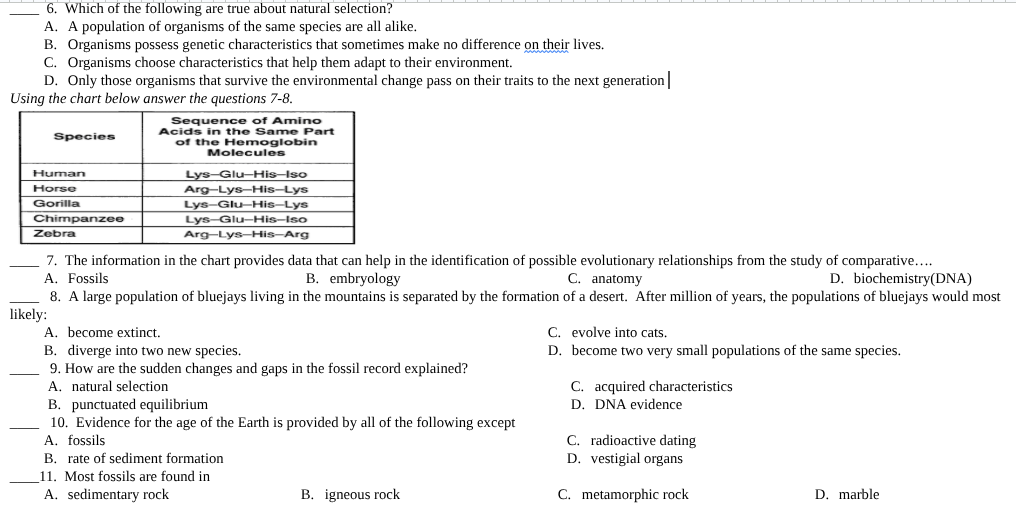
using the chart below answer the questions 7-8.
- the information in the chart provides data that can help in the identification of possible evolutionary relationships from the study of comparative....
a. fossils
b. embryology
c. anatomy
d. biochemistry(dna)
- a large population of bluejays living in the mountains is separated by the formation of a desert. after million of years, the populations of bluejays would most likely:
a. become extinct.
b. diverge into two new species.
c. evolve into cats.
d. become two very small populations of the same species.
- how are the sudden changes and gaps in the fossil record explained?
a. natural selection
b. punctuated equilibrium
c. acquired characteristics
d. dna evidence
- evidence for the age of the earth is provided by all of the following except
a. fossils
b. rate of sediment formation
c. radioactive dating
d. vestigial organs
- most fossils are found in
a. sedimentary rock
b. igneous rock
c. metamorphic rock
d. marble
🆕 New Concept Discovered: Principles of Evolutionary Biology
How populations change, adapt, and split over time
Step 1: Analyze Question 6 (Natural Selection)
Natural selection relies on genetic variation within a population.
- A is incorrect: Individuals in a population are genetically diverse, not all alike.
- B is correct: Organisms possess neutral mutations/genetic traits that do not affect their survival or reproduction (making no difference in their lives).
- C is incorrect: Organisms cannot consciously choose their traits to adapt.
- D is incorrect: Organisms do not have to survive an environmental change to pass on traits; reproduction happens continuously, and many traits are passed on before or regardless of major environmental shifts.
Step 2: Analyze Question 7 (Comparative Studies)
The chart displays sequences of amino acids (the building blocks of proteins, which are coded by DNA). Comparing amino acid or DNA sequences to determine evolutionary relationships is the basis of comparative biochemistry. Therefore, the correct option is D.
Step 3: Analyze Question 8 (Speciation)
When a single population is geographically split by a physical barrier (like a desert) for millions of years, the two groups experience different selective pressures and genetic drift. Over time, they accumulate enough genetic differences that they can no longer interbreed, leading them to diverge into two new species (allopatric speciation). Therefore, the correct option is B.
Step 4: Analyze Question 9 (Fossil Record Gaps)
The theory of punctuated equilibrium proposes that evolutionary history consists of long periods of stasis (little change) interrupted by brief, rapid bursts of speciation, which explains the sudden appearances and gaps in the fossil record. Therefore, the correct option is B.
Step 5: Analyze Question 10 (Age of the Earth Evidence)
- Fossils, sediment formation rates, and radioactive dating of rocks all provide physical clues to determine the age of the Earth or the layers within it.
- Vestigial organs are anatomical remnants that show evolutionary relationships between organisms, but they do not provide evidence for determining the physical age of the Earth. Therefore, the correct option is D.
Step 6: Analyze Question 11 (Fossil Formation)
Fossils are formed when organisms are buried by sediment over time. The heat and pressure required to form igneous or metamorphic rocks (and marble, which is metamorphic) would destroy any organic remains. Thus, most fossils are found in sedimentary rock. Therefore, the correct option is A.

Snap & solve any problem in the app
Get step-by-step solutions on Sovi AI
Photo-based solutions with guided steps
Explore more problems and detailed explanations
- 6. B
- 7. D
- 8. B
- 9. B
- 10. D
- 11. A