QUESTION IMAGE
Question
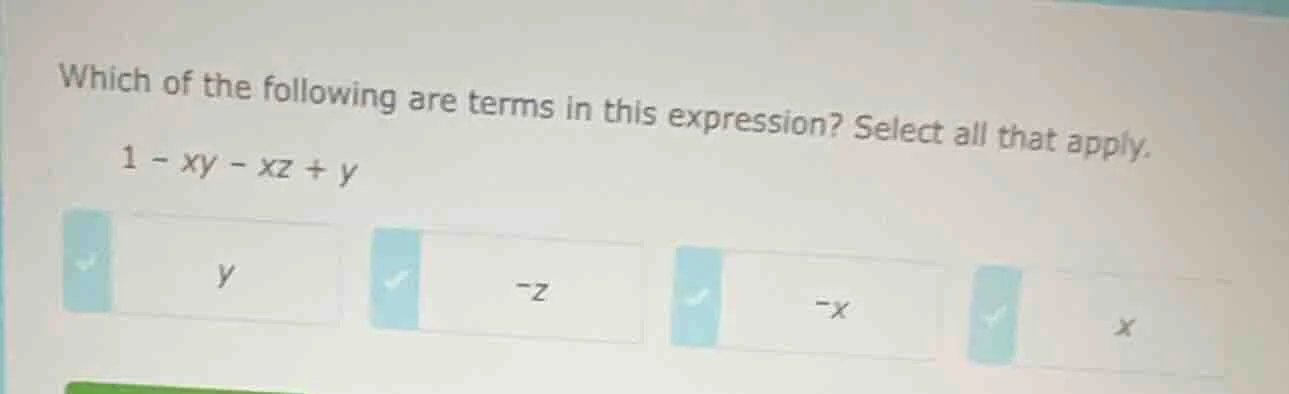
which of the following are terms in this expression? select all that apply.
1 - xy - xz + y
y -z -x x
To determine the terms in the expression \(1 - xy - xz + y\), we first recall that a term in an algebraic expression is a single number, variable, or the product of numbers and variables, separated by addition or subtraction signs. Let's analyze each option:
- Term \(y\): In the expression \(1 - xy - xz + y\), the term \(+y\) (or simply \(y\)) is present as a separate term (it's added at the end). So \(y\) is a term.
- Term \(-z\): Looking at the expression \(1 - xy - xz + y\), there is no term \(-z\). The term with \(z\) is \(-xz\) (which is \(-x \times z\)), not \(-z\) alone. So \(-z\) is not a term.
- Term \(-x\): In the expression \(1 - xy - xz + y\), there is no term \(-x\) by itself. The terms with \(x\) are \(-xy\) and \(-xz\) (which are \(-x \times y\) and \(-x \times z\)), not \(-x\) alone. So \(-x\) is not a term.
- Term \(x\): In the expression \(1 - xy - xz + y\), there is no term \(x\) by itself. The terms with \(x\) are \(-xy\) and \(-xz\) (which are \(-x \times y\) and \(-x \times z\)), not \(x\) alone. So \(x\) is not a term.
Wait, let's re - examine the original expression \(1 - xy - xz + y\) more carefully. Let's list all the terms by breaking the expression at the addition/subtraction signs:
- The first term is \(1\) (a constant term).
- The second term is \(-xy\) (the product of \(-1\), \(x\), and \(y\)).
- The third term is \(-xz\) (the product of \(-1\), \(x\), and \(z\)).
- The fourth term is \(+y\) (or just \(y\)).
Now let's check each of the given options against these terms:
- For \(y\): The fourth term is \(y\), so \(y\) is a term. This is correct.
- For \(-z\): None of the terms (\(1\), \(-xy\), \(-xz\), \(y\)) is \(-z\). The term with \(z\) is \(-xz\), which is different from \(-z\). So \(-z\) is not a term. This was marked incorrectly.
- For \(-x\): None of the terms is \(-x\). The terms with \(x\) are \(-xy\) and \(-xz\), which are products involving \(x\), not just \(-x\). So \(-x\) is not a term. This was marked incorrectly.
- For \(x\): None of the terms is \(x\) by itself. The terms with \(x\) are \(-xy\) and \(-xz\), so \(x\) is not a term. This was marked incorrectly.
So the only correct term among the given options is \(y\). The other options (\(-z\), \(-x\), \(x\)) are not terms in the expression \(1 - xy - xz + y\).
Final Answer
The only correct term is \(y\), so the correct option is \(y\) (the box next to \(y\) should be checked, and the boxes next to \(-z\), \(-x\), and \(x\) should be unchecked).

Snap & solve any problem in the app
Get step-by-step solutions on Sovi AI
Photo-based solutions with guided steps
Explore more problems and detailed explanations
To determine the terms in the expression \(1 - xy - xz + y\), we first recall that a term in an algebraic expression is a single number, variable, or the product of numbers and variables, separated by addition or subtraction signs. Let's analyze each option:
- Term \(y\): In the expression \(1 - xy - xz + y\), the term \(+y\) (or simply \(y\)) is present as a separate term (it's added at the end). So \(y\) is a term.
- Term \(-z\): Looking at the expression \(1 - xy - xz + y\), there is no term \(-z\). The term with \(z\) is \(-xz\) (which is \(-x \times z\)), not \(-z\) alone. So \(-z\) is not a term.
- Term \(-x\): In the expression \(1 - xy - xz + y\), there is no term \(-x\) by itself. The terms with \(x\) are \(-xy\) and \(-xz\) (which are \(-x \times y\) and \(-x \times z\)), not \(-x\) alone. So \(-x\) is not a term.
- Term \(x\): In the expression \(1 - xy - xz + y\), there is no term \(x\) by itself. The terms with \(x\) are \(-xy\) and \(-xz\) (which are \(-x \times y\) and \(-x \times z\)), not \(x\) alone. So \(x\) is not a term.
Wait, let's re - examine the original expression \(1 - xy - xz + y\) more carefully. Let's list all the terms by breaking the expression at the addition/subtraction signs:
- The first term is \(1\) (a constant term).
- The second term is \(-xy\) (the product of \(-1\), \(x\), and \(y\)).
- The third term is \(-xz\) (the product of \(-1\), \(x\), and \(z\)).
- The fourth term is \(+y\) (or just \(y\)).
Now let's check each of the given options against these terms:
- For \(y\): The fourth term is \(y\), so \(y\) is a term. This is correct.
- For \(-z\): None of the terms (\(1\), \(-xy\), \(-xz\), \(y\)) is \(-z\). The term with \(z\) is \(-xz\), which is different from \(-z\). So \(-z\) is not a term. This was marked incorrectly.
- For \(-x\): None of the terms is \(-x\). The terms with \(x\) are \(-xy\) and \(-xz\), which are products involving \(x\), not just \(-x\). So \(-x\) is not a term. This was marked incorrectly.
- For \(x\): None of the terms is \(x\) by itself. The terms with \(x\) are \(-xy\) and \(-xz\), so \(x\) is not a term. This was marked incorrectly.
So the only correct term among the given options is \(y\). The other options (\(-z\), \(-x\), \(x\)) are not terms in the expression \(1 - xy - xz + y\).
Final Answer
The only correct term is \(y\), so the correct option is \(y\) (the box next to \(y\) should be checked, and the boxes next to \(-z\), \(-x\), and \(x\) should be unchecked).