QUESTION IMAGE
Question
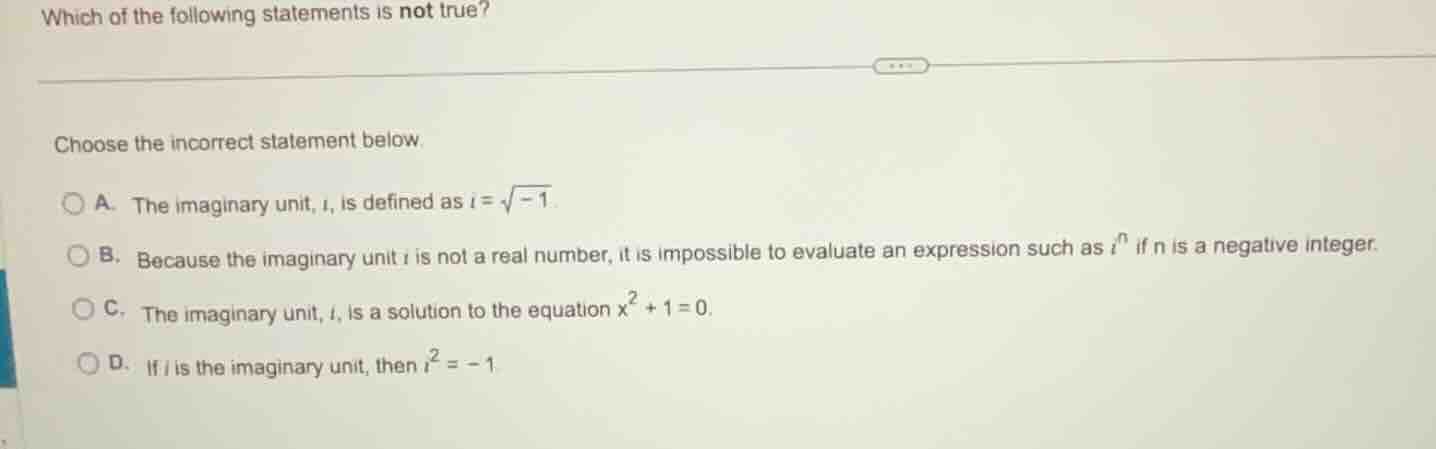
which of the following statements is not true?
choose the incorrect statement below.
a. the imaginary unit, \\(i\\), is defined as \\(i = \sqrt{-1}\\).
b. because the imaginary unit \\(i\\) is not a real number, it is impossible to evaluate an expression such as \\(i^n\\) if \\(n\\) is a negative integer.
c. the imaginary unit, \\(i\\), is a solution to the equation \\(x^2 + 1 = 0\\).
d. if \\(i\\) is the imaginary unit, then \\(i^2 = -1\\).
Analyze definition of imaginary unit
Using the Imaginary Unit knowledge point
This confirms that statement A and statement D are mathematically true.
Evaluate solution to quadratic equation
Using the Imaginary Unit knowledge point
Thus, \(i\) is indeed a solution, which makes statement C true.
Analyze negative integer powers of i
Using the Powers of i knowledge point
Since \(i^n\) is always non-zero (\(\pm 1\) or \(\pm i\)), negative powers are always evaluable. Thus, statement B is false.

Snap & solve any problem in the app
Get step-by-step solutions on Sovi AI
Photo-based solutions with guided steps
Explore more problems and detailed explanations
- A. The imaginary unit, \(i\), is defined as \(i = \sqrt{-1}\).
- B. Because the imaginary unit \(i\) is not a real number, it is impossible to evaluate an expression such as \(i^n\) if \(n\) is a negative integer. (Correct answer)
- C. The imaginary unit, \(i\), is a solution to the equation \(x^2 + 1 = 0\).
- D. If \(i\) is the imaginary unit, then \(i^2 = -1\).