QUESTION IMAGE
Question
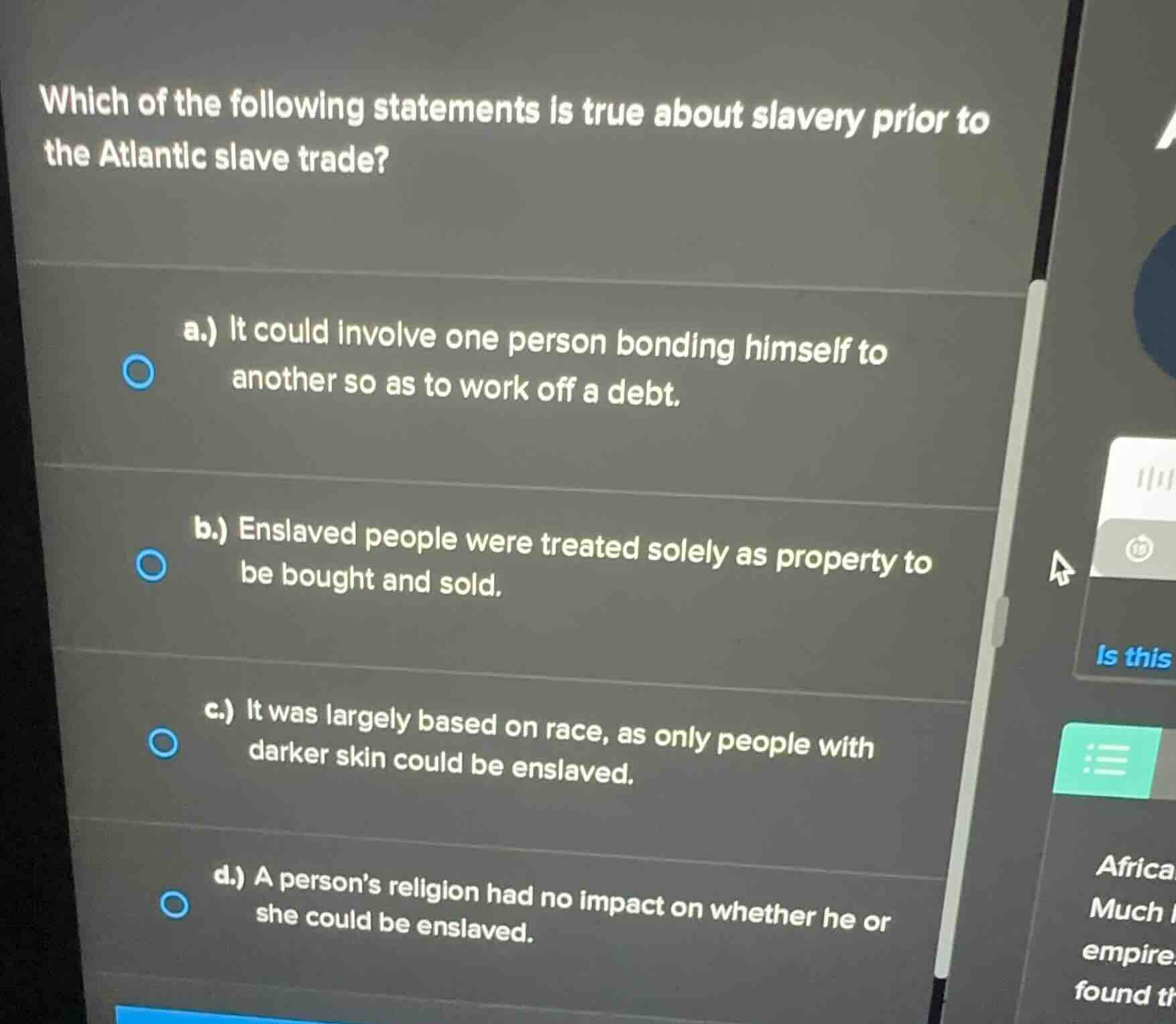
which of the following statements is true about slavery prior to the atlantic slave trade?
a.) it could involve one person bonding himself to another so as to work off a debt.
b.) enslaved people were treated solely as property to be bought and sold.
c.) it was largely based on race, as only people with darker skin could be enslaved.
d.) a persons religion had no impact on whether he or she could be enslaved.
Analyze the historical context of slavery
Prior to the transatlantic slave trade, slavery existed in many societies worldwide, including Africa, Europe, Asia, and the Americas. Unlike the racialized chattel slavery that developed during European Colonization of the Americas, ancient and pre-colonial forms of servitude were highly diverse and often not based on race or permanent, inheritable property status.
Evaluate option (a)
In many ancient and pre-colonial societies, individuals could enter servitude voluntarily or semi-voluntarily to pay off a debt, a system known as debt bondage or pawnship. This aligns with the statement that it could involve one person bonding himself to another to work off a debt.
Evaluate option (b)
The treatment of enslaved people solely as chattel (property to be bought and sold with no human rights) became the defining characteristic of the transatlantic slave trade. Prior to this, many systems of slavery allowed enslaved individuals certain legal rights, social mobility, or paths to integration into the owner's family or community.
Evaluate option (c)
Slavery prior to the Atlantic slave trade was not largely based on race. In antiquity and the Middle Ages, people of all races and ethnicities were enslaved, typically as a result of warfare, conquest, debt, or judicial punishment.
Evaluate option (d)
Religion often played a significant role in who could be enslaved. For example, in both Islamic and Christian societies during the Middle Ages, there were religious laws and customs prohibiting the enslavement of co-religionists, meaning a person's religion directly impacted their susceptibility to enslavement.

Snap & solve any problem in the app
Get step-by-step solutions on Sovi AI
Photo-based solutions with guided steps
Explore more problems and detailed explanations
- a.) It could involve one person bonding himself to another so as to work off a debt. (Correct answer)
- b.) Enslaved people were treated solely as property to be bought and sold.
- c.) It was largely based on race, as only people with darker skin could be enslaved.
- d.) A person's religion had no impact on whether he or she could be enslaved.