QUESTION IMAGE
Question
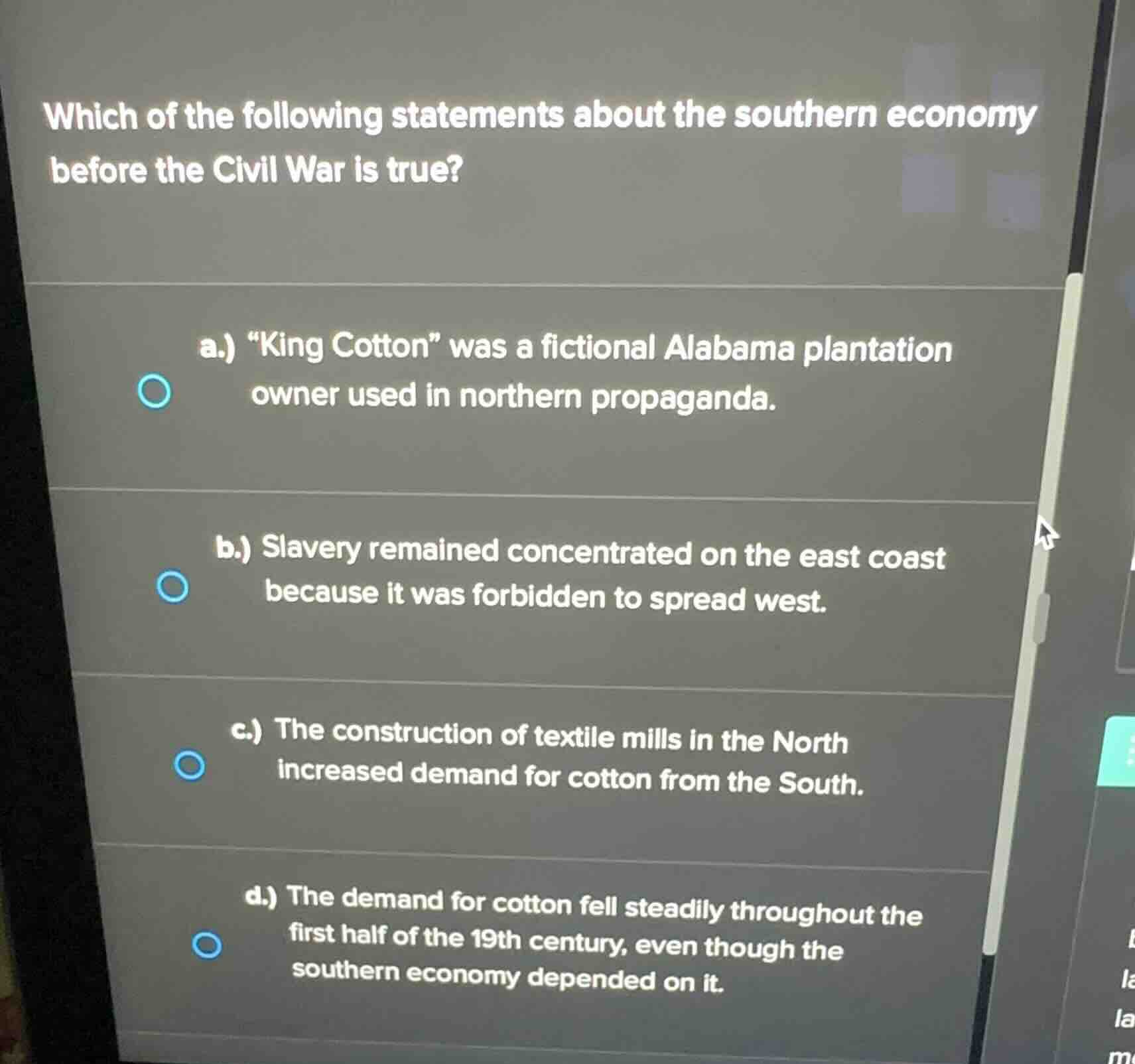
which of the following statements about the southern economy before the civil war is true?
a.) \king cotton\ was a fictional alabama plantation owner used in northern propaganda.
b.) slavery remained concentrated on the east coast because it was forbidden to spread west.
c.) the construction of textile mills in the north increased demand for cotton from the south.
d.) the demand for cotton fell steadily throughout the first half of the 19th century, even though the southern economy depended on it.
Analyze the historical context of the antebellum Southern economy
The question asks which statement about the Southern economy before the Civil War (antebellum period) is true. During this era, the Southern economy was heavily dominated by agriculture, particularly the production of short-staple cotton. This agricultural system relied extensively on the labor of enslaved people.
Evaluate option (a)
Option (a) states that "King Cotton" was a fictional Alabama plantation owner used in northern propaganda. This is historically incorrect. "King Cotton" was a popular slogan and conceptual phrase used by Southern politicians and authors to illustrate the economic dominance of the Southern cotton industry and its crucial role in global trade, particularly with Great Britain.
Evaluate option (b)
Option (b) states that slavery remained concentrated on the east coast because it was forbidden to spread west. This is historically incorrect. The domestic slave trade and the expansion of cotton cultivation led to a massive forced migration of enslaved people from the Upper South and East Coast to the Deep South and western territories (such as Alabama, Mississippi, Louisiana, and Texas).
Evaluate option (c)
Option (c) states that the construction of textile mills in the North increased demand for cotton from the South. This statement is historically accurate. The Market Revolution and 19th Century Industrialization in the Northeast led to the rapid growth of textile manufacturing. Northern mills (such as those in Lowell, Massachusetts) required vast quantities of raw cotton, which directly fueled the expansion of cotton cultivation and the reliance on enslaved labor in the South.
Evaluate option (d)
Option (d) states that the demand for cotton fell steadily throughout the first half of the 19th century. This is historically incorrect. Global and domestic demand for cotton grew exponentially during this period due to the Industrial Revolution in both New England and Great Britain.

Snap & solve any problem in the app
Get step-by-step solutions on Sovi AI
Photo-based solutions with guided steps
Explore more problems and detailed explanations
- a.) "King Cotton" was a fictional Alabama plantation owner used in northern propaganda.
- b.) Slavery remained concentrated on the east coast because it was forbidden to spread west.
- c.) The construction of textile mills in the North increased demand for cotton from the South. (Correct answer)
- d.) The demand for cotton fell steadily throughout the first half of the 19th century, even though the southern economy depended on it.