QUESTION IMAGE
Question
which of the following was a short-term outcome of president johnsons attempts to end racial segregation?
- the successful integration of all public schools in the u.s. by the end of the 1960s
- an inflammation of racial tensions resulting in several race riots in cities
- the end of democratic control of the presidency in the election of 1964
- a dramatic increase in the accessibility of college to both women and african americans
🆕 New Concept Discovered: Civil Rights Movement and Legislative Outcomes
How federal laws and social changes interacted in the 1960s
Step 1: Analyze the Historical Context
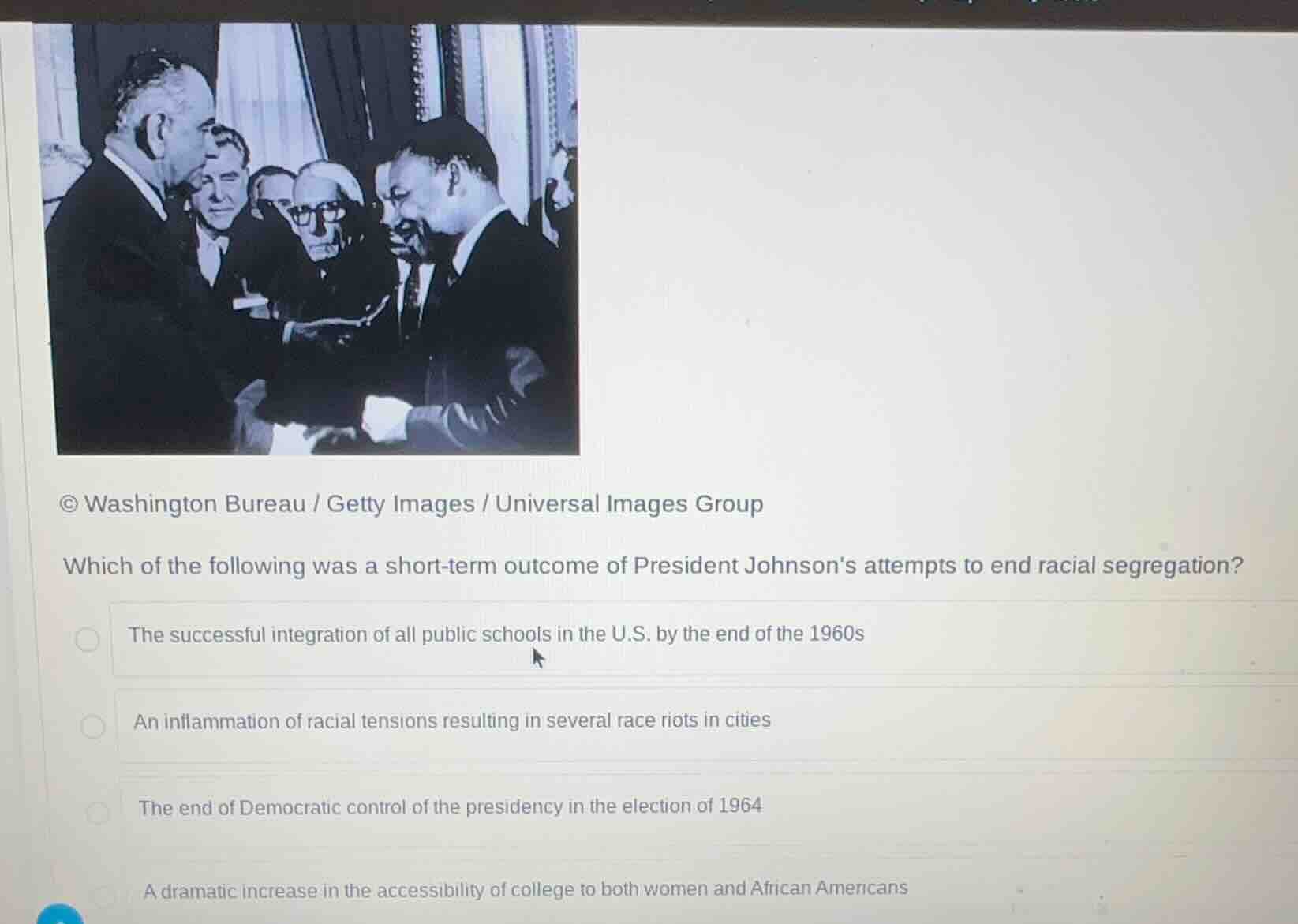
The image shows President Lyndon B. Johnson shaking hands with Dr. Martin Luther King Jr. during the signing of the Civil Rights Act of 1964. This landmark legislation aimed to end segregation in public places and ban employment discrimination on the basis of race, color, religion, sex, or national origin.
Step 2: Evaluate the Options
- Option 1: "The successful integration of all public schools in the U.S. by the end of the 1960s"
- Analysis: School integration was a slow, highly contested process that took decades following the 1954 Brown v. Board of Education decision. Many schools remained de facto segregated well past the 1960s.
- Option 2: "An inflammation of racial tensions resulting in several race riots in cities"
- Analysis: Despite the passage of civil rights legislation, deep-seated economic inequality, police brutality, and systemic racism persisted, particularly in urban areas outside the South. This frustration led to a series of major urban uprisings (often called race riots) in the mid-to-late 1960s (such as in Watts in 1965, Newark, and Detroit in 1967). This was a direct, short-term societal reaction and outcome during this period of rapid legislative change.
- Option 3: "The end of Democratic control of the presidency in the election of 1964"
- Analysis: President Johnson (a Democrat) won the 1964 presidential election in a massive landslide victory against Republican Barry Goldwater.
- Option 4: "A dramatic increase in the accessibility of college to both women and African Americans"
- Analysis: While higher education access did improve over the long term due to the Higher Education Act of 1965 and Title IX (1972), this was not the primary short-term societal outcome directly associated with the immediate push to end racial segregation shown here.
Step 3: Identify the Correct Short-Term Outcome
The passage of civil rights laws did not immediately solve systemic issues, and the friction between rapid legislative changes and ongoing societal discrimination led to heightened racial tensions and significant civil unrest in many American cities during the mid-to-late 1960s.

Snap & solve any problem in the app
Get step-by-step solutions on Sovi AI
Photo-based solutions with guided steps
Explore more problems and detailed explanations
An inflammation of racial tensions resulting in several race riots in cities