QUESTION IMAGE
Question
which of the following shifts would be considered an increase in demand?
a to b
\\(d_2\\) to \\(d_1\\)
\\(d_1\\) to \\(d_2\\)
\\(d_2\\) to s
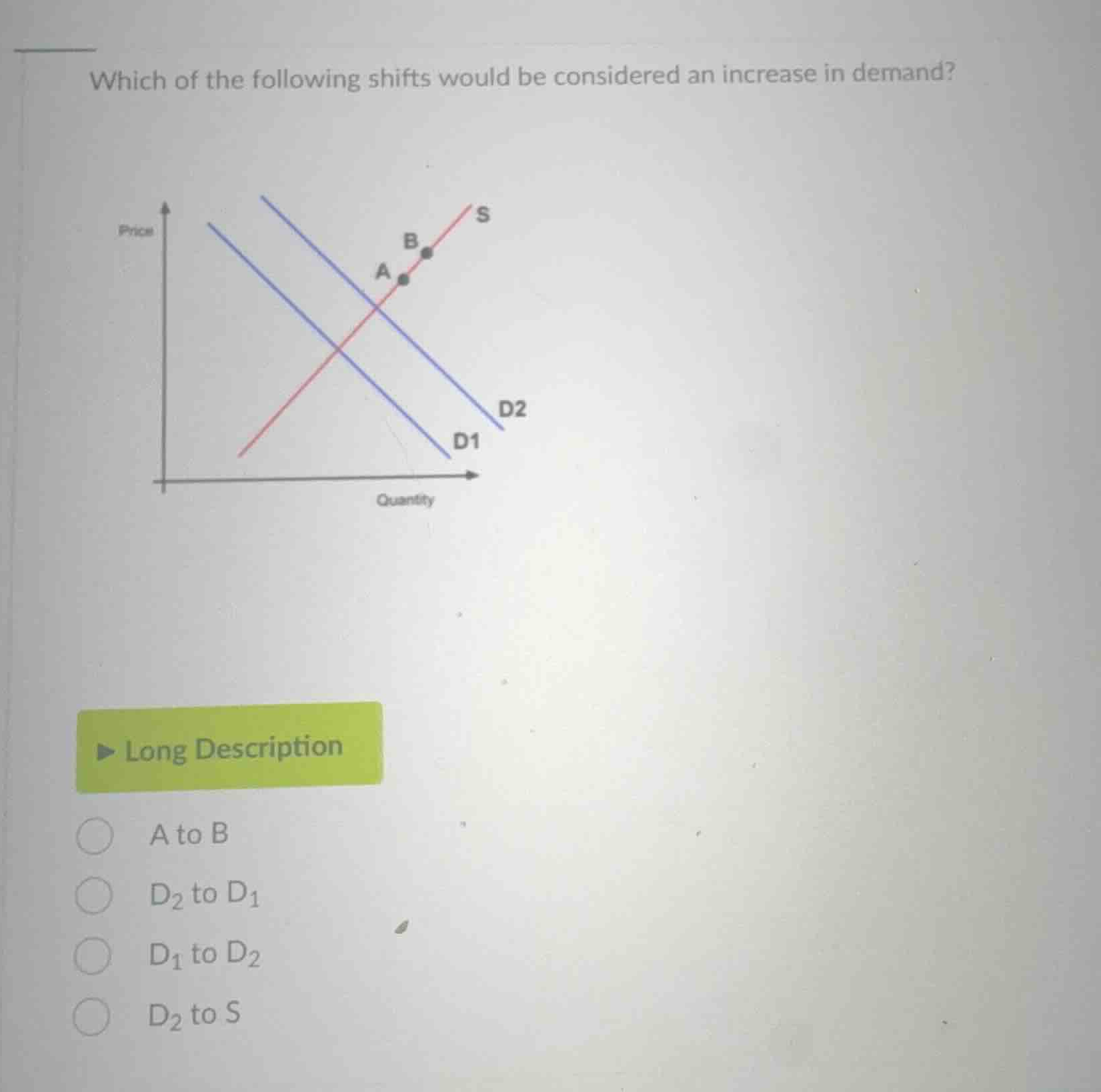
Identify the demand curves
Using the Law of Demand knowledge point, demand curves slope downward from left to right, representing the inverse relationship between price and quantity demanded. In the provided graph, the two downward-sloping blue lines labeled \(D_1\) and \(D_2\) are the demand curves.
Define an increase in demand
An increase in demand represents a greater quantity demanded at every price level. Graphically, this is represented by a rightward (or outward) shift of the entire demand curve, moving away from the origin.
Analyze the shifts
- Moving from \(D_1\) to \(D_2\) shifts the demand curve to the right, which represents an increase in demand.
- Moving from \(D_2\) to \(D_1\) shifts the demand curve to the left, representing a decrease in demand.
- Moving from \(A\) to \(B\) represents a movement along the supply curve \(S\), which is a change in quantity supplied, not a shift in demand.
- Moving from \(D_2\) to \(S\) is a comparison between a demand curve and a supply curve, not a standard shift.

Snap & solve any problem in the app
Get step-by-step solutions on Sovi AI
Photo-based solutions with guided steps
Explore more problems and detailed explanations
- (A) A to B
- (B) \(D_2\) to \(D_1\)
- (C) \(D_1\) to \(D_2\) (Correct answer)
- (D) \(D_2\) to S