QUESTION IMAGE
Question
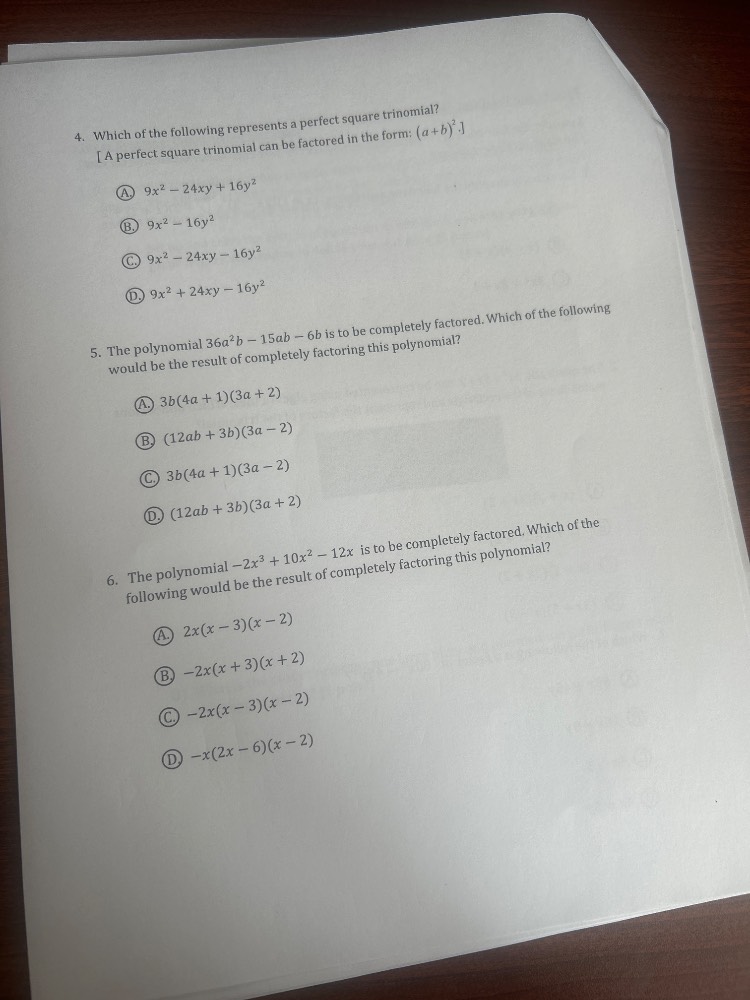
- which of the following represents a perfect square trinomial?
a perfect square trinomial can be factored in the form: ((a + b)^2)
a (9x^2 - 24xy + 16y^2)
b (9x^2 - 16y^2)
c (9x^2 - 24xy - 16y^2)
d (9x^2 + 24xy - 16y^2)
- the polynomial (36a^2b - 15ab - 6b) is to be completely factored. which of the following would be the result of completely factoring this polynomial?
a (3b(4a + 1)(3a + 2))
b ((12ab + 3b)(3a - 2))
c (3b(4a + 1)(3a - 2))
d ((12ab + 3b)(3a + 2))
- the polynomial (-2x^3 + 10x^2 - 12x) is to be completely factored. which of the following would be the result of completely factoring this polynomial?
a (2x(x - 3)(x - 2))
b (-2x(x + 3)(x + 2))
c (-2x(x - 3)(x - 2))
d (-x(2x - 6)(x - 2))
Question 4
Step1: Recall perfect square trinomial form
A perfect square trinomial is of the form \((a - b)^2=a^2 - 2ab + b^2\) or \((a + b)^2=a^2+2ab + b^2\). Let's analyze each option.
Step2: Analyze Option A
For \(9x^{2}-24xy + 16y^{2}\), we can write \(9x^{2}=(3x)^{2}\) and \(16y^{2}=(4y)^{2}\). Now, check the middle term: \(2\times3x\times4y = 24xy\). Since the middle term is \(- 24xy\), we have \((3x - 4y)^{2}=(3x)^{2}-2\times3x\times4y+(4y)^{2}=9x^{2}-24xy + 16y^{2}\). So this is a perfect square trinomial.
Step3: Analyze Option B
\(9x^{2}-16y^{2}\) is a difference of squares (\((3x)^{2}-(4y)^{2}\)) and not a trinomial, so it's not a perfect square trinomial.
Step4: Analyze Option C
For \(9x^{2}-24xy-16y^{2}\), the last term is negative. In a perfect square trinomial, the last term (the square term) should be positive (since it's a square of a real number), so this can't be a perfect square trinomial.
Step5: Analyze Option D
For \(9x^{2}+24xy - 16y^{2}\), the last term is negative. In a perfect square trinomial, the last term (the square term) should be positive (since it's a square of a real number), so this can't be a perfect square trinomial.
Step1: Factor out the greatest common factor (GCF)
First, find the GCF of \(36a^{2}b\), \(-15ab\) and \(-6b\). The GCF of the coefficients \(36\), \(- 15\) and \(-6\) is \(3\), and the GCF of the variables is \(b\). So factor out \(3b\):
\(36a^{2}b-15ab - 6b=3b(12a^{2}-5a - 2)\)
Step2: Factor the quadratic \(12a^{2}-5a - 2\)
We need to find two numbers that multiply to \(12\times(-2)=-24\) and add up to \(-5\). The numbers are \(-8\) and \(3\).
Rewrite the middle term: \(12a^{2}-8a+3a - 2\)
Group the terms: \((12a^{2}-8a)+(3a - 2)=4a(3a - 2)+1(3a - 2)=(4a + 1)(3a - 2)\)
Step3: Combine the factors
Putting it all together, \(36a^{2}b-15ab - 6b=3b(4a + 1)(3a - 2)\)
Step1: Factor out the greatest common factor (GCF)
First, find the GCF of \(-2x^{3}\), \(10x^{2}\) and \(-12x\). The GCF of the coefficients \(-2\), \(10\) and \(-12\) is \(-2\), and the GCF of the variables is \(x\). So factor out \(-2x\):
\(-2x^{3}+10x^{2}-12x=-2x(x^{2}-5x + 6)\)
Step2: Factor the quadratic \(x^{2}-5x + 6\)
We need to find two numbers that multiply to \(6\) and add up to \(-5\). The numbers are \(-3\) and \(-2\).
So \(x^{2}-5x + 6=(x - 3)(x - 2)\)
Step3: Combine the factors
Putting it all together, \(-2x^{3}+10x^{2}-12x=-2x(x - 3)(x - 2)\)

Snap & solve any problem in the app
Get step-by-step solutions on Sovi AI
Photo-based solutions with guided steps
Explore more problems and detailed explanations
A. \(9x^{2}-24xy + 16y^{2}\)