QUESTION IMAGE
Question
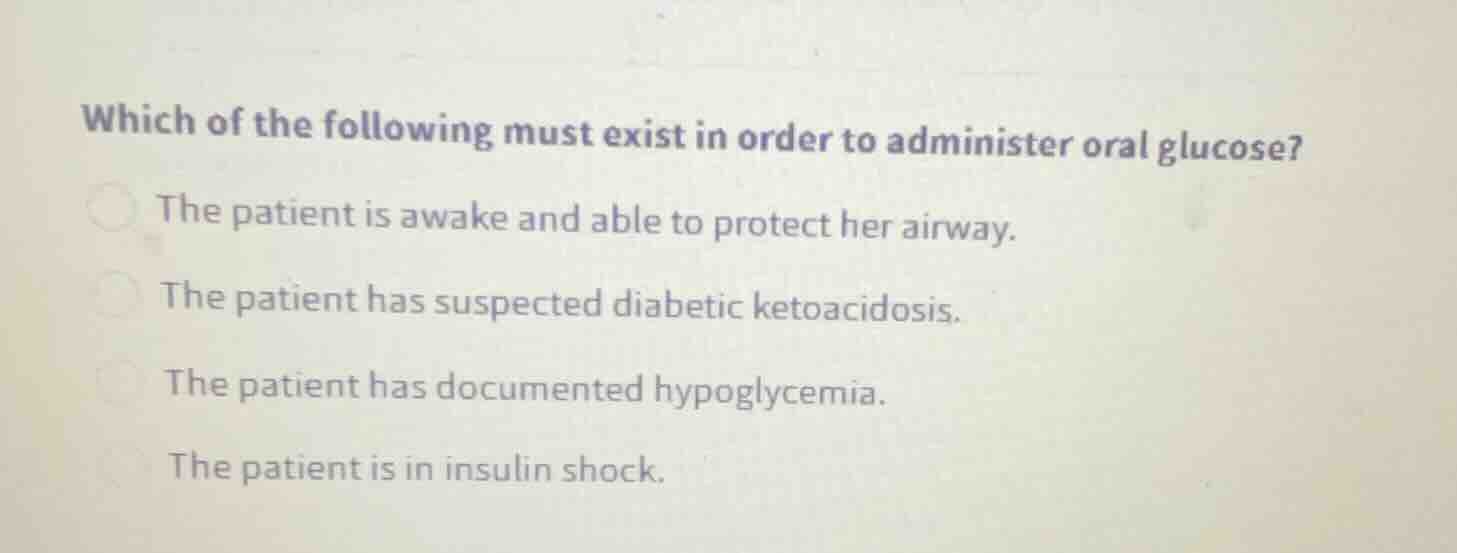
which of the following must exist in order to administer oral glucose?
the patient is awake and able to protect her airway.
the patient has suspected diabetic ketoacidosis.
the patient has documented hypoglycemia.
the patient is in insulin shock.
<pre_analysis>
{
"quality": "clear",
"question_count": 1,
"skills_matched": [
"direct_cot",
"multiple_choice_formatter",
"explain_then_answer",
"tutor",
"mastery_adaptive_brevity"
],
"needs_drawing": false,
"concepts_used": [
"Oral Glucose Contraindications"
],
"new_concepts": [
"Oral Glucose Indications"
],
"current_concepts": [
"Oral Glucose Contraindications",
"Oral Glucose Indications"
]
}
</pre_analysis>
<reasoning>
Identify the primary requirement for oral administration
Using the Oral Glucose Contraindications knowledge point
- Oral glucose is administered by mouth and must be swallowed by the patient.
- To prevent aspiration, the patient must be conscious, cooperative, and able to swallow and protect their airway.
- If a patient has an altered mental status and cannot protect their airway, oral glucose is strictly contraindicated.
Evaluate the remaining options
- Diabetic ketoacidosis is a hyperglycemic emergency where administering glucose is not indicated.
- While documented hypoglycemia or suspected insulin shock are indications, they cannot be treated orally if the patient is unconscious or unable to swallow.
- Therefore, the absolute prerequisite that must exist is that the patient is awake and able to protect their airway.
</reasoning>
<answer>
<mcq-correct>The patient is awake and able to protect her airway.</mcq-correct>
<mcq-option>The patient has suspected diabetic ketoacidosis.</mcq-option>
<mcq-option>The patient has documented hypoglycemia.</mcq-option>
<mcq-option>The patient is in insulin shock.</mcq-option>
</answer>
<post_analysis>
{
"subject": "Natural Science",
"question_type": "Multiple Choice",
"knowledge_point": [
"Natural Science",
"Medicine",
"Emergency Medical Services"
]
}
</post_analysis>
Snap & solve any problem in the app
Get step-by-step solutions on Sovi AI
Photo-based solutions with guided steps
Explore more problems and detailed explanations
<pre_analysis>
{
"quality": "clear",
"question_count": 1,
"skills_matched": [
"direct_cot",
"multiple_choice_formatter",
"explain_then_answer",
"tutor",
"mastery_adaptive_brevity"
],
"needs_drawing": false,
"concepts_used": [
"Oral Glucose Contraindications"
],
"new_concepts": [
"Oral Glucose Indications"
],
"current_concepts": [
"Oral Glucose Contraindications",
"Oral Glucose Indications"
]
}
</pre_analysis>
<reasoning>
Identify the primary requirement for oral administration
Using the Oral Glucose Contraindications knowledge point
- Oral glucose is administered by mouth and must be swallowed by the patient.
- To prevent aspiration, the patient must be conscious, cooperative, and able to swallow and protect their airway.
- If a patient has an altered mental status and cannot protect their airway, oral glucose is strictly contraindicated.
Evaluate the remaining options
- Diabetic ketoacidosis is a hyperglycemic emergency where administering glucose is not indicated.
- While documented hypoglycemia or suspected insulin shock are indications, they cannot be treated orally if the patient is unconscious or unable to swallow.
- Therefore, the absolute prerequisite that must exist is that the patient is awake and able to protect their airway.
</reasoning>
<answer>
<mcq-correct>The patient is awake and able to protect her airway.</mcq-correct>
<mcq-option>The patient has suspected diabetic ketoacidosis.</mcq-option>
<mcq-option>The patient has documented hypoglycemia.</mcq-option>
<mcq-option>The patient is in insulin shock.</mcq-option>
</answer>
<post_analysis>
{
"subject": "Natural Science",
"question_type": "Multiple Choice",
"knowledge_point": [
"Natural Science",
"Medicine",
"Emergency Medical Services"
]
}
</post_analysis>