QUESTION IMAGE
Question
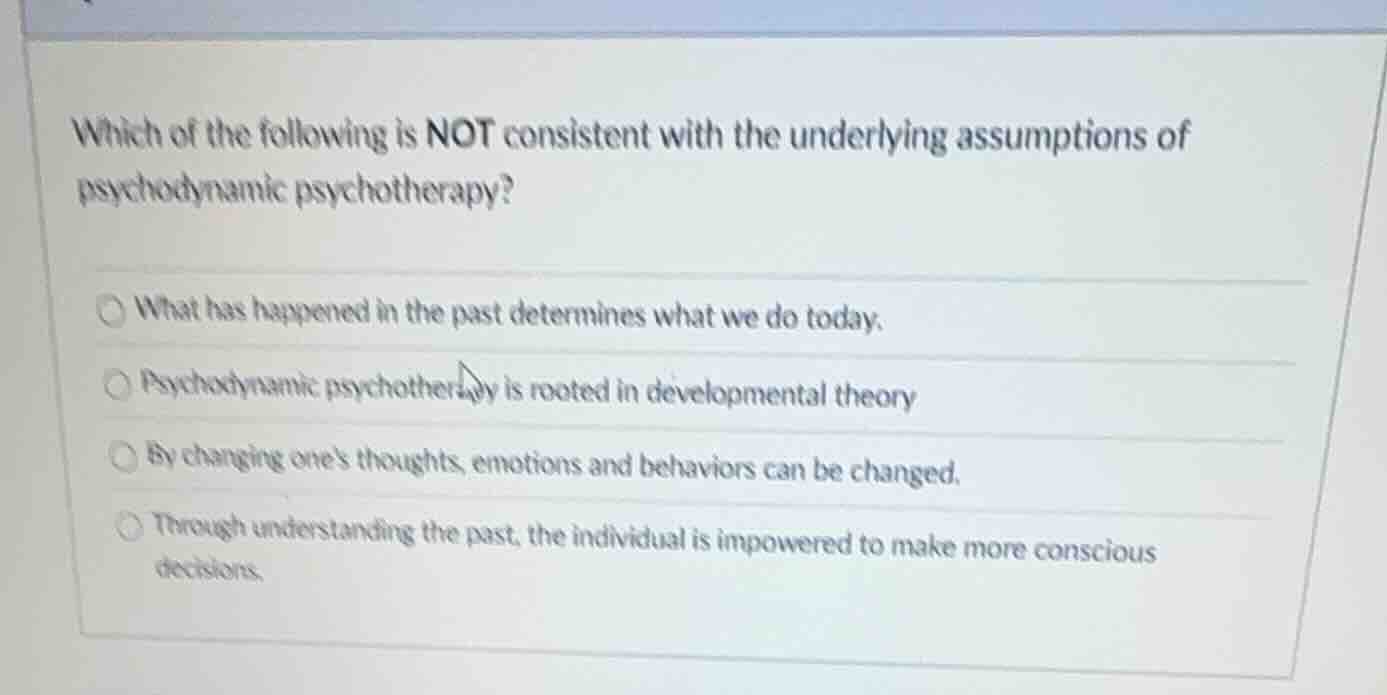
which of the following is not consistent with the underlying assumptions of psychodynamic psychotherapy?
what has happened in the past determines what we do today.
psychodynamic psychotherapy is rooted in developmental theory
by changing ones thoughts, emotions and behaviors can be changed.
through understanding the past, the individual is empowered to make more conscious decisions.
🆕 New Concept Discovered: Psychodynamic Psychotherapy Assumptions
Core beliefs about the unconscious mind and past experiences.
Step 1: Analyze the core assumptions of psychodynamic psychotherapy
Psychodynamic psychotherapy is rooted in psychoanalytic theory. Its core assumptions include:
- Psychic determinism: The belief that psychological events (behaviors, thoughts, feelings) are determined by prior mental events, particularly early childhood experiences and unconscious conflicts ("What has happened in the past determines what we do today").
- Developmental perspective: It is heavily rooted in developmental theories (such as Freud's psychosexual stages or Erikson's psychosocial stages), emphasizing how early developmental stages shape adult personality.
- Insight and consciousness: The goal of therapy is to bring unconscious conflicts into conscious awareness. By understanding the past and making the unconscious conscious, an individual is empowered to make more conscious, deliberate choices rather than being driven by automatic, unconscious patterns.
Step 2: Evaluate the given options against these assumptions
- Option 1: "What has happened in the past determines what we do today."
This aligns directly with psychic determinism and the emphasis on early life experiences in psychodynamic theory.
- Option 2: "Psychodynamic psychotherapy is rooted in developmental theory."
This is true; it relies heavily on developmental frameworks to understand personality formation and pathology.
- Option 3: "By changing one's thoughts, emotions and behaviors can be changed."
This statement describes the core premise of Cognitive Behavioral Therapy (CBT), which focuses on the cognitive triad (thoughts, feelings, and behaviors influencing one another in the present). Psychodynamic therapy, by contrast, focuses on uncovering deep-seated unconscious conflicts and defense mechanisms rather than directly restructuring conscious thoughts to alter behavior.
- Option 4: "Through understanding the past, the individual is empowered to make more conscious decisions."
This describes the primary mechanism of change in psychodynamic therapy: gaining insight to transition from unconscious reaction to conscious action.

Snap & solve any problem in the app
Get step-by-step solutions on Sovi AI
Photo-based solutions with guided steps
Explore more problems and detailed explanations
By changing one's thoughts, emotions and behaviors can be changed.