QUESTION IMAGE
Question
which fact is not used to prove that pqr is similar to str?
segments st and pq are parallel.
angle p is congruent to itself due to the reflexive property.
rp is a transversal line passing st and pq.
angles rts and rqp are congruent due to the corresponding angles theorem.
Analyze the similarity proof
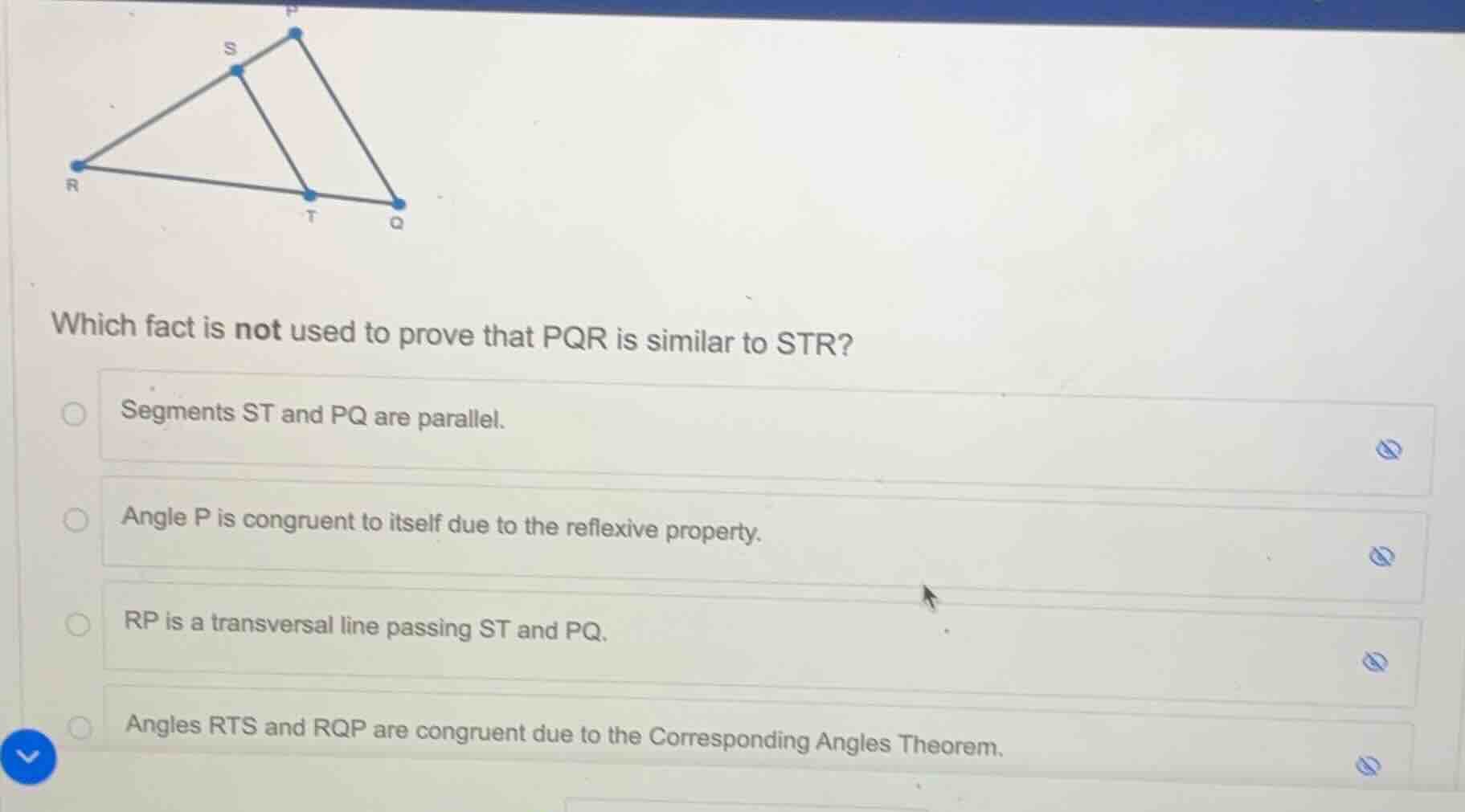
To prove that \(\triangle PQR\) is similar to \(\triangle STR\) (\(\triangle PQR \sim \triangle STR\)), we look for shared angles or proportional sides.
Both triangles share the vertex \(R\), meaning \(\angle R\) (or \(\angle PRQ\)) is congruent to itself by the Reflexive Property of Congruence.
Using the AA Similarity Postulate, we need a second pair of congruent angles.
Evaluate the role of parallel lines
If segments \(ST\) and \(PQ\) are parallel, then line \(RP\) acts as a transversal line passing through \(ST\) and \(PQ\).
This parallel relationship makes corresponding angles congruent. Specifically, \(\angle RST \cong \angle RPQ\) and \(\angle RTS \cong \angle RQP\) due to the Corresponding Angles Theorem.
Thus, the facts involving parallel segments, the transversal line, and corresponding angles are all directly used to establish angle congruence for the Triangle Similarity Proofs.
Identify the unused fact
The second option states: "Angle P is congruent to itself due to the reflexive property."
While the Reflexive Property is used in this proof, it applies to the shared angle at vertex \(R\) (\(\angle R \cong \angle R\)), not angle \(P\).
Angle \(P\) is not shared by both \(\triangle PQR\) and \(\triangle STR\); vertex \(P\) is only a vertex of the larger triangle \(\triangle PQR\).
Therefore, this statement is false and is not used in the proof.

Snap & solve any problem in the app
Get step-by-step solutions on Sovi AI
Photo-based solutions with guided steps
Explore more problems and detailed explanations
- (A) Segments ST and PQ are parallel.
- (B) Angle P is congruent to itself due to the reflexive property. (Correct answer)
- (C) RP is a transversal line passing ST and PQ.
- (D) Angles RTS and RQP are congruent due to the Corresponding Angles Theorem.