QUESTION IMAGE
Question
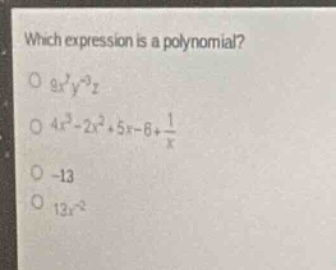
which expression is a polynomial?
\\(9x^7 y^{-3} z\\)
\\(4x^3 - 2x^2 + 5x - 8 + \frac{1}{x}\\)
\\(-13\\)
\\(13x^{-2}\\)
🆕 New Concept Discovered: Identifying Polynomial Expressions
Only non-negative integer exponents allowed.
Step 1: Understand the definition of a polynomial
A polynomial is an expression consisting of variables and coefficients, where the variables are raised only to non-negative integer powers (such as \(0, 1, 2, 3, \dots\)).
This means a polynomial cannot have:
- Variables in the denominator (which represents a negative exponent, like \(x^{-1} = \frac{1}{x}\)).
- Variables raised to negative exponents.
- Variables under radicals or raised to fractional exponents.
Step 2: Analyze each option
- Option 1: \(9x^7 y^{-3} z\)
- This expression contains \(y^{-3}\). Since \(-3\) is a negative exponent, this is not a polynomial.
- Option 2: \(4x^3 - 2x^2 + 5x - 8 + \frac{1}{x}\)
- The term \(\frac{1}{x}\) can be written as \(x^{-1}\). Because of this negative exponent, this is not a polynomial.
- Option 3: \(-13\)
- This is a constant term. It can be written as \(-13x^0\). Since \(0\) is a non-negative integer, any constant number is considered a monomial (a polynomial with one term) of degree \(0\). Therefore, this is a polynomial.
- Option 4: \(13x^{-2}\)
- This expression contains \(x^{-2}\). Since \(-2\) is a negative exponent, this is not a polynomial.

Snap & solve any problem in the app
Get step-by-step solutions on Sovi AI
Photo-based solutions with guided steps
Explore more problems and detailed explanations
\(-13\)