QUESTION IMAGE
Question
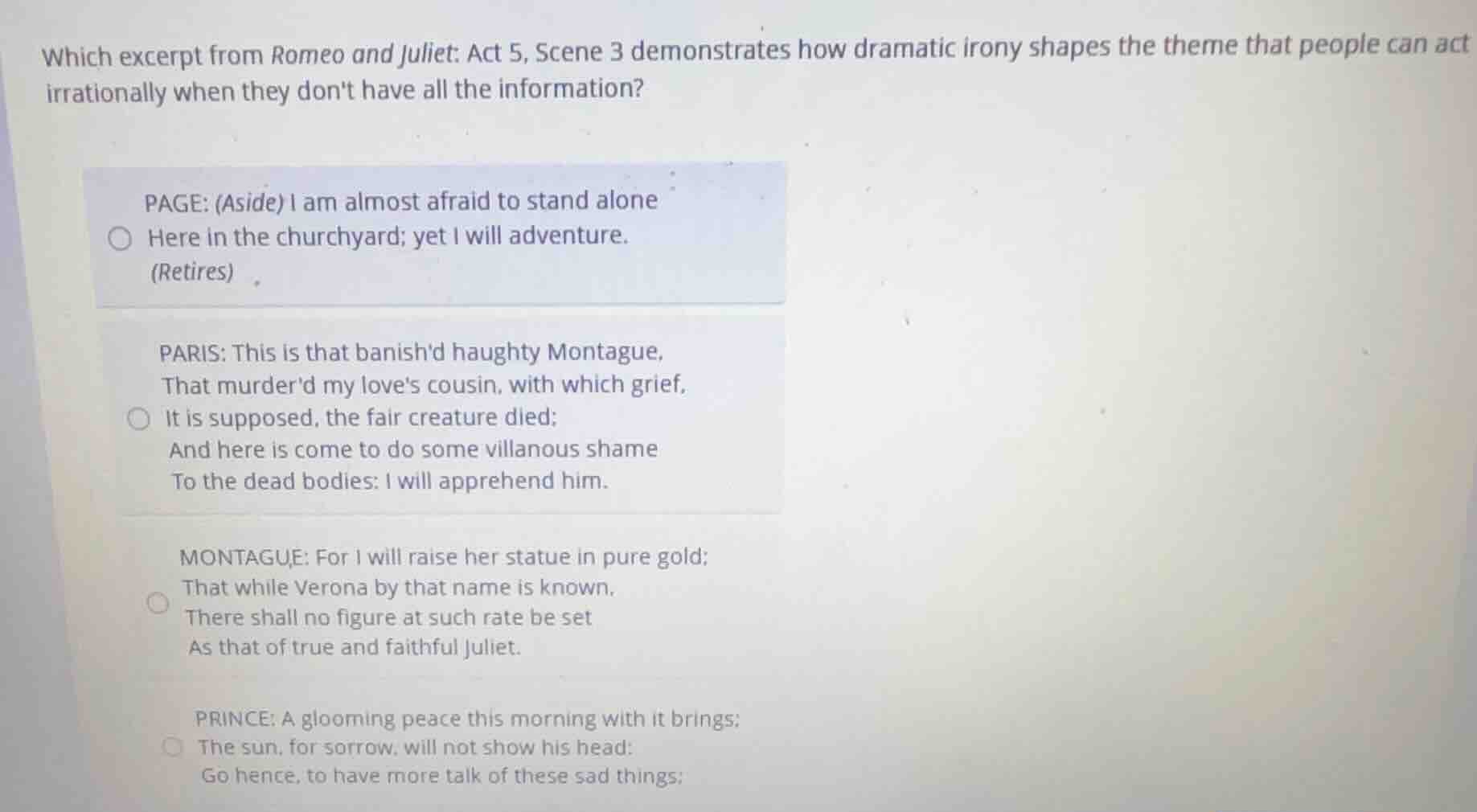
which excerpt from romeo and juliet: act 5, scene 3 demonstrates how dramatic irony shapes the theme that people can act irrationally when they dont have all the information?
page: (aside) i am almost afraid to stand alone
here in the churchyard; yet i will adventure.
(retires)
paris: this is that banishd haughty montague,
that murderd my loves cousin, with which grief,
it is supposed, the fair creature died;
and here is come to do some villanous shame
to the dead bodies: i will apprehend him.
montague: for i will raise her statue in pure gold;
that while verona by that name is known,
there shall no figure at such rate be set
as that of true and faithful juliet.
prince: a glooming peace this morning with it brings;
the sun, for sorrow, will not show his head:
go hence, to have more talk of these sad things;
Analyze the prompt's thematic and dramatic requirements
The question asks for an excerpt from Romeo and Juliet, Act 5, Scene 3, that demonstrates how dramatic irony shapes the theme that people can act irrationally when they don't have all the information.
Evaluate the options for dramatic irony and irrational behavior
- Option 1 (Page): Expresses fear of standing alone in the churchyard but decides to stay. This does not involve dramatic irony or irrational actions based on missing information.
- Option 2 (Paris): Paris believes Romeo has come to desecrate the Capulet tomb ("do some villainous shame / To the dead bodies") because he thinks Romeo is a hateful Montague who murdered Tybalt (indirectly causing Juliet's death from grief). The audience knows Romeo has actually come to die alongside Juliet out of love. Because Paris lacks this information, he acts irrationally by confronting and attempting to apprehend Romeo, which leads to his own death. This perfectly matches dramatic irony shaping the theme of irrational action due to incomplete information.
- Option 3 (Montague): Lord Montague offers to build a golden statue of Juliet to honor her. This occurs after the truth has been fully revealed to everyone, so there is no dramatic irony or irrational action due to missing information.
- Option 4 (Prince): The Prince reflects on the tragic peace brought by the morning. This is a concluding statement after all information has been revealed, containing no dramatic irony.

Snap & solve any problem in the app
Get step-by-step solutions on Sovi AI
Photo-based solutions with guided steps
Explore more problems and detailed explanations
- PAGE: (Aside) I am almost afraid to stand alone / Here in the churchyard; yet I will adventure. / (Retires)
- PARIS: This is that banish'd haughty Montague, / That murder'd my love's cousin, with which grief, / It is supposed, the fair creature died; / And here is come to do some villainous shame / To the dead bodies: I will apprehend him. (Correct answer)
- MONTAGUE: For I will raise her statue in pure gold; / That while Verona by that name is known, / There shall no figure at such rate be set / As that of true and faithful juliet.
- PRINCE: A glooming peace this morning with it brings; / The sun, for sorrow, will not show his head: / Go hence, to have more talk of these sad things;