QUESTION IMAGE
Question
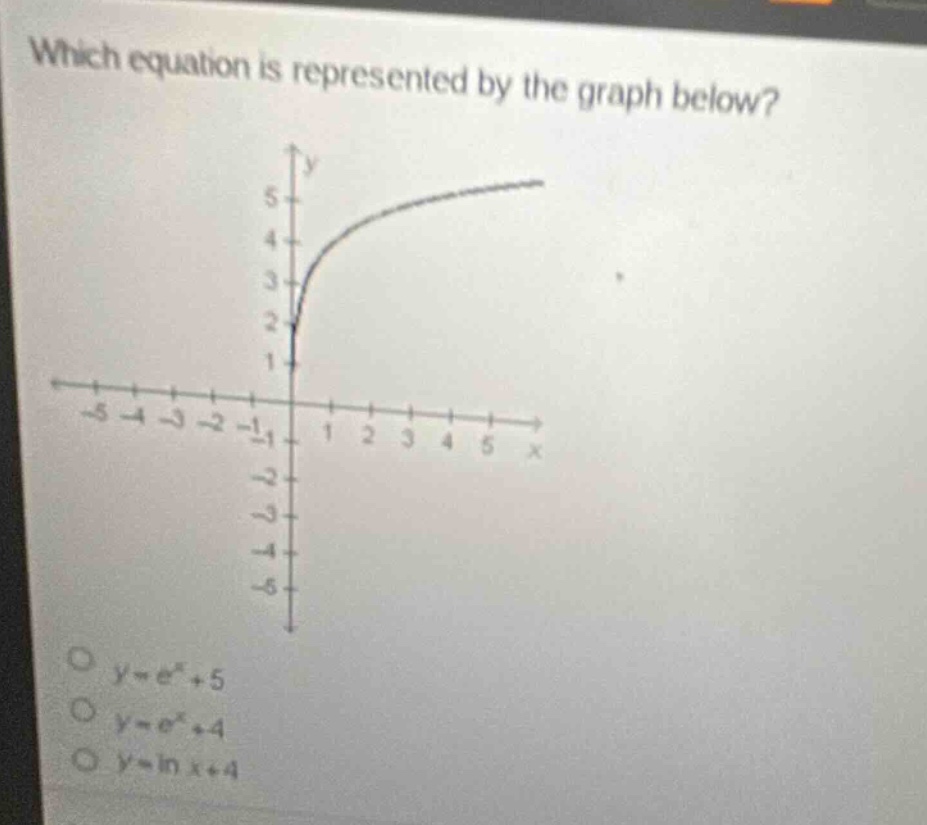
which equation is represented by the graph below?
graph showing a curve starting at (0,2) and increasing slowly as x increases, passing through (1,3)
- (y = e^x + 5)
- (y = e^x + 4)
- (y = \ln x + 4)
⚡ Using what you learned: Understanding Logarithmic Functions
Step 1: Identify key features of the graph
Observe the behavior and key points on the given graph:
- The graph has a vertical asymptote at the y-axis, \(x = 0\).
- The domain is \(x > 0\).
- The graph passes through the point \((1, 4)\).
- The graph passes through another clear point near \((2.7, 5)\), which corresponds to \((e, 5)\).
These features (vertical asymptote at \(x = 0\) and domain \(x > 0\)) are characteristic of a logarithmic function, \(y = \ln(x) + c\), rather than an exponential function, \(y = e^x + c\).
Step 2: Test the logarithmic option
Test the point \((1, 4)\) in the logarithmic equation option:
Substitute \(x = 1\):
This matches the point \((1, 4)\) on the graph perfectly.

Snap & solve any problem in the app
Get step-by-step solutions on Sovi AI
Photo-based solutions with guided steps
Explore more problems and detailed explanations
\(y = \ln(x) + 4\)