QUESTION IMAGE
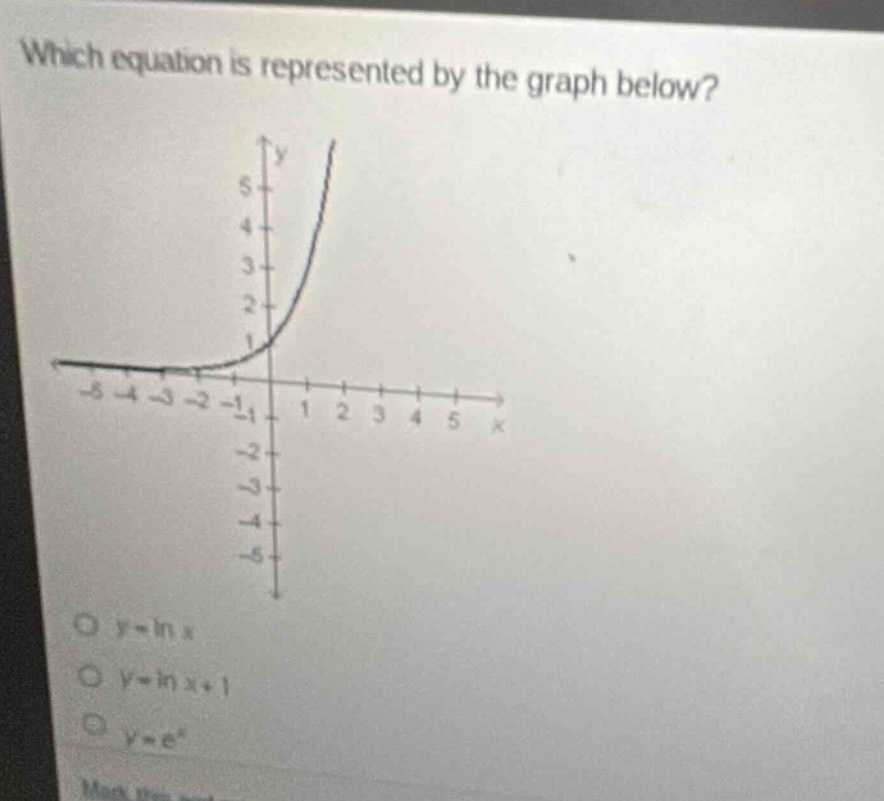
Question
which equation is represented by the graph below?
\\(y = \ln x\\)
\\(y = \ln x + 1\\)
\\(y = e^x\\)
⚡ Using what you learned: Graphing Exponential Functions
Step 1: Identify key features of the graph
Observe the behavior of the graph:
- As \( x \to -\infty \), the graph approaches the horizontal line \( y = 0 \) (the x-axis). This indicates a horizontal asymptote at \( y = 0 \).
- The graph passes through the y-intercept at \( (0, 1) \).
- As \( x \) increases, the graph grows rapidly upward.
- The domain of the function is all real numbers, \( (-\infty, \infty) \).
Step 2: Evaluate the given options
Let's test the given equations against these features:
- Option 1: \( y = \ln x \)
- The natural logarithmic function is only defined for \( x > 0 \). Its graph has a vertical asymptote at \( x = 0 \) (the y-axis) and passes through \( (1, 0) \). This does not match the given graph.
- Option 2: \( y = \ln x + 1 \)
- Similar to \( y = \ln x \), this logarithmic function is only defined for \( x > 0 \) and has a vertical asymptote at \( x = 0 \). This does not match the given graph.
- Option 3: \( y = e^x \)
- This is a natural exponential function.
- Its domain is all real numbers.
- It has a horizontal asymptote at \( y = 0 \) as \( x \to -\infty \).
- When \( x = 0 \), \( y = e^0 = 1 \), giving a y-intercept of \( (0, 1) \).
- When \( x = 1 \), \( y = e^1 \approx 2.718 \), which matches the point plotted on the graph.

Snap & solve any problem in the app
Get step-by-step solutions on Sovi AI
Photo-based solutions with guided steps
Explore more problems and detailed explanations
\( y = e^x \)