QUESTION IMAGE
Question
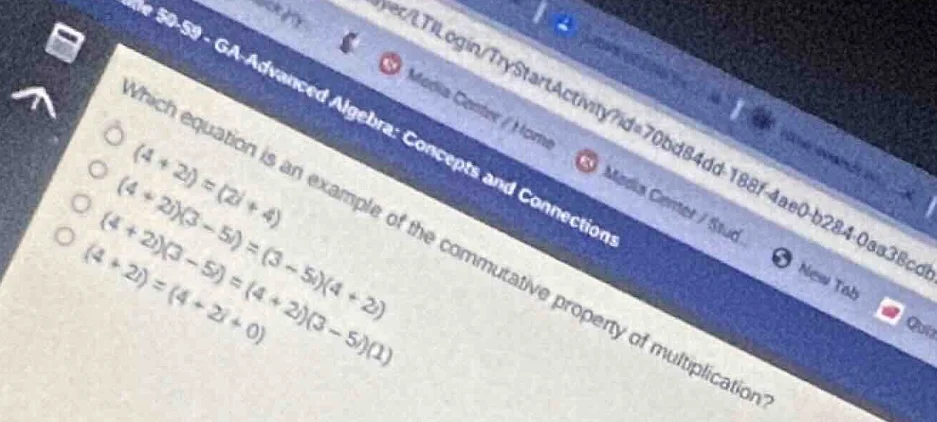
which equation is an example of the commutative property of multiplication?
(4 2) = (2 4)
(4 2)(3 - 5) = (3 - 5)(4 2)
(4 2)(3 - 5) = (4 2)(3 - 5)(1)
(4 2) = (4 2) * 0
To determine which equation represents the commutative property of multiplication, we first recall the definition: the commutative property of multiplication states that for any two numbers \(a\) and \(b\), \(a\times b = b\times a\) (the order of multiplication does not change the product).
Analyzing each option:
- First option: \((4\times2)=(2\times4)\)
This involves multiplication, but it looks at the order of the factors within a single multiplication (simplifying both sides: \(8 = 8\)). However, the commutative property of multiplication is about the order when multiplying two expressions (not just simplifying a single product). Let's check the others.
- Second option: \((4\times2)(3 - 5)=(3 - 5)(4\times2)\)
Let \(a=(4\times2)\) and \(b=(3 - 5)\). By the commutative property of multiplication, \(a\times b = b\times a\). Here, we are multiplying two expressions \((4\times2)\) and \((3 - 5)\), and the order is reversed (left side: \((4\times2)\) first, then \((3 - 5)\); right side: \((3 - 5)\) first, then \((4\times2)\)). This matches \(a\times b = b\times a\).
- Third option: \((4\times2)(3 - 5)=(4\times2)(3 - 5)(1)\)
This involves multiplying by 1, which is the identity property of multiplication (\(a\times1=a\)), not the commutative property.
- Fourth option: \((4\times2)=(4\times2)+0\)
This involves adding 0, which is the identity property of addition (\(a + 0=a\)), not related to multiplication.
So the equation that shows the commutative property of multiplication is \(\boldsymbol{(4\times2)(3 - 5)=(3 - 5)(4\times2)}\).

Snap & solve any problem in the app
Get step-by-step solutions on Sovi AI
Photo-based solutions with guided steps
Explore more problems and detailed explanations
The second option (the one with \((4 \times 2)(3 - 5) = (3 - 5)(4 \times 2)\))