QUESTION IMAGE
Question
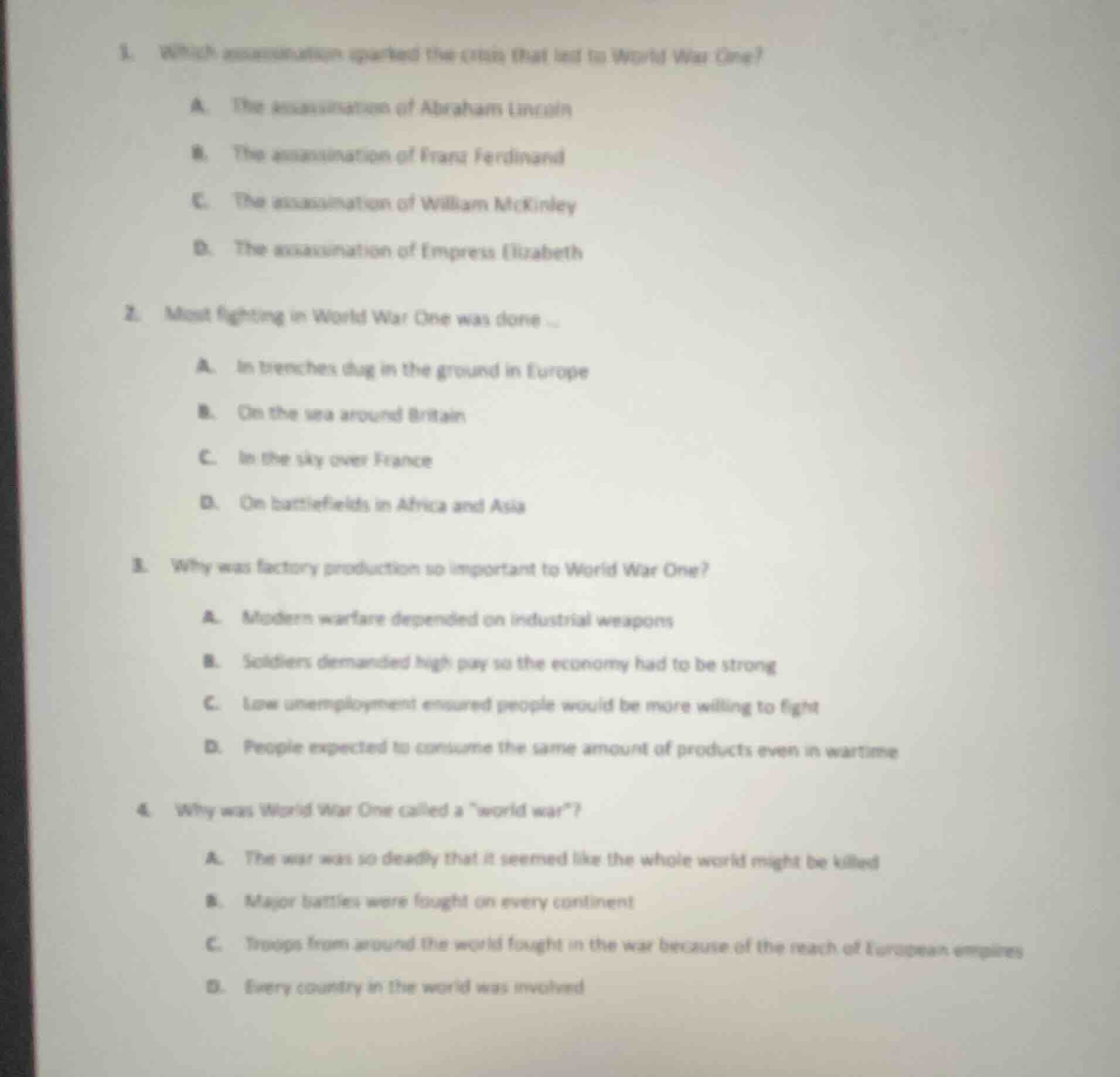
- which assassination sparked the crisis that led to world war one?
a. the assassination of abraham lincoln
b. the assassination of franz ferdinand
c. the assassination of william mckinley
d. the assassination of empress elizabeth
- most fighting in world war one was done...
a. in trenches dug in the ground in europe
b. on the sea around britain
c. in the sky over france
d. on battlefields in africa and asia
- why was factory production so important to world war one?
a. modern warfare depended on industrial weapons
b. soldiers demanded high pay so the economy had to be strong
c. low unemployment ensured people would be more willing to fight
d. people expected to consume the same amount of products even in wartime
- why was world war one called a \world war\?
a. the war was so deadly that it seemed like the whole world might be killed
b. major battles were fought on every continent
c. troops from around the world fought in the war because of the reach of european empires
d. every country in the world was involved
Question 1
To determine the assassination that sparked WWI, we recall historical facts. The assassination of Archduke Franz Ferdinand in 1914 triggered the chain of events leading to WWI. Lincoln's assassination was related to the US Civil War, McKinley's to US politics, and Empress Elizabeth's was not WWI - related.
In WWI, the Western Front (in Europe) was characterized by trench warfare. Naval battles around Britain, air combat over France, and African/Asian battlefields were not the primary or most extensive fighting areas. Trench warfare in Europe was the main form of land combat.
WWI was a modern industrial war. Factory production was crucial for making weapons (like machine guns, artillery, etc.) needed for warfare. Soldiers' pay, unemployment, or civilian consumption were not the main reasons for factory production's importance in the war.

Snap & solve any problem in the app
Get step-by-step solutions on Sovi AI
Photo-based solutions with guided steps
Explore more problems and detailed explanations
B. The assassination of Franz Ferdinand