QUESTION IMAGE
Question
when to use an and (intersection) or an or (union).
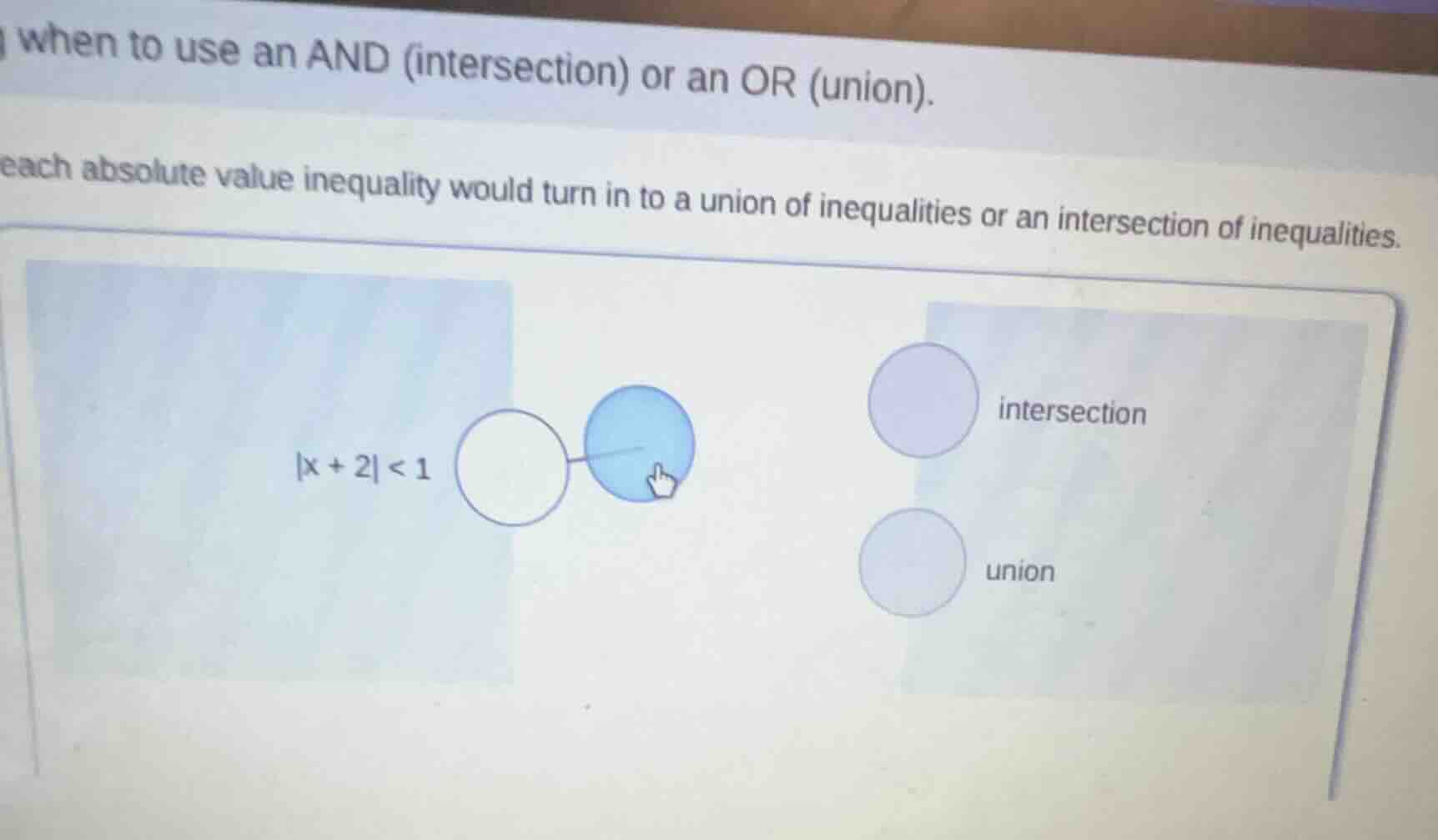
each absolute value inequality would turn in to a union of inequalities or an intersection of inequalities.
\\(|x + 2| < 1\\)
intersection
union
Analyze the inequality type
The given absolute value inequality is:
This inequality uses the "less than" (\(<\)) operator.
Apply the absolute value definition
Using Compound Inequalities, we know that an absolute value inequality of the form \(|u| < a\) (where \(a > 0\)) represents all numbers whose distance from zero is less than \(a\). This translates to:
\(-a < u < a\)
Which is a compound inequality joined by "AND":
\(u > -a\) AND \(u < a\)
Determine union or intersection
An "AND" compound inequality represents the overlap of the individual solution sets. In set theory, this overlap is called the intersection. Therefore, the inequality \(|x + 2| < 1\) turns into an intersection of inequalities:
\(-1 < x + 2 < 1\)

Snap & solve any problem in the app
Get step-by-step solutions on Sovi AI
Photo-based solutions with guided steps
Explore more problems and detailed explanations
- intersection (Correct answer)
- union